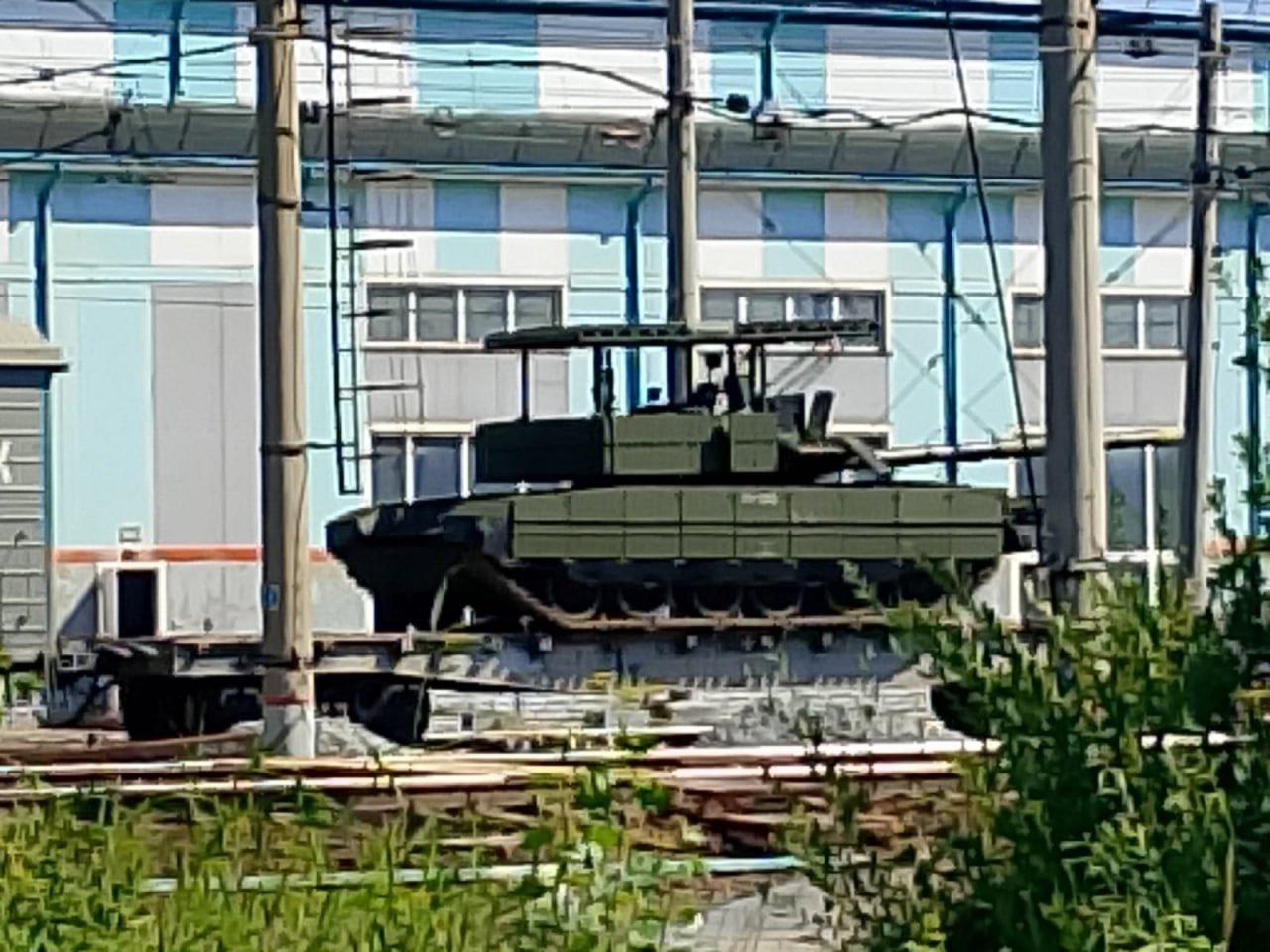
MOSCOW — A modernized Russian T-80BVM main battle tank fitted with what appears to be a refined anti-drone protection system and an upgraded side armor package has been photographed on a railway flatcar in Russia. The image, which circulated on social media as a screenshot, shows the vehicle being transported in July 2026 toward an undisclosed destination.
While the exact destination of the tank and the receiving military unit remain unknown, the sighting highlights Russia's continued efforts to improve armored vehicle protection against the growing threat posed by first-person-view (FPV) drones and loitering munitions. However, the screenshot alone does not independently verify the precise filming location beyond the July 2026 timeframe claimed in the social media post.
Updated Anti-Drone Protection Visible
The most noticeable feature in the image is a redesigned turret-mounted anti-drone shield. The wire-mesh or slat-armor structure, commonly known among Russian and Ukrainian troops as the "Mangal" or "barbecue grill," is intended to detonate shaped-charge warheads carried by FPV drones and loitering munitions before they can strike the tank's thinner top armor.
The photograph also appears to show an updated arrangement of explosive reactive armor (ERA) along the side skirts and turret. ERA uses explosive-filled armor blocks that detonate outward when hit, helping disrupt incoming anti-tank projectiles before they reach the vehicle's main armor.
Although the image suggests further refinements to the protection package, the presence of additional onboard systems cannot be confirmed from the available photograph.
T-80BVM Modernization
The T-80BVM is the latest modernization of the Soviet-era T-80BV main battle tank. It was first publicly unveiled during Russia's Zapad military exercise in 2017 and entered service with the Russian Ground Forces in 2018.
Unlike the diesel-powered T-72 family, the T-80BVM is powered by a GTD-1250 series gas turbine engine producing approximately 1,250 horsepower, providing high mobility across a variety of terrain.
Its modernization also introduced the Relikt explosive reactive armor (ERA) system, replacing the earlier Kontakt-1 ERA. Relikt provides improved protection against both shaped-charge warheads and kinetic energy projectiles and covers major sections of the hull front, side skirts, and turret frontal arc.
Follows Recent Factory Upgrades
The configuration seen in the July 2026 image closely follows recent upgrades introduced by Russian tank manufacturer Uralvagonzavod.
On May 9, 2026, ahead of Victory Day, Rostec—the state-owned defense conglomerate that owns Uralvagonzavod—announced the delivery of upgraded T-90M, T-80BVM, and T-72B3M tanks to Russian forces.
According to Rostec, the vehicles incorporated lessons learned from combat operations and feedback from frontline personnel. The upgraded tanks featured reinforced anti-drone cages, additional explosive reactive armor on the side skirts and rear sections, and the Volnorez electronic warfare system.
Volnorez uses two omnidirectional antennas to jam drone control signals at distances of 600 to 1,000 meters, providing an additional layer of protection against FPV drone attacks.
Continued Evolution Against Drone Threats
Military Watch Magazine reported that the anti-drone cage designs introduced in the May 2026 deliveries represented a further evolution of protective measures first adopted by Russian forces in 2022.
Similar approaches to improving top-attack protection have since appeared in several other countries, including South Korea and Israel.
If the July 2026 rail transport image reflects another updated version of the design, it suggests Uralvagonzavod continues refining the protection package based on operational experience rather than adopting a fixed configuration.
The latest sighting also reflects the growing importance of drone protection as unmanned aerial systems continue to influence battlefield tactics and armored vehicle survivability.
Protection Comes With Operational Trade-Offs
Additional protective structures can improve resistance against drone attacks but may also create operational limitations.
Analysis published by The National Interest, citing data from the Dutch open-source intelligence group Oryx, which documents equipment losses through verified photographs and videos, reported that 35 Russian T-80BVM tanks have been captured by Ukrainian forces since 2022.
According to the same analysis, some of those vehicles carried heavier anti-drone cage designs, often referred to online as "cope cages." While these structures may improve protection against top-attack drones, they can also reduce crew visibility, restrict turret traverse, and limit aiming angles, potentially affecting the tank's responsiveness during combat.
Expert Reaction
Commenting on the railway image, an account associated with armored vehicle specialist Andrey Tarasenko described the visible configuration as "a step forward compared to the previous one, no joke."
The comment suggests the design represents a meaningful improvement over earlier protection layouts. However, the technical reasons behind that assessment and the credentials associated with the circulating account could not be independently verified.
Ongoing Battlefield Adaptation
The latest sighting adds to the growing record of incremental upgrades being made to Russian armored vehicles as manufacturers continue adapting tanks to counter the widespread use of FPV drones and loitering munitions.
While the available image does not confirm where the tank is being deployed, it provides another indication that Russian industry is continuing to refine the T-80BVM's protection package based on operational experience and evolving battlefield requirements.
Source : defence-blog
——— End of Article ———