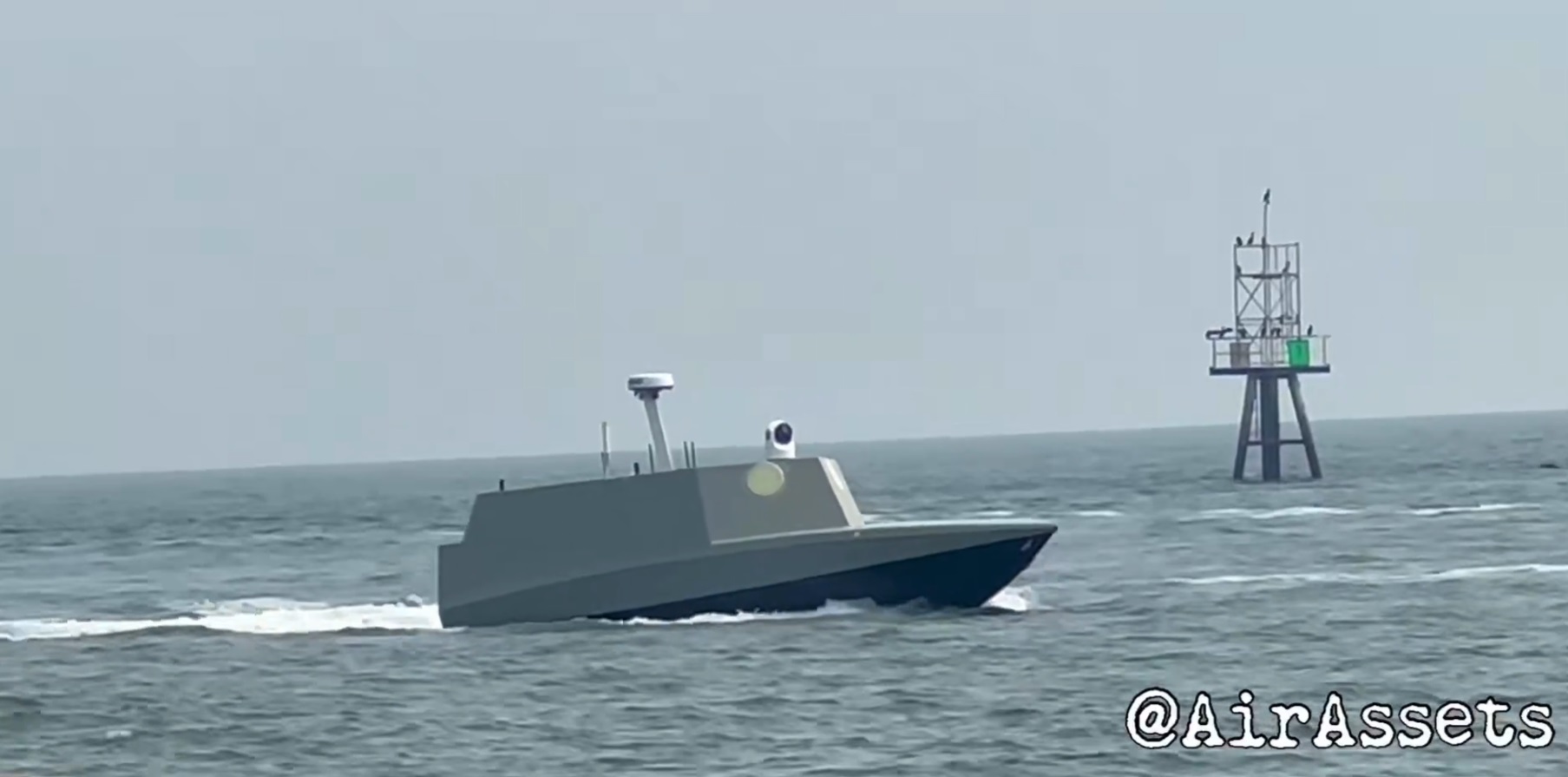
VIRGINIA BEACH, Va., July 19, 2026 — An unidentified uncrewed surface vessel (USV) was recently spotted departing Naval Amphibious Base Little Creek under the escort of a U.S. Navy security boat. Images shared by the open-source military tracking account Aviation and Naval Assets show a vessel that does not match any publicly known U.S. Navy unmanned surface vessel currently in service.
The sighting, reported on July 18 or 19, occurred as the vessel departed the Virginia Beach installation, which serves as the home of the U.S. Navy's Atlantic Fleet amphibious forces and a major center for Naval Special Warfare training. The base's focus on amphibious and special operations makes it a logical location for testing emerging maritime technologies.
Vessel Equipped With Multiple Sensors
Published images indicate the vessel carries a commercial marine radar similar to Simrad navigation systems used for navigation and collision avoidance. It is also fitted with a rotating electro-optical turret combining daylight and thermal imaging cameras for surveillance and navigation in low-visibility conditions.
Hull-mounted mesh networking antennas are visible, allowing unmanned platforms to exchange data directly with one another during coordinated operations.
According to Aviation and Naval Assets, the vessel also appears to carry two synthetic aperture radar (SAR) antennas mounted at the rear. SAR technology creates high-resolution images by combining radar data collected while the platform is moving, enabling detailed surface mapping, target identification, and detection of objects in complex maritime environments.
At the front, the vessel appears to feature millimeter-wave radar or collision-avoidance sensors to help it safely navigate around other vessels, buoys, and floating debris during autonomous operations.
The rear deck includes a structure resembling a landing or deployment platform. While its purpose has not been confirmed, it could support the launch and recovery of smaller payloads such as aerial drones, underwater inspection systems, or other mission equipment.
Navy Has Not Identified the Platform
The U.S. Navy has not publicly identified the vessel, its manufacturer, or the program it belongs to, which is common during the early stages of prototype testing.
The sighting comes as the Navy advances its Medium Unmanned Surface Vessel (MUSV) program. In late May 2026, the service awarded $15 million contracts to Sea Machines, Leidos, Saronic Technologies, Galliano Marine Services, PacMar Technologies, Birdon, and Huntington Ingalls Industries to develop prototype vessels.
Sea trials began in June and will continue through October 2026. Each prototype is required to autonomously travel 2,500 nautical miles while carrying a 25-ton payload. The Navy plans to procure 81 MUSVs by fiscal year 2031, although it remains unclear whether the vessel seen at Little Creek is part of the MUSV competition, a Naval Special Warfare project, or another testing program.
Autonomous Maritime Programs Continue to Expand
The U.S. Navy is increasing the use of uncrewed surface vessels for missions including surveillance, intelligence collection, maritime monitoring, and fleet support.
Recent examples include the Saildrone Surveyor, which expanded its role during the RIMPAC exercise, and Textron Systems' TSUNAMI family of USVs, demonstrated during the Navy's Fleet Experimentation (FLEX) event in May 2026 and currently used for missions such as counter-narcotics and search-and-rescue operations.
Autonomous naval technology is also advancing internationally. In March 2026, China demonstrated a swarm of L30 uncrewed surface vessels near Zhuhai, highlighting the continued global development of autonomous maritime systems.
The U.S. Navy has not released additional information about the unidentified vessel, and its role remains unknown. However, the sighting reflects ongoing efforts to evaluate new autonomous technologies for future naval operations.
——— End of Article ———