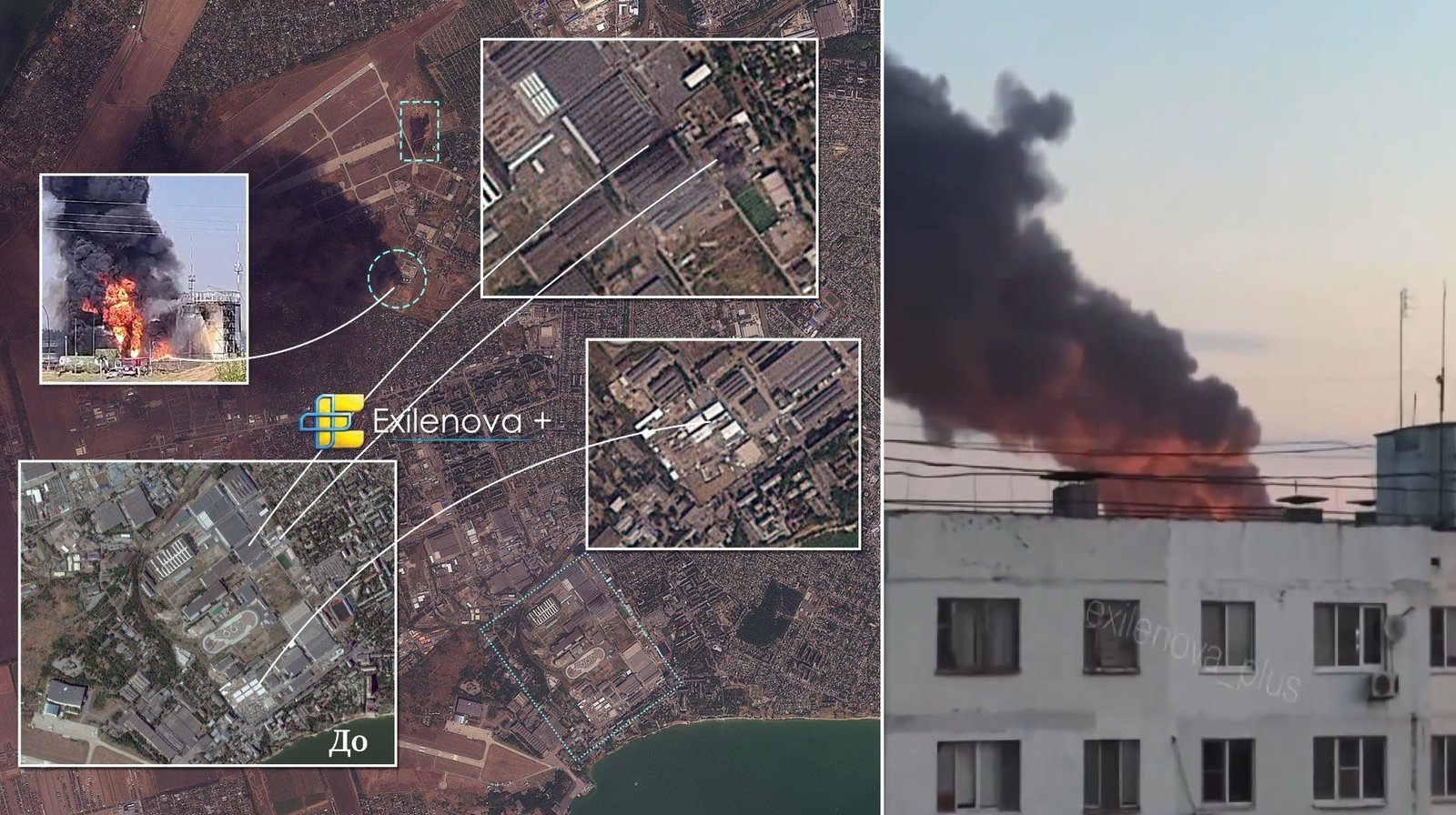
TAGANROG, Russia — Ukrainian forces carried out overnight drone strikes on September 12 against military and industrial targets in Taganrog, Rostov region, and Tolyatti, Samara region. Local reports, satellite imagery, monitoring groups and Ukrainian officials reported fires at several locations.
In Taganrog, one of the main targets was the Atlant Aero facility at the former Taganrog Automobile Plant (TagAZ). According to Ukrainian military information and open-source reports, Atlant Aero conducts the design, production and testing of Russia’s Molniya (Lightning) strike-reconnaissance UAVs and produces components for Orion UAVs. Satellite imagery showed at least three impacts on workshops and warehouses, while Exilenova+ and other monitors reported fires and a burning storage tank. NASA’s FIRMS system also detected fire hotspots.
On the night of September 12, Ukraine's Defense Forces struck a key Russian defense industry facility—"Atlant Aero" in Taganrog.
— Exilenova+ (@Exilenova_plus) September 12, 2026
"Atlant Aero" handles the full cycle of design, manufacturing, and testing for "Molniya" (Lightning) strike-reconnaissance UAVs, as well as components… pic.twitter.com/O5Bg3w8nM2
The airfield and military housing area in Taganrog were also attacked. A fire is currently burning there. pic.twitter.com/DTz8ov5dxN
— Exilenova+ (@Exilenova_plus) September 12, 2026
The Security Service of Ukraine (SBU) said its Alpha Special Operations Center, together with other Ukrainian Defense Forces units, struck an FPV drone production facility, two UAV storage warehouses, a fuel and lubricants storage tank, a Pantsir-S2 air-defense system and a P-18 Terek radar station. The SBU said the strikes reduced Russia’s UAV production and storage capacity.
Fires were also reported near the Beriev Taganrog Aviation Scientific and Technical Complex and Taganrog-Yuzhny airfield. The Beriev complex maintains and modernizes A-50 airborne early warning and control aircraft, Be-series amphibious aircraft used by the Russian Navy, and Tu-95MS/MSM strategic bombers used to launch Kh-101 cruise missiles. Taganrog-Yuzhny is used for Beriev flight testing.
Russian outlet ASTRA reported that Taganrog-Central military airfield may also have been targeted. The airfield is home to Russia’s 708th Military Transport Aviation Regiment, while the nearby 325th Aircraft Repair Plant repairs military transport aircraft. Fires were reported in the area, and monitors reported the destruction of a fuel storage tank. A fire near S-400 positions was also reported, although damage to the systems remains unconfirmed.
Taganrog head Svetlana Kambulova said Russian air defenses engaged drones around 7 a.m. and that falling debris caused fires. She reported no casualties. Rostov authorities also reported attacks in several districts and around Taganrog Bay, with debris causing a fire in a store building but no deaths or injuries.
In Tolyatti, Ukrainian drones reportedly traveled more than 850 kilometers to strike the KuibyshevAzot chemical plant. Exilenova+ reported a fire at the facility. KuibyshevAzot produces ammonia, ammonium nitrate, urea, ammonium sulfate, nitric acid, caprolactam and polyamide products. Reports said it accounts for about 50 percent of Russia’s caprolactam production and roughly 75 percent of domestic tire-cord output.
Samara Region Governor Vyacheslav Fedorishchev confirmed that an industrial enterprise was hit. Local authorities reported damage to several residential buildings, one person hospitalized and temporary evacuation in one neighborhood. No fatalities were reported, while operations at Kurumoch International Airport were temporarily suspended.
Ukraine’s General Staff also reported a strike on the nearby Tolyattikauchuk plant, which produces synthetic rubbers and chemical fractions used as binders and components in solid rocket fuel for tactical and ballistic missiles.
President Volodymyr Zelensky said Ukrainian forces had also struck two chemical-industry enterprises in Russia’s Perm and Samara regions, a target in the Black Sea and multiple military targets in Taganrog during the previous 24 hours.
The strikes followed a September 11 attack on Volgogradpromproekt in Volgograd. Ukrainian sources said FP-5 Flamingo cruise missiles caused a fire at the enterprise, which is involved in Russia’s military-industrial complex and produces ferrocene-based combustion catalysts and chemical production technologies.
Damage from the September 12 attacks continues to be assessed through satellite imagery, local footage and official statements.
——— End of Article ———