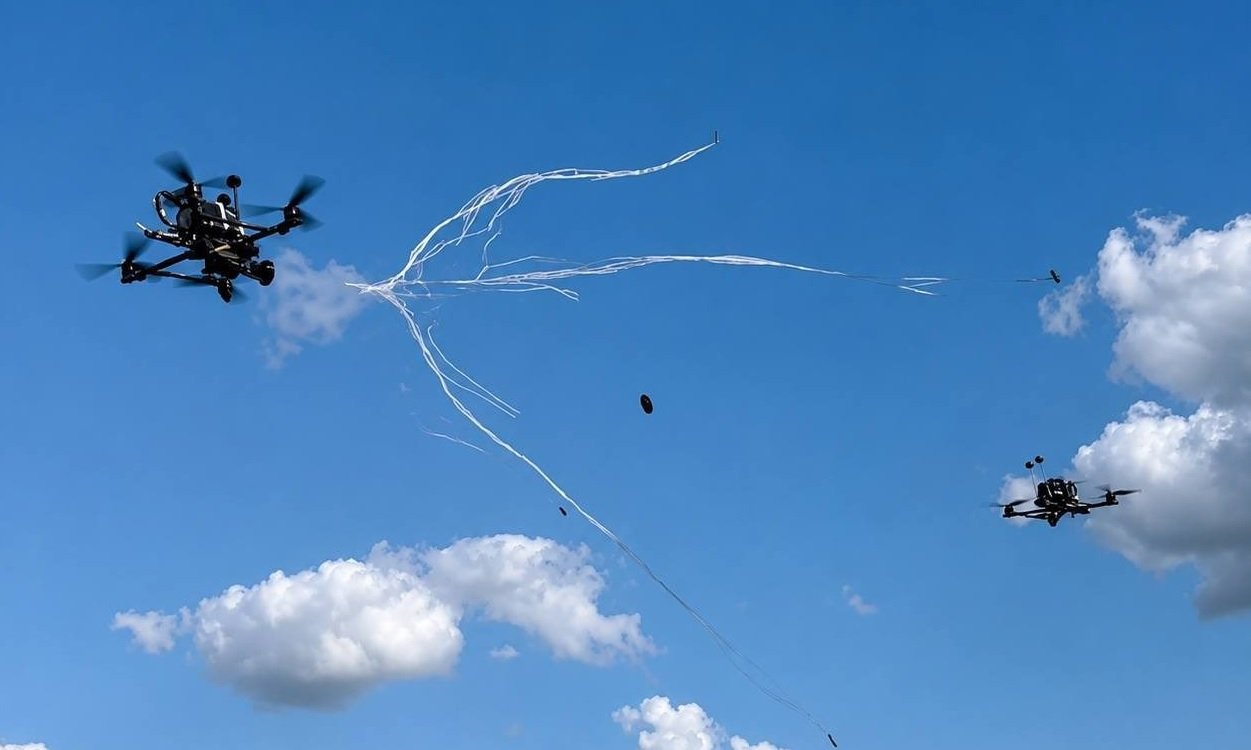
KYIV, Ukraine — Ukrainian defense technology company WINFLY has introduced the WINFLY Spider, a reusable interceptor drone designed to capture enemy unmanned aerial vehicles (UAVs) using a net rather than destroying them through a direct impact.
The Spider is based on WINFLY's existing WINFLY 10 Hunter airframe and is equipped with the KARAKURT-K2 net-launching system. According to WINFLY, the interceptor can deploy the net against an airborne target and then return to its launch point for another mission. The development was reported by Ukrainian defense outlet Militarnyi.
WINFLY Spider Based on WINFLY 10 Hunter
The WINFLY 10 Hunter platform gives the Spider a maximum speed of up to 160 km/h and an operational ceiling of up to 5,000 meters. The drone has a range of more than 18 kilometers and can remain airborne for up to 25 minutes.
WINFLY states that the system can be deployed in less than three minutes and can detect and identify targets at distances of up to 500 meters through its digital video link.
The Spider is intended to counter several types of UAVs, including fixed-wing reconnaissance drones, Mavic-series quadcopters, FPV drones and fiber-optic-controlled UAVs. WINFLY produces the system in both daytime and night-vision configurations.
KARAKURT-K2 Net Launcher
The main difference between the Spider and conventional impact-based interceptors is its KARAKURT-K2 net launcher.
The launcher weighs 210 grams and is made from high-strength aluminum. It connects to the drone through a USB Type-C interface and is designed to operate in temperatures ranging from −20°C to +50°C.
According to the manufacturer, the KARAKURT-K2 can fire its net at a target from a distance of up to 15 meters. When launched from approximately 3 to 5 meters from the target, the net expands to around 3 × 3 meters and is intended to entangle the target's rotors or airframe.
Reusable Interceptor
WINFLY designed the Spider to remain intact after an interception. Instead of colliding with the target and being lost, the interceptor deploys the net and then returns to its launch location, where it can be prepared for another sortie.
WINFLY lists the cost of a single net deployment at 1,100 Ukrainian hryvnia, reported as approximately $26. The reusable design therefore separates the cost of the interceptor itself from the expendable net deployment.
WINFLY Spider Specifications
| Specification | Details |
|---|---|
| Base platform | WINFLY 10 Hunter |
| Maximum altitude | Up to 5,000 m (16,400 ft) |
| Maximum speed | Up to 160 km/h (99 mph) |
| Operational range | More than 18 km (11 miles) |
| Flight endurance | Up to 25 minutes |
| Deployment time | Less than 3 minutes |
| Target detection/identification | Up to 500 m (1,640 ft) |
| Net launcher | KARAKURT-K2 |
| Launcher weight | 210 g |
| Net firing range | Up to 15 m |
| Expanded net size | Approximately 3 × 3 m |
| Net deployment distance | Approximately 3–5 m from target |
| Operating temperature | −20°C to +50°C |
| Net deployment cost | 1,100 UAH, approximately $26 |
The introduction of the Spider adds a reusable net-based interception option to WINFLY's UAV systems. Its development also reflects the company's move from an earlier impact-based interception approach toward a system in which the interceptor can recover after engaging a target.
——— End of Article ———