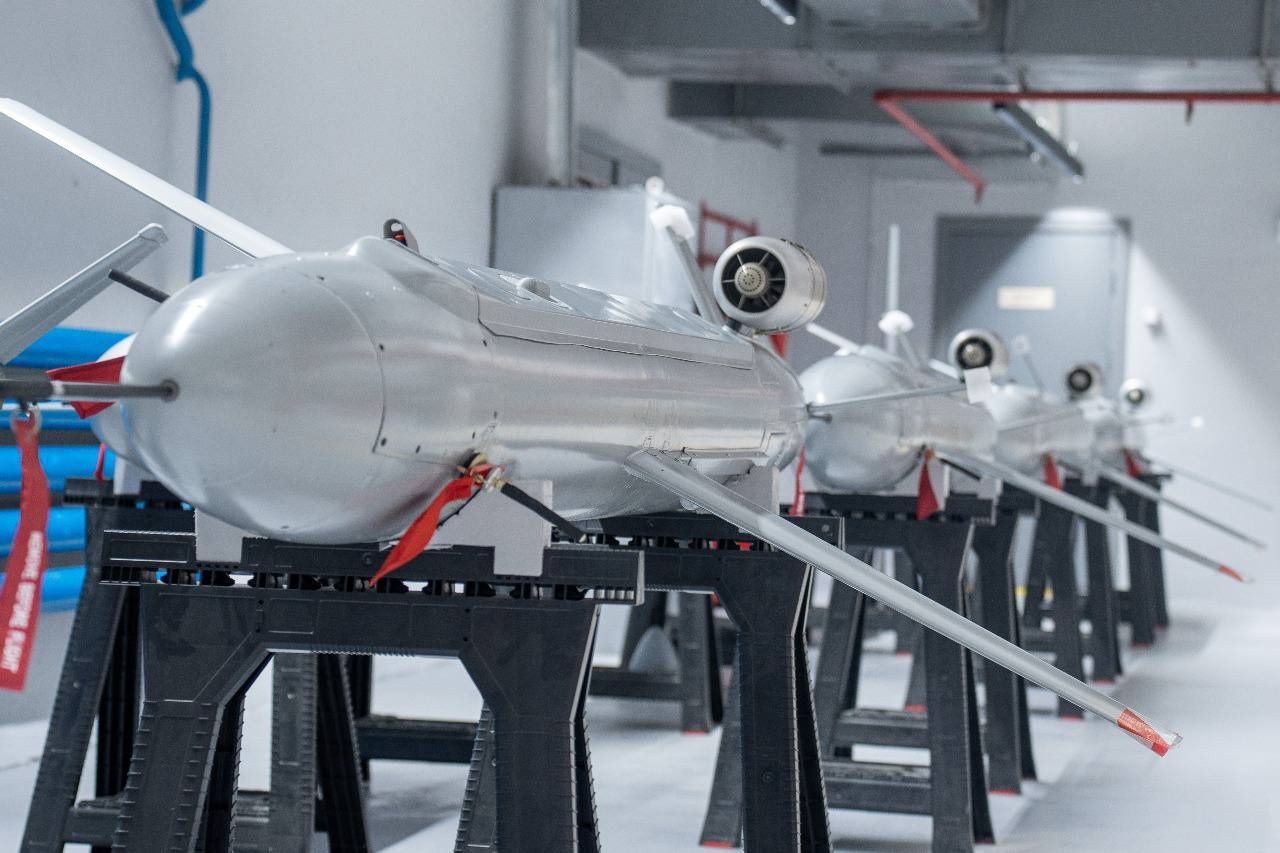
KYIV — May 31, 2026 : The Defense Intelligence of Ukraine (DIU) has officially integrated the domestically produced Peklo jet-powered kamikaze drone into its operational arsenal, marking a further expansion of Ukraine’s long-range strike capabilities. Recent photographs published by Associated Press photojournalist Efrem Lukatsky provide visual confirmation of the system’s deployment, showing Ukrainian military personnel preparing the drones for operations at an undisclosed location in Ukraine.
The images, taken on May 28, 2026, show launch equipment and airframes for five Peklo drones positioned alongside the An-196 “Lyutyi” (Fierce) long-range strike unmanned aerial vehicle (UAV). The presence of both systems highlights Ukraine’s continued use of domestically developed strike platforms intended for operations against targets located far from the frontline.
The Peklo, translated as “Hell,” is a jet-powered loitering munition that functions more similarly to a compact cruise missile than a conventional propeller-driven drone. Unlike slower one-way attack UAVs, the Peklo is powered by a turbojet engine, enabling it to reach subsonic speeds of up to 700 kilometers per hour, equivalent to approximately Mach 0.57.
According to available specifications, the system has an operational strike range of up to 700 kilometers, allowing Ukrainian forces to target objectives deep inside adversary-controlled territory. Guidance and navigation are conducted through an autonomous inertial navigation system supported by GPS satellite correction to improve strike accuracy during flight.
Defense analysts estimate the Peklo carries a warhead weighing between 30 and 50 kilograms. Its payload capacity is considered limited by the aerodynamic design and size of the airframe, though it remains suitable for attacking logistical infrastructure, support facilities, and lightly protected targets.
The system was developed by Ukroboronprom and officially introduced to the public in December 2024 during a presentation by President Volodymyr Zelenskyy. At the time, Ukrainian officials announced the delivery of the first batch consisting of several dozen Peklo systems to the country’s Defense Forces.
Officials stated that approximately 70 percent of the drone’s components are produced domestically, reflecting Ukraine’s broader effort to strengthen sovereign defense manufacturing and reduce dependence on foreign-supplied systems. Ukrainian authorities have increasingly focused on expanding local production of long-range strike systems as part of efforts to sustain military operations.
According to developers, the Peklo is also designed to remain cost-efficient in production despite its jet-powered configuration. Ukrainian sources reported that manufacturing costs are lower than those of the propeller-driven An-196 Lyutyi kamikaze drone, which was estimated to cost approximately $200,000 per unit in early 2024. Lower production costs could support larger-scale procurement and sustained operational use.
Although official photographs of the system in DIU service have only recently emerged, the Peklo has reportedly been used in combat since its initial delivery. The first known evidence of the drone’s battlefield use appeared in June 2025 after Russian military sources reported strikes in occupied territory.
According to Russian reports, a coordinated strike targeted a crossing over the Aidar River along with a nearby pumping station. Initial assessments from Russian forces incorrectly identified the incoming munition as an An-196 Lyutyi drone. However, recovered debris from the strike area reportedly included fragments of a tail section fitted with a jet-powered engine, later confirming the munition as a Peklo system.
Russian sources reported that the attack caused structural damage to the pumping station and destroyed the river crossing. Defense analysts assessing the reported damage noted that, given the Peklo’s estimated 30–50 kilogram payload, the targeted crossing was likely a light pontoon structure rather than a reinforced concrete bridge.
The Peklo operates alongside the An-196 Lyutyi, also referred to as Liutyi, a propeller-driven long-range one-way attack drone developed by Antonov ASTC in cooperation with Ukroboronprom. The Lyutyi reportedly has a range exceeding 1,000 kilometers, with some reports indicating operational employment at distances of up to 2,000 kilometers. It carries a larger estimated warhead of between 50 and 75 kilograms and features a distinctive V-shaped tail configuration designed for long-range strike missions.
The concurrent deployment of both systems indicates Ukraine’s continued reliance on a combination of high-speed jet-powered munitions and longer-range propeller-driven drones to support deep-strike operations. While the Peklo provides faster strike capabilities against selected targets, the Lyutyi offers extended range and greater payload capacity.
Ukrainian officials have not disclosed the exact number of Peklo drones delivered to the DIU or detailed future operational plans. However, the integration of the system reflects Ukraine’s ongoing effort to expand domestically produced long-range unmanned strike capabilities for sustained military operations.
——— End of Article ———