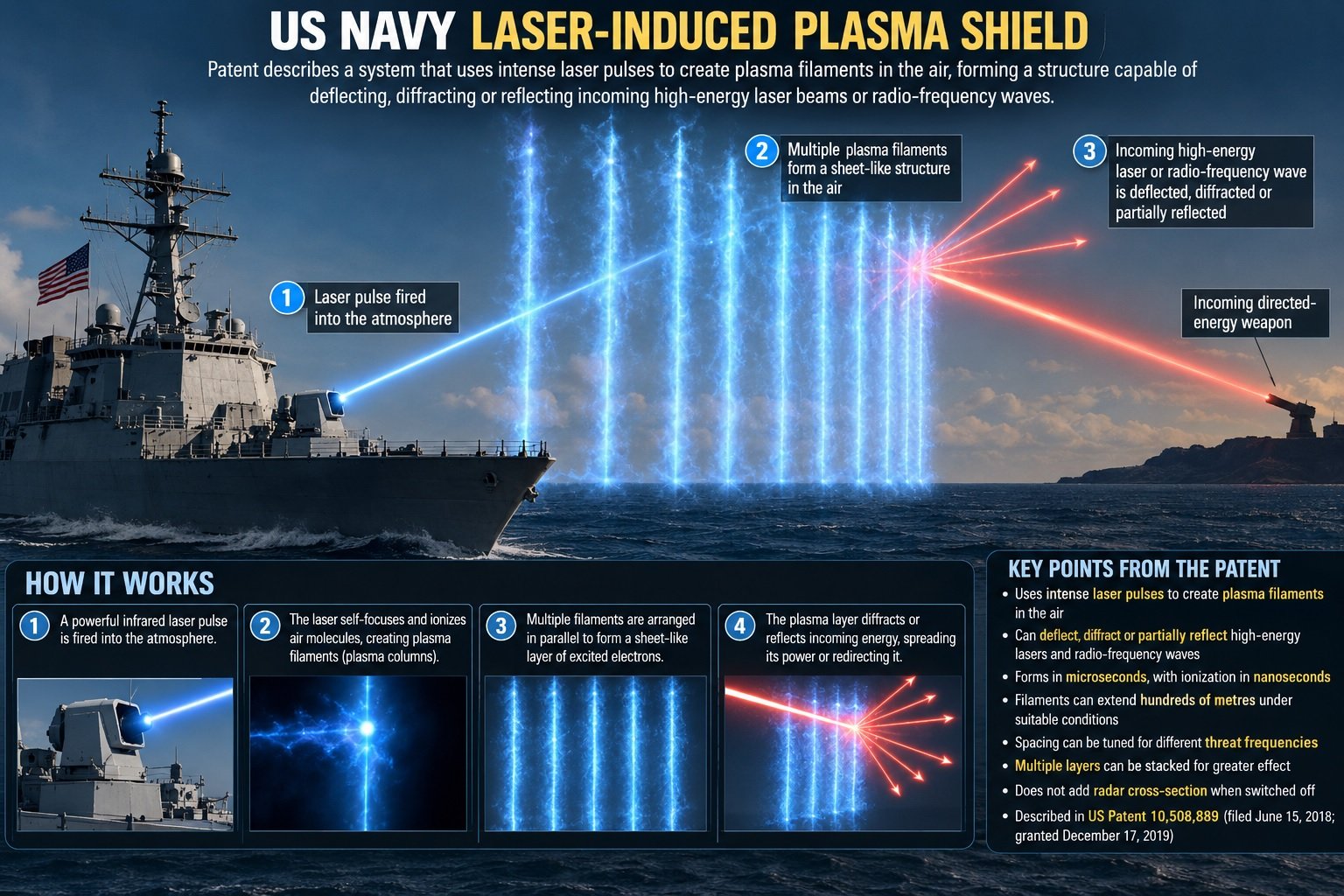
WASHINGTON, — A US Navy patent describes a system that uses powerful laser pulses to create plasma filaments in the air, forming a temporary structure designed to deflect, diffract or partially reflect incoming high-energy laser beams and radio-frequency waves. The concept aims to provide a rapid response to directed-energy threats against military platforms.
The patent, titled Method and Apparatus for Laser-Induced Plasma Filaments for Agile Counter-Directed Energy Weapon Applications, was filed on June 15, 2018, by the United States of America as represented by the Secretary of the Navy. It was granted as US Patent 10,508,889 on December 17, 2019. The inventors are Brittany E. Lynn, Alexandru Hening and Ryan P. Lu, based in San Diego, California. The work is assigned to the US government under Navy Case Number 104178.
How the Plasma Filament System Works
The process begins with a powerful infrared laser pulse travelling through the atmosphere. As the pulse moves through the air, the optical Kerr effect causes it to self-focus as the air’s refractive index changes with light intensity. At sufficiently high intensity, air molecules become ionized, creating plasma that causes the beam to defocus.
The balance between self-focusing and plasma-induced defocusing allows the laser pulse to remain concentrated over longer distances, leaving a plasma column behind it. The patent describes initial electron densities ranging from (10^{13}) to (10^{17}) electrons per cubic centimetre, with filaments potentially extending hundreds of metres under suitable conditions.
By generating multiple plasma columns in a parallel arrangement, the system creates a temporary, sheet-like structure in the air. The spacing between the filaments can be designed to interact with the incoming electromagnetic waves.
In transmission mode, the array can diffract incoming energy into different directions, spreading it over a larger area and reducing the energy concentrated on a protected target. In reflection mode, it can redirect part of the incoming energy towards its source. Because the plasma columns are discrete, the reflection is partial rather than complete.
Rapid Response to Directed-Energy Threats
The patent identifies high-energy lasers and high-power radio-frequency systems as threats capable of damaging military sensors, electronics and platforms. Existing countermeasures, such as water jets and smoke clouds, can require time to deploy and do not disable the attacking weapon.
The proposed plasma-based structure is designed to form rapidly. The patent describes a response on the order of microseconds, with ionization occurring within nanoseconds. Laser pulse energy, repetition rate and wavelength can be adjusted to influence the plasma and its interaction with incoming electromagnetic energy.
The document also describes stacking multiple filament planes to increase their combined effect and using a secondary electromagnetic beam to extend the lifetime of the ionized regions. It states that the system would not add radar cross-section when switched off.
Research Status and Potential Applications
The Naval Information Warfare Center Pacific has pursued related applications of laser-induced plasma filaments, including infrared countermeasures against heat-seeking missiles, free-space optical communications and plasma-based antennas or electromagnetic test targets.
The patent is available for licensing to qualified commercial entities through TechLink, the Department of Defense’s technology-transfer intermediary. Licensing and technical inquiries are also identified in the patent documentation for the Navy’s Office of Research and Technical Applications.
However, the patent describes a proposed technology, not a confirmed operational defence system. Its publication and grant do not establish that the system has been deployed on Navy ships or demonstrated to provide a complete shield against directed-energy weapons.
——— End of Article ———