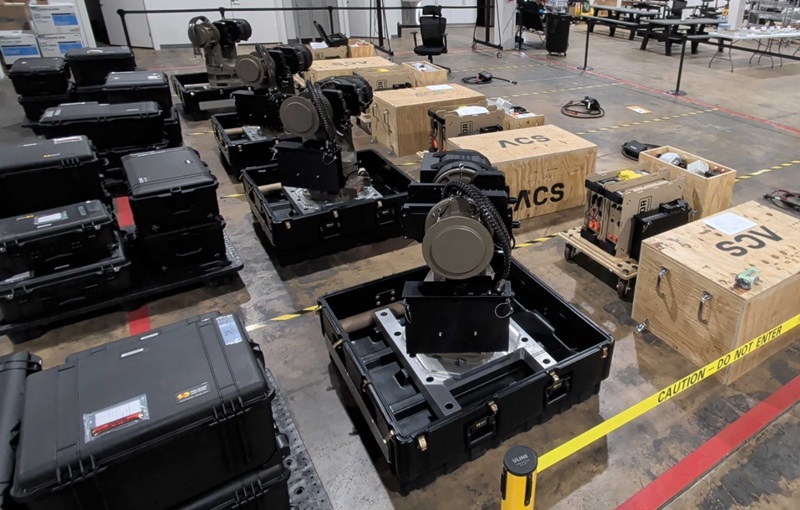
QUANTICO, Virginia — May 19, 2026 : American Rheinmetall has completed a week-long operator training program for the United States Marine Corps Warfighting Laboratory (MCWL) centered on the Fieldranger Remotely Controlled Weapon Station (RCWS), concluding with day and night live-fire exercises at Marine Corps Base Quantico.
The training involved Marines from Fleet Marine Force combat units and personnel from the Supporting Establishment. The program combined classroom instruction with practical exercises focused on system operation, tactical employment, target acquisition, and sensor management under operational conditions.
The Commanding General of the Marine Corps Warfighting Laboratory observed the final live-fire phase of the course, where Marines conducted simulated mission scenarios using the Fieldranger system. During the event, senior leadership and operators discussed potential battlefield applications and future operational concepts for remotely operated weapon systems within Marine Corps formations.
Marine Corps Base Quantico, located south of Washington, D.C., covers more than 50,000 acres and operates over 40 live-fire ranges. The installation serves as a major testing and evaluation site for emerging military technologies and advanced combat systems.
Fieldranger RCWS Designed for Protected Operations
The Rheinmetall-developed Fieldranger is a family of remotely operated weapon stations designed for integration on multiple vehicle platforms, ranging from light tactical vehicles to heavily armored combat systems. The weapon station allows crews to conduct surveillance, identify targets, aim weapons, and engage threats while remaining inside the protected interior of the vehicle.
All Fieldranger variants incorporate a stabilized electro-optical sensor package consisting of a high-resolution day camera, thermal imager, and laser rangefinder. The integrated system enables accurate target detection and engagement during day and night operations, including in poor weather and low-visibility environments.
The Fieldranger family includes four primary variants configured for different operational roles:
- Fieldranger Light weighs less than 75 kilograms and supports 5.56mm or 7.62mm machine guns.
- Fieldranger Multi weighs approximately 200 kilograms and can mount either a .50 caliber heavy machine gun or a 40mm automatic grenade launcher.
- Fieldranger Dual weighs around 260 kilograms and supports a primary weapon alongside a coaxial secondary armament.
- Fieldranger 20 is equipped with a 20mm Oerlikon automatic cannon for medium-caliber fire support missions.
Focus on Reducing Crew Vulnerability
The training also emphasized the operational advantages of remotely controlled weapon stations compared to traditional ring-mounted crew-served weapons. Conventional vehicle-mounted gun positions often expose operators above the vehicle’s roofline, increasing vulnerability to small arms fire, fragmentation, and sniper attacks.
The U.S. military identified these risks during operations in Iraq and Afghanistan, where elevated turret positions contributed to casualties during convoy security and patrol missions. Remote weapon stations reduce this exposure by allowing operators to remain under armor while using stabilized optics and automated fire-control systems for observation and engagement tasks.
In addition to improving crew protection, RCWS platforms provide greater firing stability during vehicle movement and reduce operator fatigue during prolonged missions.
Ongoing Marine Corps and Rheinmetall Collaboration
The Quantico training represents another stage in the continuing partnership between American Rheinmetall and the Marine Corps Warfighting Laboratory, which was established in 1995 to support the development of expeditionary warfare concepts and evaluate emerging operational technologies.
In recent years, cooperation between the two organizations has increasingly focused on autonomous and unmanned ground systems integration.
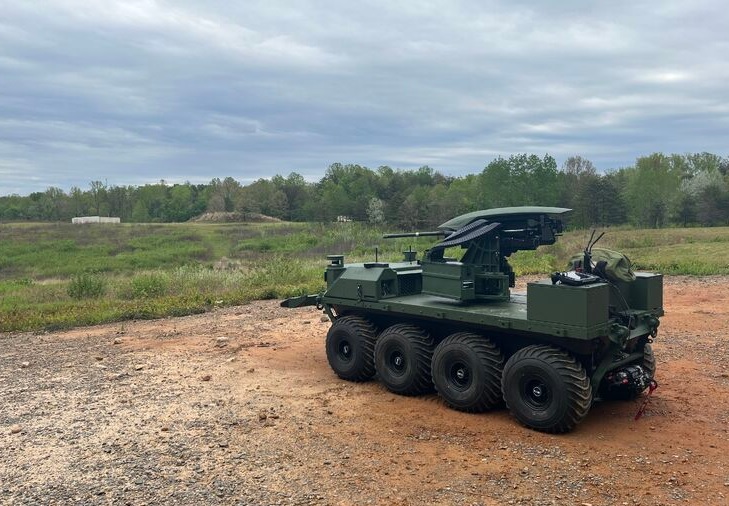
In early 2023, American Rheinmetall Vehicles delivered the Mission Master SP autonomous unmanned ground vehicle (UGV) to the Marine Corps for evaluation. The platform was later tested during the multinational Talisman Sabre exercise in Queensland, Australia, in summer 2023, followed by additional assessments during the Apollo Shield exercise at Marine Corps Base Twentynine Palms, California, later that year.
In March 2024, Rheinmetall conducted a live-fire demonstration at Fort Clinton, Ohio, featuring the Mission Master SP integrated with the Fieldranger RCWS. The demonstration evaluated capabilities including armed reconnaissance, sentry overwatch, fire support, flank security, and screening operations.
Those evaluations followed a structured “crawl-walk-run” methodology designed to assess how infantry units can effectively operate alongside autonomous ground vehicles in combat environments.
The Fieldranger RCWS used during the recent Quantico training is the same system previously integrated with the Mission Master SP platform during earlier demonstrations and field evaluations.
American Rheinmetall has not released further details regarding future procurement decisions or additional follow-on testing activities related to the Fieldranger system.
——— End of Article ———