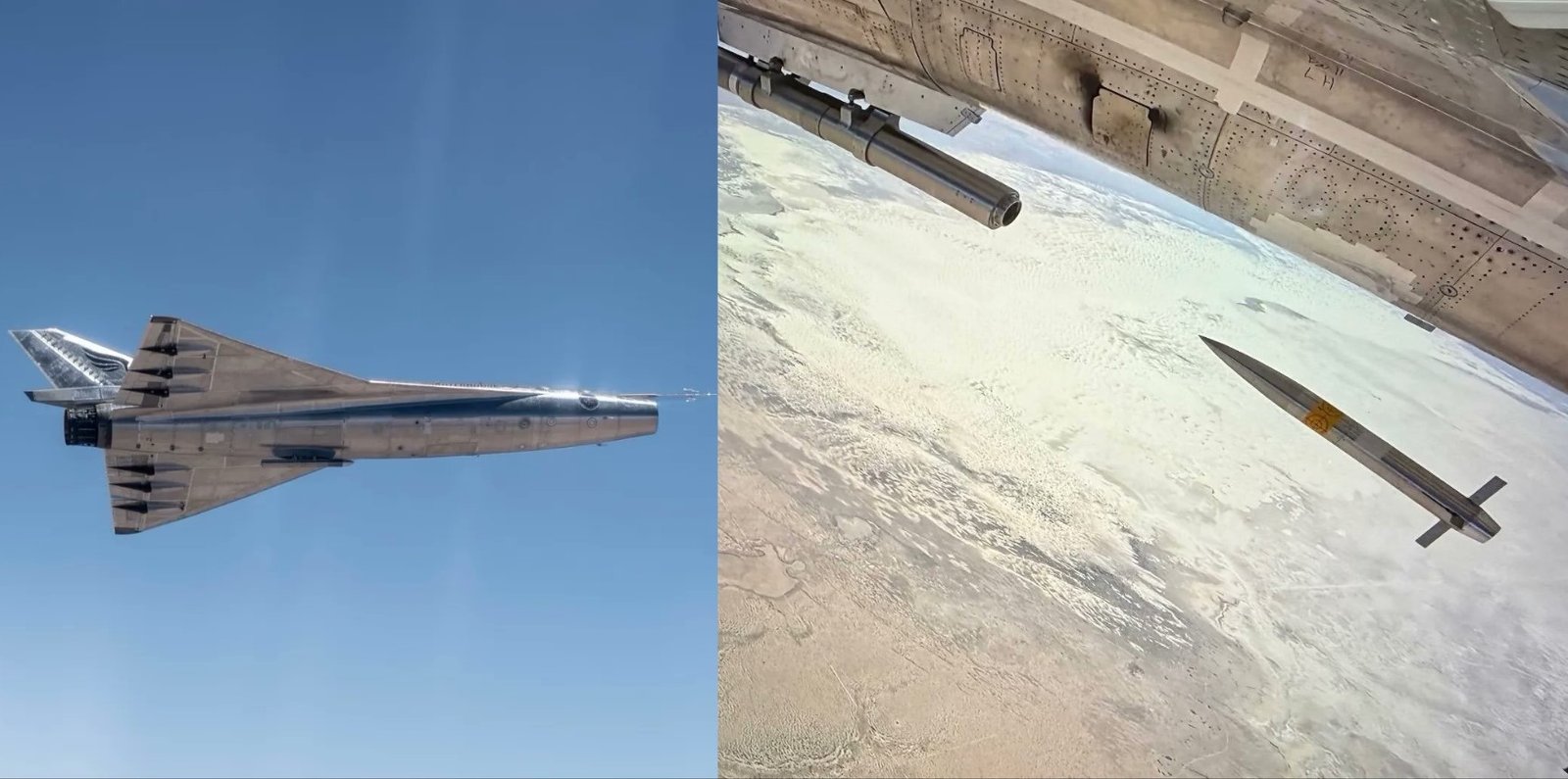
El Segundo, California — The U.S. Defense Innovation Unit (DIU) and Atlanta-based hypersonic aircraft company Hermeus have successfully completed an unmanned stores separation flight test with the Quarterhorse uncrewed aerial vehicle (UAV), marking another milestone in the Hypersonic and High-Cadence Airborne Testing Capabilities (HyCAT) program.
The successful flight demonstrated that the Quarterhorse aircraft can safely release an external payload during flight, an important requirement for military aircraft designed to carry and deploy equipment such as munitions, sensor pods, or electronic warfare systems. Until this capability is validated, an aircraft remains primarily a research and testing platform rather than one capable of operational payload deployment.
DIU described the achievement as another important milestone for the HyCAT program, noting that the stores separation test was completed during the program's fifth flight since spring 2026.
"Another huge HyCAT milestone, a successful unmanned stores separation flight test with Hermeus. This was only the program's 5th flight since the Spring. Tests like this usually take years. We're moving 4x as fast," DIU stated.
Stores Separation Test Validates Safe Payload Release
A stores separation test verifies that an external payload can be released safely without striking the aircraft or disrupting its flight. The process is considered a critical certification step for any military aircraft expected to carry external stores.
The challenge becomes greater at high subsonic and transonic speeds, where airflow around the aircraft and released object becomes increasingly complex. If a payload does not separate correctly, it could collide with the aircraft or create flight instability.
The successful demonstration provides engineers with flight data that can be used to model payload releases at progressively higher speeds as the Quarterhorse flight test program expands.
HyCAT Program Aims to Accelerate Hypersonic Testing
The HyCAT program was launched by the Defense Innovation Unit in early 2023 to accelerate hypersonic flight testing by working with commercial aerospace companies instead of relying solely on traditional defense acquisition processes.
Hypersonic flight testing has historically faced challenges including limited wind tunnel capacity, restricted access to specialized test ranges, and the technical complexity of sustained flight above Mach 5.
Through partnerships with private industry and the use of commercial investment alongside government funding, DIU aims to shorten development timelines and generate flight data more rapidly than conventional programs.
Quarterhorse Supports Future High-Speed Aircraft Development
The aircraft used during the test was Hermeus' Quarterhorse, an uncrewed experimental aircraft developed to mature technologies for future high-speed military aircraft.
According to Hermeus, Quarterhorse is powered by its Chimera turbine-based combined-cycle (TBCC) propulsion system, built around a modified General Electric J85 turbojet core. The engine is designed to operate as a conventional turbojet at lower speeds before transitioning to another propulsion mode as the aircraft approaches higher-speed flight, allowing one propulsion system to support multiple flight regimes.
Earlier in 2026, Hermeus reported that Quarterhorse reached Mach 1.21, approximately 930 miles per hour (1,497 km/h), during a previous flight. The company plans to expand the aircraft's flight envelope toward Mach 3 by 2027.
Expanded DIU-Hermeus Partnership
DIU first selected Hermeus for the HyCAT program in November 2023 with a contract valued at $23 million to demonstrate propulsion, thermal management, power generation, and mission-system technologies.
In May 2026, the partnership expanded through a $159 million contract modification, increasing the total contract ceiling to $219 million.
Under the updated agreement, Hermeus will continue Quarterhorse flight testing throughout 2026 and 2027 while providing flight data to DIU, the U.S. Air Force, and the U.S. Navy. The expanded work includes high-Mach flight demonstrations and high-speed payload release testing to support future military aircraft concepts.
Hermeus has stated that Quarterhorse is intended as a technology development platform rather than an operational aircraft. The company plans to apply the knowledge gained from Quarterhorse to its future uncrewed aircraft, Darkhorse.
Hermeus describes Darkhorse as a reusable, multi-mission hypersonic uncrewed aircraft intended for strike and reconnaissance missions. The company has said the platform will incorporate propulsion, structural, and thermal management technologies validated through the Quarterhorse flight test program.
Defense analysts have also noted that future high-speed uncrewed aircraft could complement programs such as the U.S. Air Force's Collaborative Combat Aircraft initiative or operate independently in strike and electronic attack roles.
HyCAT Continues to Expand
The HyCAT program has recorded additional progress during 2026.
In February, Rocket Lab's HASTE suborbital launch vehicle carried the DART AE hypersonic testbed, developed by Australian company Hypersonix, during the Cassowary Vex mission. The flight exceeded Mach 5 and collected propulsion, trajectory, and vehicle performance data under hypersonic flight conditions.
DIU is also advancing the next phase of the program, HyCAT 2, which includes work with California-based NXTRAC to develop guidance, navigation, and control technologies for future hypersonic test vehicles.
The latest stores separation demonstration adds another validated capability to the Quarterhorse flight test program and provides additional flight data to support the continued development of future high-speed military aircraft under the HyCAT initiative.
——— End of Article ———