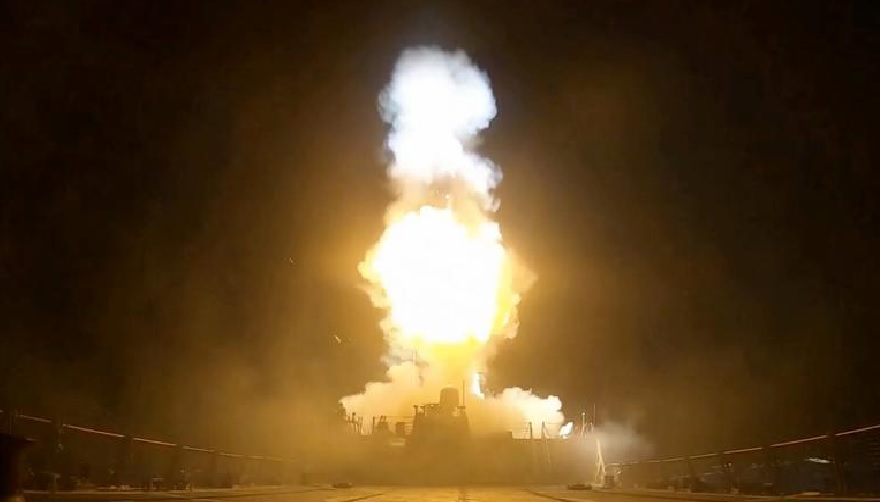
WASHINGTON / DUBAI — The United States carried out a ninth consecutive night of airstrikes against Iranian military installations, continuing its campaign to reduce Iran's ability to threaten commercial shipping in the Strait of Hormuz as regional tensions continue to escalate. U.S. Central Command (CENTCOM) said it successfully completed the ninth consecutive evening of strikes at 10 p.m. ET on July 19.
According to U.S. Central Command (CENTCOM), the three-hour operation targeted military command centers, integrated air defense systems, coastal surveillance sites, communications networks, maritime capabilities, and missile and drone launch positions in southern Iran. CENTCOM said the strikes were intended to reduce Iran's capability to attack commercial vessels and civilian mariners transiting the Strait of Hormuz.
The operation is part of a broader U.S. air and maritime campaign that has struck more than 140 Iranian military targets since the latest phase of the conflict began. It also supports the renewed U.S. naval blockade of Iranian ports following the collapse of a 60-day interim cessation arrangement reached in June.
Campaign Targets Command Network
The U.S. campaign is focused on disrupting the command-and-control network that coordinates attacks on merchant shipping rather than targeting only individual missile launchers or drones.
Military targets have included communications centers, command headquarters, coastal observation posts, radar systems, IRGC naval infrastructure, and facilities supporting missile and drone operations.
Explosions were reported in several Iranian locations, including Tabriz, Bushehr, Chabahar, and Bandar Mahshahr. Coastal military facilities around Bandar Abbas, Jask, Konarak, Abu Musa, and Greater Tunb have also been targeted to reduce radar coverage and anti-ship missile capabilities.
The operations rely on surveillance aircraft, satellites, and electronic intelligence systems to identify military targets and assess strike results. The sustained campaign has reportedly forced Iranian units to relocate launch systems more frequently and reduce radio communications.
Strait of Hormuz Remains the Focus
The Strait of Hormuz, about 34 kilometers wide at its narrowest point, carries around 20 percent of global oil shipments and a significant share of Qatar's liquefied natural gas exports.
To support maritime security, the U.S. has expanded its naval presence in the region. During the first blockade from April 13 to June 18, U.S. forces redirected more than 140 vessels and disabled nine. Since the blockade resumed, CENTCOM said that by July 19 it had redirected six commercial vessels and disabled one.
Operations are supported by the destroyers USS John Finn and USS Donald Cook, while Marines from the 11th Marine Expeditionary Unit have conducted inspections of commercial vessels.
On July 15 near Kharg Island, U.S. forces used Hellfire missiles to disable the tanker M/T Belma by striking its smokestack, stopping the vessel without damaging its cargo tanks.
On July 20, the United Kingdom Maritime Trade Operations (UKMTO) reported that a vessel caught fire and drifted about eight nautical miles northwest of Kumzar, Oman, after being struck by an unidentified projectile. The crew abandoned the ship and was rescued by a tug.
Iran's Islamic Revolutionary Guard Corps (IRGC) also claimed that two oil tankers attempting to use the southern shipping route were immobilized after explosions.
Regional Attacks Continue
Iran has continued missile and drone attacks against U.S. positions and partner nations across the region.
The United States has confirmed that 17 service members have been killed since the conflict escalated.
On July 17, an Iranian ballistic missile and drone attack in Jordan killed two U.S. service members. The remains of a third service member, previously reported missing, were later recovered.
On July 18, another U.S. service member was killed and one was injured in northern Iraq during the controlled disposal of an unexploded Iranian drone.
Iranian attacks have also prompted missile interceptions over Jordan, while Kuwait activated its air defense systems following drone attacks on a power generation and desalination facility. In Bahrain, home to the U.S. Fifth Fleet, warning sirens sounded after the U.S. Embassy warned of potential Iranian strikes near central Manama.
Oil Prices Rise
The conflict has continued to affect global energy markets.
Brent crude oil rose above $91 per barrel, while the average price of regular gasoline in the United States returned to about $4 per gallon.
U.S. Secretary of State Marco Rubio said Iran was attempting to use the Strait of Hormuz as leverage and called on international partners to help protect freedom of navigation.
U.S. Energy Secretary Chris Wright said maintaining the uninterrupted flow of oil and natural gas through the strait remains a key U.S. objective.
Military operations continue as the United States seeks to reduce Iran's ability to threaten commercial shipping through one of the world's most important maritime trade routes, while Iran continues to rely on dispersed mobile missile and drone systems to sustain its operations.
Source : CENTCOM
——— End of Article ———