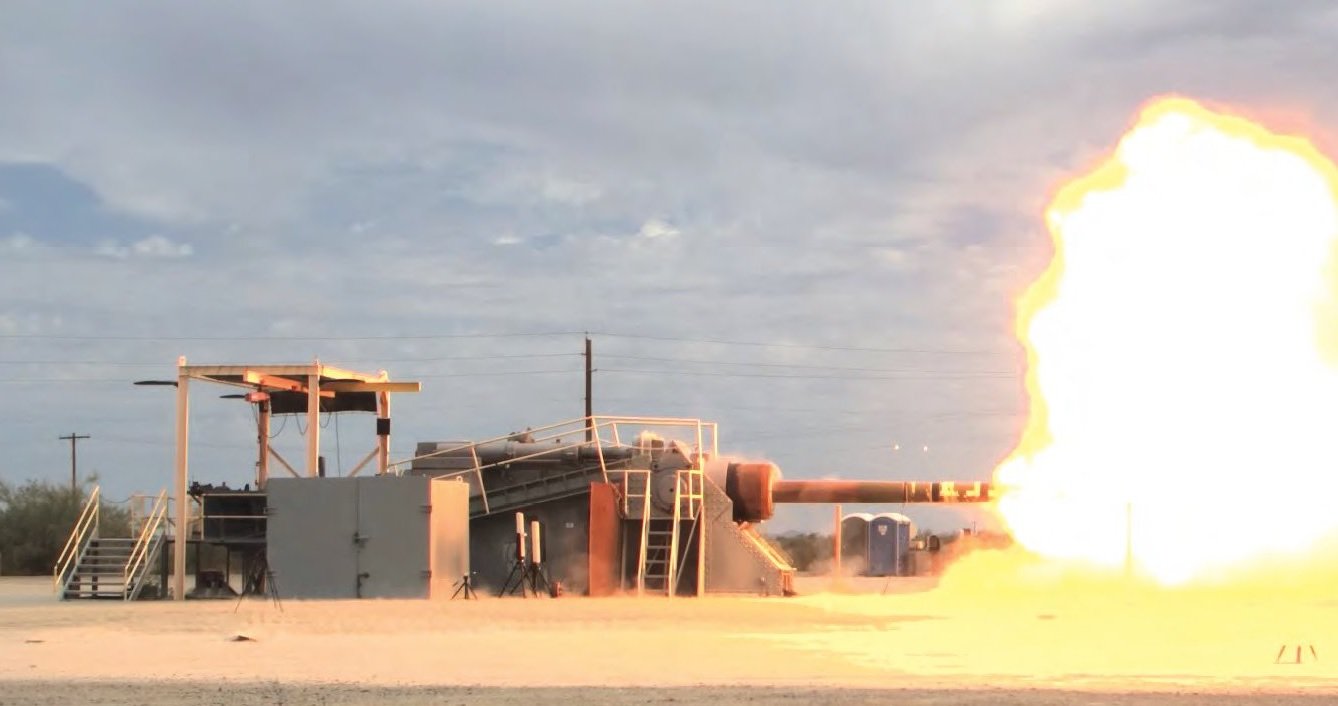
YUMA PROVING GROUND, Ariz. — The U.S. Army and its government research partners have successfully completed a live-fire test of a hypersonic warhead using a cannon-based launch system, demonstrating a new testing capability that could provide a lower-cost and more efficient alternative to traditional rocket-based hypersonic testing.
The milestone, detailed in the July 30, 2026 edition of The Outpost, the official publication of Yuma Proving Ground, marks the successful demonstration of a new method for evaluating hypersonic warhead performance and lethality. The effort was carried out jointly by Lawrence Livermore National Laboratory (LLNL) and the U.S. Army Combat Capabilities Development Command Armaments Center (DEVCOM-AC).
LLNL, a U.S. Department of Energy research laboratory, specializes in advanced weapons science, while DEVCOM-AC is responsible for developing weapons and munitions technologies for the U.S. Army.
Lower-Cost Alternative to Rocket-Based Testing
Hypersonic weapons are designed to sustain speeds above Mach 5, or approximately 3,836 miles per hour (6,174 km/h). At these speeds, much of their effectiveness comes from the kinetic energy generated by their mass and velocity, in addition to any explosive payload.
Traditionally, testing hypersonic warheads has required dedicated rocket-propelled test vehicles. Officials said this approach is expensive and faces limitations, including restricted flight-test ranges, limited wind tunnel availability, and complex logistics.
The new cannon-based approach allows engineers to accelerate a warhead to hypersonic speeds using a gun system instead of a rocket. This enables researchers to study warhead behavior, flight characteristics, and impact performance while reducing the cost and complexity of testing.
Project Began with Proof-of-Concept Testing
According to officials, the program began about two years ago as a concept for conducting hypersonic warhead lethality assessments. These assessments measure how effectively a warhead damages or destroys its intended target after impact.
Before moving to live ordnance, the LLNL and DEVCOM-AC team conducted an inert proof-of-concept test using a non-explosive version of the warhead. The purpose of the test was to validate the underlying engineering and physics while reducing safety and financial risks.
Data collected from the inert firing confirmed the feasibility of the concept and allowed engineers to refine the design before proceeding to live-fire testing.
Yuma Proving Ground Supported Test Operations
Personnel at Yuma Proving Ground played a central role in integrating the testing system and supporting both the inert and live-fire events.
Located in southwestern Arizona, the proving ground includes more than 1,300 square miles of desert testing area and nearly 2,000 square miles of restricted airspace, providing facilities for large-scale weapons testing.
How the Live-Fire Test Was Conducted
On the day of the test, personnel moved to designated safety bunkers while the launch sequence began.
A test-purpose truck positioned the Integrated Launch Package at the firing location. After the fuze was armed, the gun crew loaded the warhead followed by the propelling charge. Throughout the countdown, teams monitored real-time telemetry data to track the weapon's performance.
Following the launch, engineers reviewed telemetry data along with high-speed camera footage of the warhead's flight and impact. Officials confirmed that the test performed as expected and met its planned objectives.
Key Engineering Components
The successful demonstration relied on several specialized engineering developments.
Engineers designed a sabot package, a structural carrier that stabilizes the projectile while it travels through the gun barrel before separating safely after the projectile exits the muzzle.
The team also carried out detailed interior ballistic analysis to evaluate the forces acting on the warhead during launch and ensure it could withstand the stresses generated during firing.
In addition, DEVCOM-AC integrated an electronic safe-and-arm fuze, designed to prevent premature detonation while ensuring the warhead arms correctly before impact.
Before manufacturing any test hardware, the program underwent multiple peer reviews to verify engineering models and confirm the safety of the testing approach.
Addressing Hypersonic Testing Challenges
U.S. hypersonic development programs have faced testing capacity limitations for several years due to limited wind tunnel access, restricted flight-test ranges, and the high cost of rocket-based testing.
Officials said the cannon-launched method provides an additional testing option that can help improve efficiency while supporting hypersonic warhead evaluation at relevant speed and scale.
In a related development, Kratos Defense completed a $50 million, 68,000-square-foot payload integration facility in Crane, Indiana, in July 2026. The facility is designed to prepare multiple experimental hypersonic payloads simultaneously, supporting increased testing activity.
Program Milestone
Officials said the successful live-fire demonstration validates a concept that began as an experimental idea about two years ago.
According to the project team, the cannon-based testing method provides a practical platform for evaluating hypersonic warhead lethality while enabling faster data collection for multiple hypersonic programs. They added that the capability can help accelerate development efforts by providing a complementary testing method alongside traditional rocket-based evaluations.
——— End of Article ———