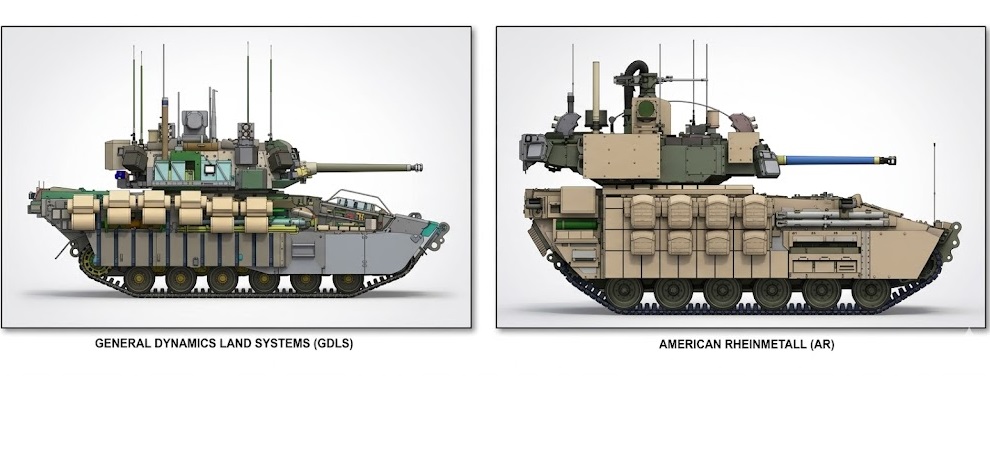
DETROIT, MICHIGAN — May 25, 2026 : The U.S. Army has officially unveiled the competing engineering concepts for the XM30 mechanized combat vehicle programme, providing the first public look at the next-generation platforms intended to replace the Bradley Infantry Fighting Vehicle (IFV). The reveal marks a significant milestone in one of the Pentagon’s largest future ground combat modernization programmes, focused on delivering a digitally connected, highly survivable, and software-defined armored platform for future high-intensity warfare.
The Computer-Aided Design (CAD) renderings from competing prime contractors, General Dynamics Land Systems (GDLS) and American Rheinmetall, were presented on May 13 by XM30 Program Manager Colonel Novak during the National Defense Industrial Association Maneuver Defense and Expeditionary Conference (NDIA MDEX 2026) in Detroit. The concepts currently represent the vehicle configurations advancing through detailed engineering, prototype manufacturing, and testing phases.
Programme Schedule and Acquisition Strategy
The U.S. Army confirmed that the CAD models displayed at MDEX 2026 represent designs advancing through Phases 3 and 4 of the XM30 programme, covering detailed design work, prototype construction, and physical testing. Evaluation activities are expected to continue through December 2027, after which the programme will move into Phase 5, transitioning to a Middle Tier Acquisition – Rapid Fielding pathway.
A formal request for proposals (RFP) for production is scheduled to be issued during the first quarter of Fiscal Year 2027, while the Pentagon’s Fiscal Year 2027 budget request has already allocated $547 million for the procurement of 19 initial XM30 test vehicles. Contracts awarded to both competing teams in June 2023 for Phases 3 and 4 are collectively valued at approximately $1.6 billion, underlining the strategic importance of the programme to the Army’s future armored force structure.
Design Philosophy and Operational Role
The XM30 programme is intended to replace the Bradley IFV fleet with a next-generation mechanized combat vehicle optimized for network-centric warfare, autonomous battlefield integration, and high-intensity operations against technologically advanced adversaries. Unlike legacy Cold War-era infantry fighting vehicles, the XM30 is being developed with a focus on artificial intelligence-supported battlefield awareness, modular combat systems, software-defined architecture, and greater resistance to emerging threats such as drones, loitering munitions, and precision-guided weapons.
Army planners expect the future platform to operate alongside next-generation armored formations while supporting rapid battlefield connectivity, sensor integration, and future autonomous mission systems. The programme also prioritizes lower crew workload through automation and advanced digital systems intended to improve battlefield decision-making and engagement speed.
Crew Layout, Armament, and Internal Configuration
Although exact dimensions and survivability specifications remain classified, publicly available programme information indicates that both tracked concepts will exceed 40 tonnes and feature an almost identical internal layout.
Each vehicle is designed around a two-person crew seated side-by-side directly behind the engine compartment, while the rear troop section provides space for six fully equipped infantry soldiers. The platform is also expected to support an optionally manned operational configuration, allowing future integration of autonomous and remotely operated combat functions.
Both concepts feature large uncrewed turrets, ensuring that turret systems do not penetrate internal crew space and thereby maximizing internal survivability and usable volume. The primary weapon system on both designs is the Northrop Grumman XM913 50 mm chain gun, firing 50×228 mm ammunition, paired with a coaxial 7.62 mm M240 machine gun.
The vehicles are additionally configured to support a roof-mounted remotely operated weapon station armed with a 12.7 mm Browning M2A1 heavy machine gun to provide close-range defensive fire and battlefield flexibility.
Alongside cannon armament, the XM30 incorporates a universal missile launcher system capable of deploying TOW anti-tank guided missiles, Combat Common Missile System-Heavy (CCMS-H) munitions, or future loitering drone systems, allowing the platform to engage armored vehicles, hardened defensive positions, and emerging battlefield threats.
Mobility and Hybrid-Electric Systems
Mobility requirements remain central to the programme because the XM30 is expected to maneuver alongside modern main battle tanks, including future Abrams formations, while reducing logistical burden and improving battlefield endurance.
Both competing concepts incorporate hybrid-electric propulsion systems, InArm hydropneumatic suspension, and six pairs of road wheels to support improved ride stability and cross-country performance. The vehicles also employ composite tracks, intended to reduce vibration, improve mobility, and lower maintenance requirements while supporting the platform’s increasing electrical power demands for sensors, networking systems, and future upgrades.
General Dynamics Land Systems’ “Wolf XM30”
The GDLS proposal, known as Wolf XM30, emphasizes a compact turret profile, enhanced side-hull protection, and an extensive distributed digital sensor architecture intended to improve survivability and battlefield awareness.
Engineering renderings presented during MDEX 2026 show multiple communication antennas, modular armor layouts, and elevated observation masts designed to feed automated, artificial intelligence-supported threat detection systems. The vehicle appears optimized for reduced battlefield signature and rapid digital integration across Army formations operating in contested environments.
The concept is also reported to incorporate components associated with the ASCOD armored vehicle platform while utilizing composite tracks supplied by Soucy.
American Rheinmetall’s “Lynx XM30”
The competing proposal from American Rheinmetall, designated Lynx XM30, is derived from the KF41 Lynx infantry fighting vehicle family and adopts a larger turret structure optimized for modular upgrades and expanded internal growth capacity.
The design prioritizes increased internal space to accommodate advanced electronics, autonomous mission software, electronic warfare suites, and expanded ammunition handling systems. American Rheinmetall is leading the development effort through Team Lynx, an industrial consortium involving Textron Systems, RTX, L3Harris Technologies, Allison Transmission, and Anduril Industries.
Survivability and Battlefield Protection
Survivability has emerged as a key requirement for the XM30 programme following battlefield lessons observed in Ukraine, where drones, loitering munitions, top-attack systems, and precision artillery have transformed armored warfare.
To address these threats, both competing vehicles incorporate modular armor protection, advanced situational awareness systems, and the Iron Fist Active Protection System (APS) developed by Elbit Systems.
The protection suite is currently undergoing U.S. Army standardization under the XM251 designation, with the system expected to transition to the fully standardized M251 configuration for use across the XM30 platform, the future M1E3 Abrams main battle tank, and the Stryker armored vehicle family.
Fielding Timeline
Initial prototype deliveries are scheduled to begin during 2026, followed by testing and operational evaluations continuing through 2027. Following the Army’s future production downselect process, the XM30 programme is expected to move toward initial operational fielding between 2028 and 2030, depending on acquisition timelines and final contract awards.
——— End of Article ———