Washington, D.C. — The U.S. Army has selected Anduril Industries to lead the operational rollout of its Next-Generation Command and Control (NGC2) network under a contract worth up to $1.8 billion over five years.
The contract has an initial base value of $162.8 million, with options that could increase the total value to $1.8 billion. The award moves NGC2 from division-level prototype testing toward operational fielding, beginning with I Corps.
I Corps to Receive NGC2
I Corps, headquartered at Joint Base Lewis-McChord, Washington, commands four Army divisions and oversees a significant portion of the Army's presence in the Indo-Pacific region.
The Pacific operating environment presents challenges because Army units can be separated by thousands of miles and must coordinate with other U.S. military services and allied forces. NGC2 is also designed to continue supporting units when communications with higher headquarters are disrupted.
Anduril has not disclosed which I Corps units will receive NGC2 first, how many vehicles or devices will be equipped, or the exact fielding timeline.
Common Data Network
NGC2 is designed to connect previously separate command, intelligence and fire-control systems through a common data architecture.
Sensors, weapons, vehicles and applications from different manufacturers can exchange information through the network without soldiers having to manually transfer data between systems. Anduril's Lattice platform provides the common data layer.
The architecture uses an open-system approach, allowing the Army to add sensors, applications and weapons from different vendors without rebuilding the underlying network.
Testing With 4th Infantry Division
The contract follows approximately a year of NGC2 testing. In July 2025, the Army awarded an Anduril-led team, including Palantir and Microsoft, a $99.6 million prototype agreement.
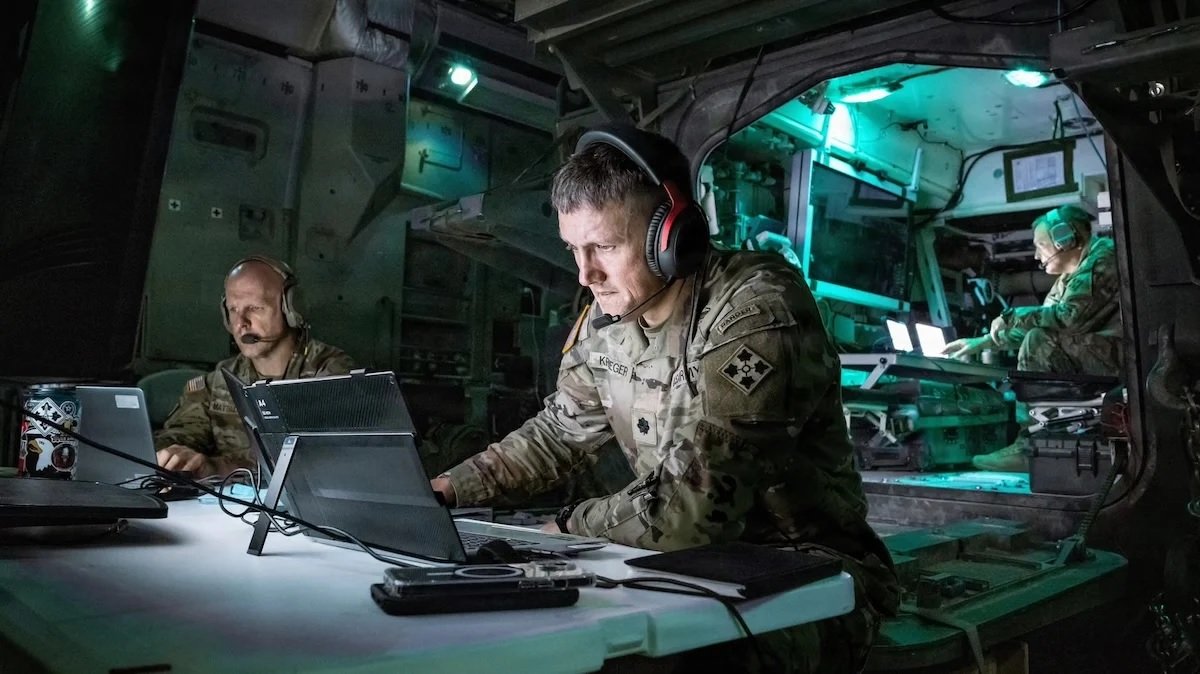
Anduril subsequently worked with soldiers from the 4th Infantry Division at Fort Carson, Colorado, during exercises known as Ivy Sting.
During the first Ivy Sting exercise in September 2025, soldiers used artillery fire-control software running on Lattice to fire M777 howitzers.
By the Ivy Mass exercise in May 2026, the entire 4th Infantry Division was operating on NGC2. The network supported more than 2,500 end-user devices and multiple applications.
According to Anduril, NGC2 reduced artillery fire timelines by 90% compared with legacy systems and accelerated airspace coordination. Testing also demonstrated data sharing with U.S. Marine Corps and U.S. Navy systems.
Parallel Testing and Selection
The Army also tested a second NGC2 prototype with the 25th Infantry Division in Hawaii. The effort was led by Lockheed Martin and included the Lightning Surge exercises and Exercise Balikatan 2026 in the Philippines.
After both divisions completed their testing in June 2026, the Army established a common NGC2 data baseline and selected Anduril to lead the scaling effort, working with Palantir and Raft.
The new contract now takes NGC2 into its next phase, beginning with I Corps and establishing the foundation for broader operational fielding across the U.S. Army.
——— End of Article ———