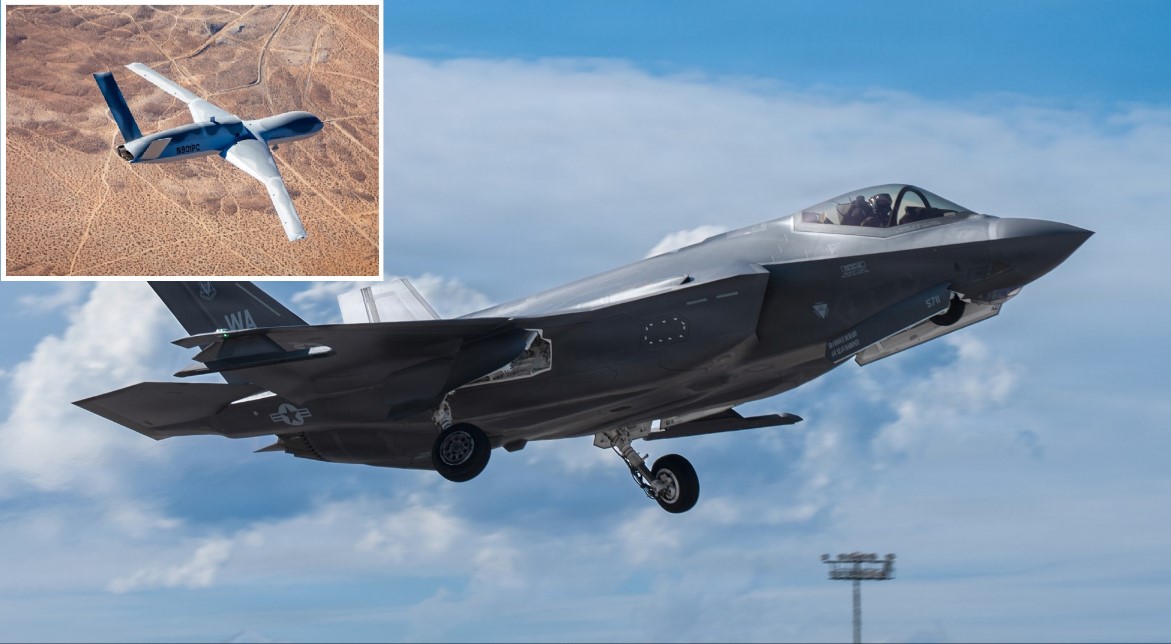
SAN DIEGO — May 28, 2026 : General Atomics Aeronautical Systems, Inc. (GA-ASI) has successfully demonstrated advanced manned-unmanned teaming capabilities by pairing an F-35 Lightning II fighter jet with an MQ-20 Avenger unmanned aircraft in support of the U.S. Air Force’s Collaborative Combat Aircraft (CCA) program. The test marked a key step in validating how crewed fighters could coordinate with semi-autonomous drones during future combat operations.
The demonstration was conducted in partnership with the F-35 Joint Program Office, Lockheed Martin, autonomy firm Autonodyne, the 309th Software Engineering Group, and the 461st and 370th Flight Test Squadrons. During the exercise, the F-35 remained on the ground while the MQ-20 Avenger operated in flight as a surrogate Collaborative Combat Aircraft, enabling operators and engineers to evaluate command-and-control functions, autonomy systems, and tactical data exchange.
Beyond-Line-Of-Sight Control Demonstrated
According to GA-ASI, the demonstration relied on beyond-line-of-sight (BLOS) communications linked through a proliferated low Earth orbit satellite network. A pilot seated inside the F-35 cockpit used a tablet through the Bashi Pilot Vehicle Interface to issue tactical autonomy commands to the MQ-20, showing how future operators may manage autonomous wingmen during missions.
The commands directed the MQ-20 to perform tactical maneuvers, dynamically adjust flight waypoints, and relay ADS-B track data back to the F-35. At the same time, the unmanned aircraft transmitted operational data including location, altitude, velocity, and autonomous response status, enabling the pilot to monitor aircraft activity and mission execution in real time.
GA-ASI stated that the exercise validated seamless communication between a crewed aircraft and a surrogate CCA platform through an operationally relevant data link while confirming the functionality of supporting hardware, software, and network architecture needed for future autonomous combat operations.
TacACE Autonomy Software And Integration
The MQ-20 Avenger was powered by GA-ASI’s TacACE (Tactical Autonomy Ecosystem) software, which is based on the Autonomy Government Reference Architecture (A-GRA). The architecture is designed to accelerate software integration and enable rapid adoption of commercial and government technologies, allowing autonomy systems to be updated more efficiently as operational requirements evolve.
Michael Atwood, vice president of Advanced Programs at GA-ASI, described the demonstration as an important integration milestone for the Collaborative Combat Aircraft effort and said it highlighted near-term opportunities for operational force integration using mission autonomy and advanced data links.
The MQ-20 Avenger has served as a primary Air Force surrogate platform for autonomy testing and CCA-related experimentation for more than five years. The latest F-35 demonstration follows earlier manned-unmanned teaming tests involving the F-22 Raptor, including an October 2025 exercise at the Nevada Test and Training Range and another test conducted at Edwards Air Force Base in February 2026.
Path Toward Operational Collaborative Combat Aircraft
While the MQ-20 continues to support software, networking, and autonomy validation, the Air Force’s long-term objective is to field purpose-built Collaborative Combat Aircraft capable of operating alongside crewed fighters during combat missions. In April 2024, the Air Force selected GA-ASI and defense technology company Anduril to develop the first operational increment of the CCA program.
GA-ASI’s aircraft, designated the YFQ-42A and later named Dark Merlin, completed its maiden flight in August 2025. The aircraft resumed testing in late May 2026 after software corrections addressed a non-fatal April 6 incident caused by miscalculations involving aircraft weight and center-of-gravity data.
The Air Force plans to begin procurement of its first production Collaborative Combat Aircraft in fiscal year 2027, viewing the systems as a lower-cost means of increasing combat mass, strike capacity, reconnaissance capability, and electronic warfare support while reducing operational risks to pilots.
Congressional Support And Indo-Pacific Considerations
Support for the program has also expanded in Congress. In a proposed National Defense Authorization Act (NDAA) draft released on May 26, the House Armed Services Committee included several provisions backing continued CCA development and praised the pace of cooperation between the Air Force and industry.
Lawmakers noted that General Atomics and Anduril conducted initial flight demonstrations within approximately 18 months, describing the timeline as faster than recent tactical fighter-like aircraft development efforts. The committee also supported the Air Force’s plans to transition the first CCA increment toward production.
At the same time, lawmakers highlighted long-term operational concerns related to a potential Indo-Pacific contingency, particularly the threat posed by Chinese long-range weapons systems. Committee members stated that future Collaborative Combat Aircraft may require sufficient range, speed, and endurance to self-deploy across extended distances or launch from outside contested zones if operations from forward bases near the first island chain become impractical.
Under the proposed legislation, the Air Force and Navy secretaries would be required to submit a report to Congress by January 15, 2027, detailing the cost implications and operational tradeoffs of their respective CCA requirements. Separately, the Navy secretary has been directed to brief lawmakers by December 15, 2026, on the service’s acquisition strategy and plans to incorporate technologies and development approaches pioneered through the Air Force’s CCA Increment 1 program.
——— End of Article ———