MARIETTA, Georgia, — U.S. space technology company Atomic-6 has successfully tested its composite Space Armor Lite material against high-speed orbital debris, demonstrating its potential to protect astronauts during spacewalks.
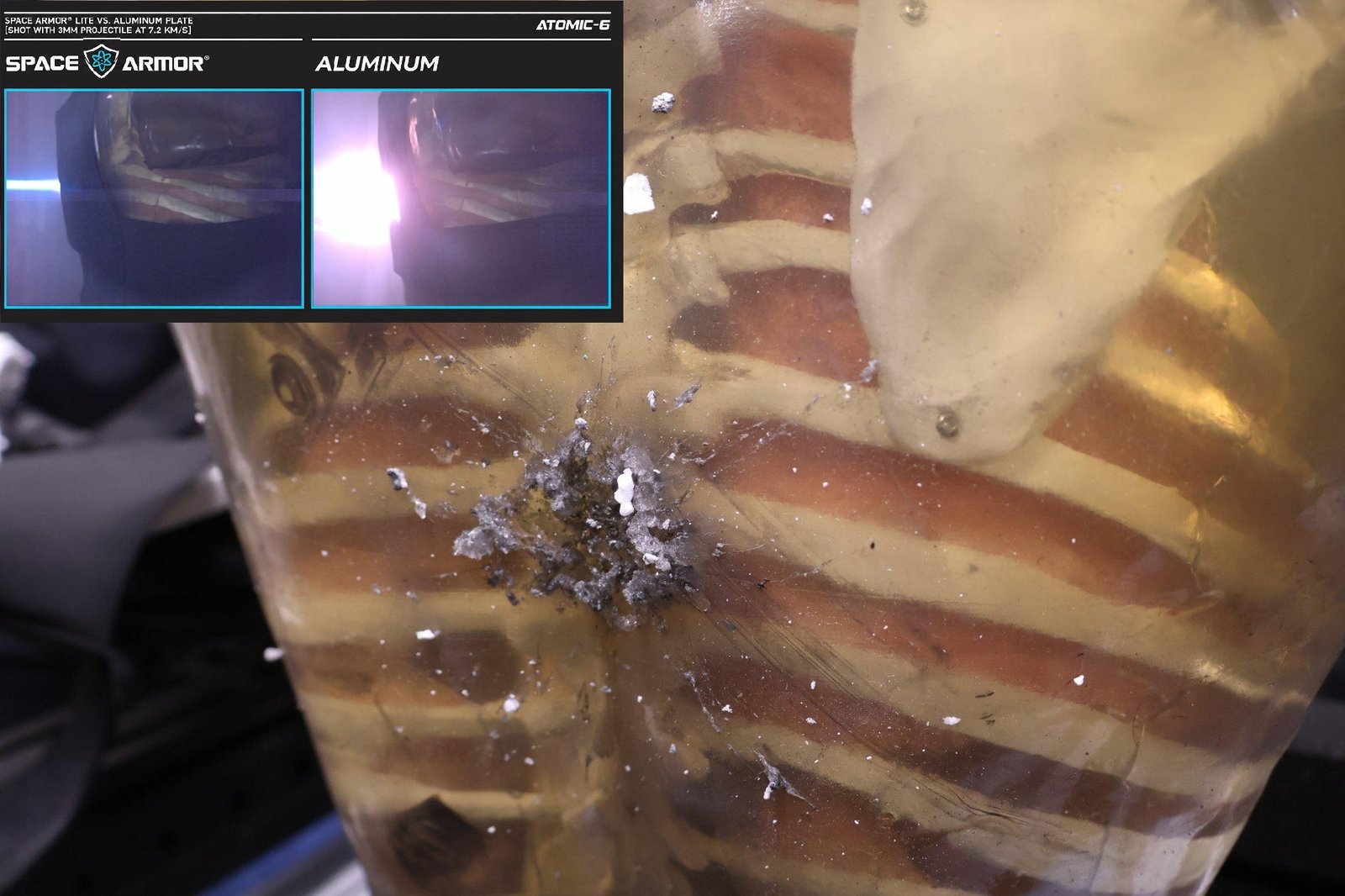
The proof-of-concept test was conducted at Texas A&M University’s Hypervelocity Impact Laboratory. Researchers fired a 3-millimeter aluminum projectile at approximately 7.2 kilometres per second (16,100 mph) toward a transparent simulated human torso protected by a hexagonal Space Armor Lite tile.
The projectile did not penetrate the shield, and the simulated torso showed no visible damage. Its rear surface also showed no visible bulging, cracking or material detachment.
In a comparison test under the same impact conditions, a 4-millimeter-thick aluminum plate failed to stop the projectile, leaving metal fragments embedded in the simulated torso. The plate thickness was selected using NASA ballistic-limit equations to represent protection similar to that used in current spacesuits.
Composite Armor Designed for Space Debris Protection
Atomic-6 originally developed Space Armor to protect satellites against micrometeoroids and orbital debris that are too small to track reliably from Earth.
The company says debris measuring 3 millimeters or smaller accounts for roughly 90 percent of objects in low Earth orbit. Such particles can damage spacecraft because of their extremely high impact speeds.
Unlike conventional metallic Whipple shields, Space Armor uses a patented, non-metallic fibre-to-resin composite designed to absorb impact energy while producing minimal secondary debris.
The tiles are under one inch thick, with an areal mass of approximately 14 kilograms per square metre. They are also designed to be lighter and more compact than traditional metallic shielding. Their composite construction allows radio-frequency signals to pass through, supporting applications around satellite communication antennas.
Atomic-6 offers two versions: Space Armor Lite, designed to stop objects up to 3 millimeters in diameter, and Space Armor Max, designed for debris impacts up to 12.5 millimeters.
Space Armor Already Tested in Orbit
The latest ground test follows the technology's first operational deployment in orbit. Space Armor tiles were launched aboard Portal Space Systems’ Starburst-1 spacecraft in October 2026 on a SpaceX Falcon 9 rocket as part of the Bandwagon-5 mission. The satellite is scheduled for a one-year mission in sun-synchronous orbit.
Further Testing Planned for Spacesuit Integration
Atomic-6 is now exploring the possibility of integrating Space Armor into astronaut spacesuits. Former International Space Station commander Chris Hadfield, who serves on the company's advisory board, said better protection against micrometeoroids and orbital debris is important because an astronaut's spacesuit functions as a one-person spacecraft during spacewalks.
CEO Trevor Smith said the company initially developed the material to protect spacecraft but is now examining its potential to improve astronaut safety.
However, the recent experiment was conducted using a stationary ballistic torso and a flat protective tile. It did not test an operational spacesuit, life-support systems, injury outcomes or whether a suit could maintain pressure after an impact.
The company plans further tests using curved shielding tiles and different impact angles. It is also in early discussions with spacesuit manufacturers about integrating the material without restricting astronaut movement. Additional testing will be required before the technology can be considered for operational spacesuits.
——— End of Article ———