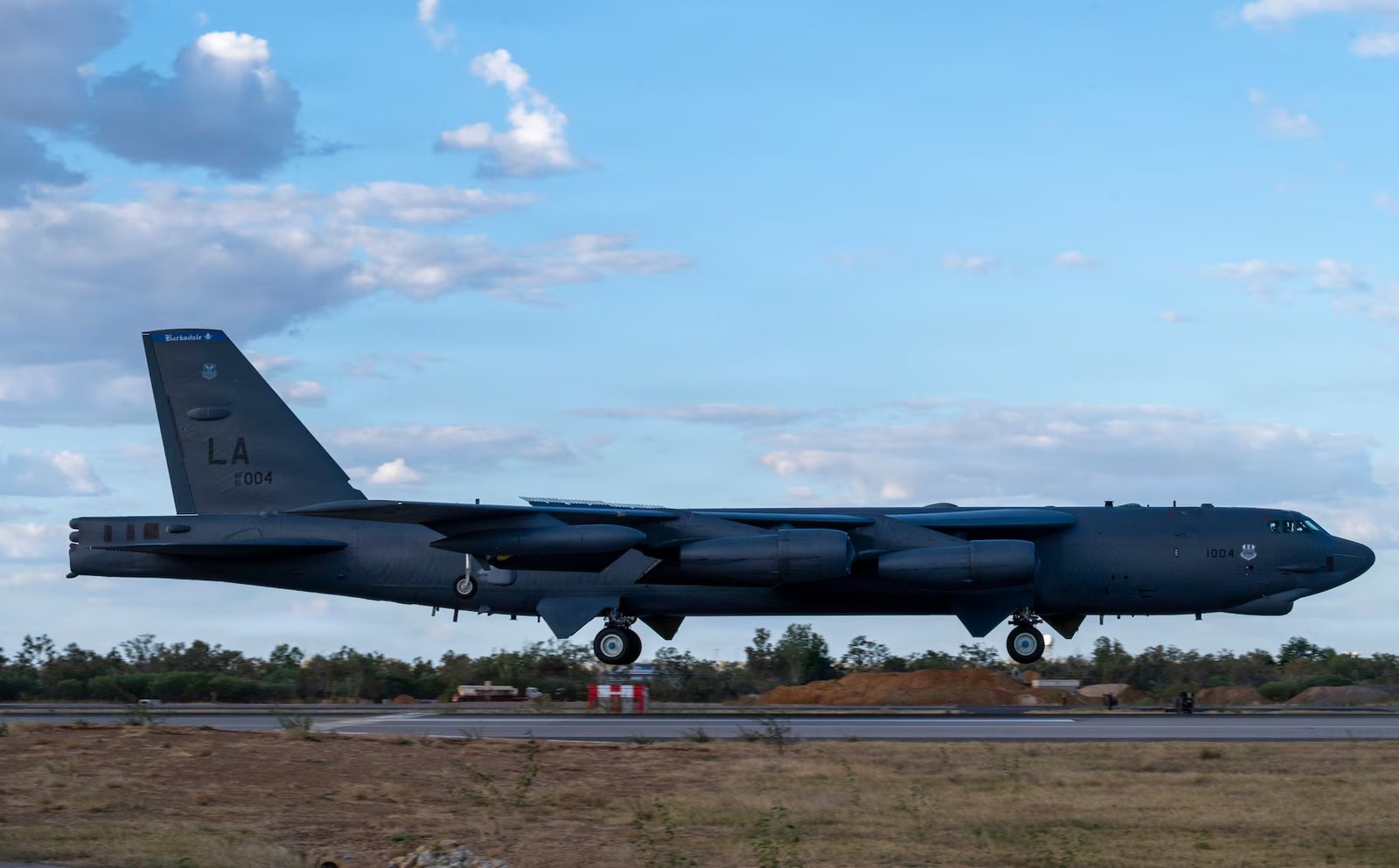
BARKSDALE AIR FORCE BASE, La. — The U.S. Air Force has fielded the IRIS satellite communications prototype on B-52 Stratofortress bombers, providing crews with beyond-line-of-sight connectivity for long-range missions. Air Force Global Strike Command (AFGSC) is evaluating the system as a potential long-term communications solution for the bomber fleet.
Developed by Outerlink Global Solutions, a technology company based in Shreveport, Louisiana, IRIS integrates a satellite communications terminal with aircraft and ground support components. It supports voice, video, and analog and digital aircraft system data, helping crews exchange information over long distances.
The system is intended to replace the Global Iridium Bomber Set (GLIBS), which has been in service since 2017. IRIS also supports the Department of Defense's Joint All-Domain Command and Control (JADC2) concept, which aims to connect data and sensors across military services and operational domains. The system builds on Iridium Certus technology and the Iridium NEXT low-Earth-orbit satellite constellation.
“The ability to communicate reliably across vast distances is foundational to our global operations,” said Maj. Gen. Ty Neuman, commander of 8th Air Force and the Joint-Global Strike Operations Center. He said IRIS helps crews stay connected, share information and execute missions in dynamic and contested environments.
Development and Testing
The program began with an airborne demonstration in June 2022 at Barksdale Air Force Base. During the flight, the 608th Air Operations Center evaluated voice and data transfers, including live video and images.
AFGSC subsequently used an AFWERX Small Business Innovation Research Phase II contract to integrate Outerlink's commercial technology onto the B-52. In 2023, the effort received a $26 million Strategic Funding Increase (STRATFI) contract, the first such contract designated specifically to AFGSC.
The command's Rapid Capabilities and Bomber Requirements divisions adapted the system to the aircraft's physical constraints and modernization needs. The B-52 System Program Office, 307th Bomb Wing and 49th Test and Evaluation Squadron provided engineering expertise and operational feedback.
In March 2026, ground and flight testing assessed reliability and technical maturity. The 608th Air Operations Center and 49th Test and Evaluation Squadron validated end-to-end performance through approved network pathways. Following airworthiness approval by the B-52 System Program Office, multiple IRIS kits had been installed by April 1, 2026. The aircraft were then delivered to the 49th Test and Evaluation Squadron for crew training and operational employment.
“Partnership is what made this possible,” said Maj. Gen. Peter Bonetti, director of AFGSC's Strategic Plans, Programs, and Requirements Directorate, highlighting the cooperation between operators, technical teams and industry.
Prototype Status and Next Steps
Although IRIS is already in operational use, it remains designated as a prototype. Further evaluation will help AFGSC determine its suitability as a permanent beyond-line-of-sight communications solution for the B-52.
The bomber has supported U.S. long-range strike missions and nuclear deterrence for more than 70 years. Modern communications are intended to help it meet current and future operational requirements.
“This is about readiness,” said Jackie Ford, chief of AFGSC's Rapid Capabilities division. She said rapidly delivering capabilities to operators would help keep the B-52 prepared for present and future missions.
——— End of Article ———