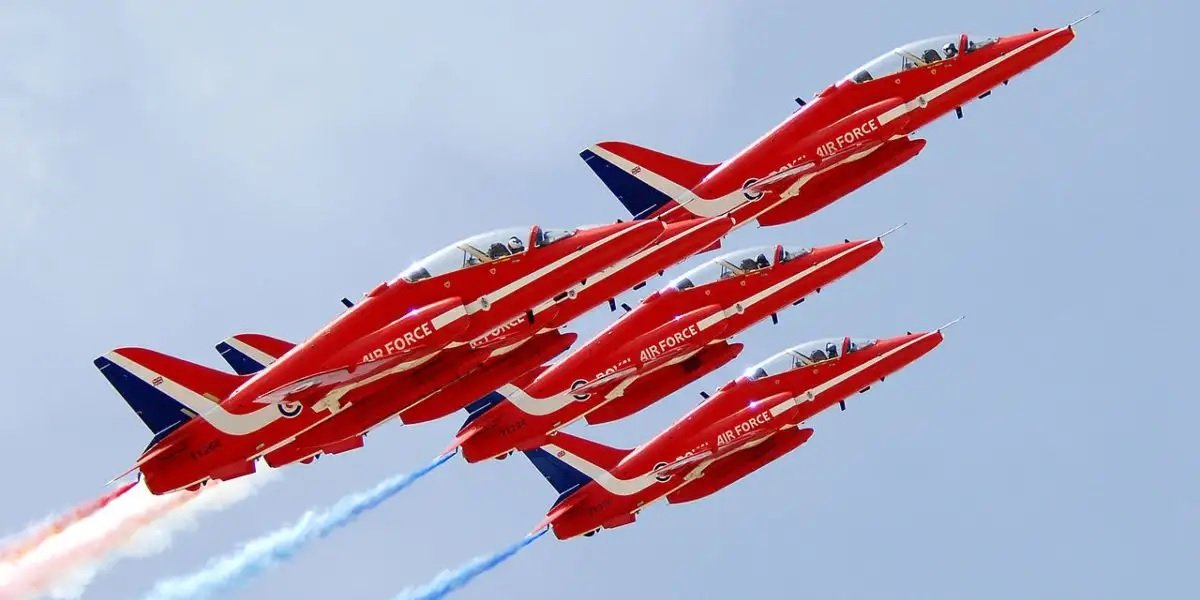
LONDON, UK — The UK Ministry of Defence (MoD) has opened market engagement for a new Jet Training System to replace the ageing Hawk aircraft used by the Royal Air Force’s Red Arrows and support future fast-jet pilot training.
The programme, listed under project code 700004994-RFI, is part of the UK government’s Defence Investment Plan 2026, which commits £360 million to the full recapitalisation of the Jet Training System. The investment includes new aircraft for the Red Arrows and is intended to provide a modernised training capability for UK and international fast-jet training requirements.
The MoD says the new system will also support the transition towards fifth- and sixth-generation air systems and will include a significant UK workshare.
Hawk T1 replacement
The Hawk T1 entered Royal Air Force service in 1976 and has been flown by the Red Arrows since 1979, when the team moved from the Folland Gnat.
The aircraft is now approaching the end of its service life, with the Hawk T1 scheduled to leave UK service in 2030. It is no longer used for the RAF's main advanced fast-jet training role, although the Red Arrows and a small number of other operators have continued to fly the type.
The new programme will provide a replacement aircraft for the Red Arrows while also addressing the wider requirement for a modern fast-jet training system.
Current fast-jet training
Advanced fast-jet training for RAF and Royal Navy pilots is currently conducted using the Hawk T2 at RAF Valley in Wales under the UK Military Flying Training System.
The Hawk T2 has experienced availability problems in the past, which have affected the military flying-training pipeline. The National Audit Office and parliamentary committees have previously examined problems affecting the UK's military flying-training system.
The MoD is now developing the replacement requirement as part of its wider effort to modernise military pilot training.
International competition
The UK no longer has an active Hawk production line. BAE Systems closed the Hawk production line in 2020 after completing its final export orders.
Potential aircraft available on the international market include the Boeing-Saab T-7A Red Hawk, Leonardo M-346 and Korea Aerospace Industries T-50 family. These aircraft are among the established jet-training platforms that could potentially meet elements of the UK's future requirement.
BAE Systems has partnered with Boeing and Saab to promote the T-7 for the UK requirement. Leonardo has also been associated with the competition.
The British company Aeralis, which was developing a modular jet trainer concept, had also been pursuing the requirement. The company entered administration in May 2026 following funding difficulties.
The MoD's requirement for significant UK workshare means industrial participation will be an important part of any future procurement.
Link to future combat aircraft
The replacement training system is being developed as the RAF prepares for future generations of combat aircraft.
The UK is continuing to expand its F-35 capability and is working with Italy and Japan through the Global Combat Air Programme (GCAP), which is intended to deliver a next-generation combat aircraft from 2035.
The Defence Investment Plan also includes funding for Collaborative Combat Aircraft that will operate alongside crewed combat aircraft.
A modern training system will therefore need to prepare pilots for increasingly advanced aircraft and operating concepts.
Procurement process
The current Request for Information is an early market-engagement exercise. It is being used by the MoD to gather information from potential suppliers before the detailed requirement, delivery approach and procurement strategy are finalised.
Interested companies have been asked to provide their details, a point of contact and their areas of interest to the programme team. The deadline for submissions is 11 September 2026.
The MoD has made clear that the exercise is for information gathering only. It is not an invitation to tender and does not represent a commitment to procure a particular aircraft.
The aircraft type, number of aircraft and exact delivery schedule have not yet been confirmed. The programme will determine those details as the procurement process develops.
——— End of Article ———