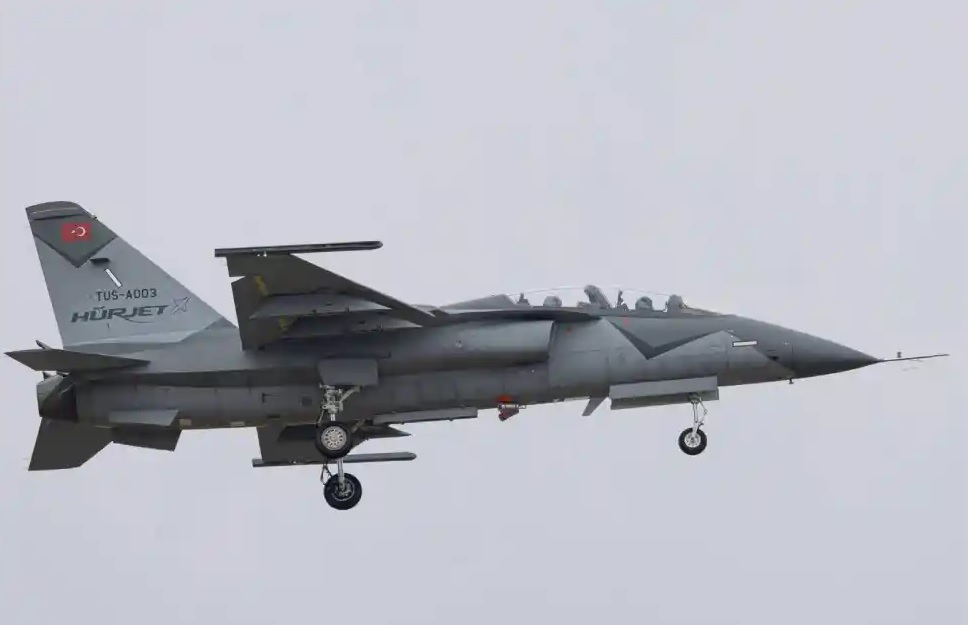
ANKARA, — May 24, 2026 : Turkish Aerospace Industries (TAI) has continued development of its Hürjet advanced jet trainer, with new imagery indicating progress toward an armed light combat configuration after a prototype aircraft was photographed equipped with a full complement of weapon pylons during a recent test flight.
On May 19, 2026, aviation photographer Enes Ötken published images showing the second Hürjet prototype, designated TUS-A003 (PT-2), flying with wingtip and underwing pylons while returning from a test sortie near Turkish Aerospace Industries facilities northwest of Ankara. The aircraft was photographed during landing with its landing gear and speedbrakes extended, reinforcing indications that the flight formed part of ongoing developmental testing of the platform’s combat-oriented configuration.
The sighting follows earlier reports this month that TAI is actively pursuing a light attack variant of the Hürjet aimed at competing in the international market for advanced trainers and lightweight combat aircraft.
Flight Test Configuration and Prototype Details
The aircraft photographed is the second Hürjet prototype and previously debuted a new light and dark gray camouflage scheme in November 2024. The latest imagery revealed an extensive external pylon arrangement, including wingtip pylons intended for within-visual-range air-to-air missiles, four underwing pylons, and one centerline fuselage pylon, representing a full external weapons carriage configuration under evaluation.
Several pieces of flight-test instrumentation were also visible. A pitot tube mounted on the nose was installed for air-data collection, while cameras positioned in a V-pattern behind the landing gear and ahead of the fuselage pylon appeared to monitor structural and aerodynamic behavior during flight. Such systems are commonly used to assess pylon vibration, airflow interaction, and the mechanical impact of external stores on the airframe during testing.
TAI has not publicly issued a statement regarding the exact purpose of the flight or confirmed details surrounding the pylon-equipped configuration observed on TUS-A003.
Weapons Integration and Combat Role
The Hürjet program has entered the serial production phase, with four prototypes currently engaged in flight testing. The armed version of the aircraft is expected to support close air support, armed air policing, and secondary light combat operations alongside its primary training mission.
Industry reporting, including information published by Turkish defense outlets, indicates the combat Hürjet will integrate the domestically developed MURAD family of Active Electronically Scanned Array (AESA) radars. Planned air-to-air armament includes the Gökdoğan beyond-visual-range missile and Bozdoğan within-visual-range missile, both developed to enhance indigenous air combat capability.
Initial production aircraft are expected to remain powered by the U.S.-manufactured General Electric F404-GE-104 turbofan engine, producing approximately 17,700 pounds of thrust with afterburner, allowing speeds of up to Mach 1.4. Over the longer term, future production batches are expected to transition to Turkey’s domestically developed TF-series turbofan engines under development by TUSAŞ Engine Industries (TEI).
Aircraft Specifications and Program Development
The Hürjet is a single-engine, tandem-seat supersonic aircraft developed by TAI to serve both training and light combat missions. The platform incorporates a full-authority digital fly-by-wire flight control system, glass cockpit, head-up display, helmet-mounted display compatibility, night-vision imaging system support, and aerial refueling capability.
The aircraft has a reported service ceiling of 45,000 feet, an operational range of approximately 1,060 nautical miles, and a payload capacity of up to 3,400 kilograms distributed across seven hardpoints. Measuring 13.6 meters in length, with a 9.5-meter wingspan and 4.1-meter height, the Hürjet is intended to provide a modern replacement for aging trainer fleets while maintaining operational flexibility for light combat missions.
Development of the Hürjet program began in 2017, while the first prototype completed its maiden flight on April 25, 2023. The second prototype, TUS-A003, completed its maiden flight on November 12, 2024, before later appearing in an updated camouflage scheme.
Turkish Air Force Modernization and Naval Variant Plans
For the Turkish Air Force (Türk Hava Kuvvetleri), the Hürjet is expected to replace the service’s aging fleet of 68 T-38 Talon advanced jet trainers. Turkey has ordered 12 Hürjet aircraft, which are expected to support pilot training requirements while also providing secondary operational capability for limited combat tasks.
TAI has also officially outlined plans for a carrier-capable Hürjet variant. Unveiled during SAHA EXPO 2026, the naval derivative is being designed for Short Take-Off But Arrested Recovery (STOBAR) operations aboard Turkey’s planned MUGEM aircraft carrier, while retaining future compatibility with Catapult Assisted Take-Off But Arrested Recovery (CATOBAR) systems if operational requirements evolve.
Spain’s SAETA II Export Program
The Hürjet has secured its first international export customer through Spain’s Integrated Combat Training System (ITS-C) program, under which the Spanish Air and Space Force (Ejército del Aire y del Espacio) will acquire 30 aircraft designated as the SAETA II.
The fleet will replace 19 F-5M Freedom Fighter trainers currently operated by Ala 23 (23rd Wing) at Talavera La Real Air Base, supporting pilot transition training for frontline aircraft including the Eurofighter Typhoon and F/A-18 Hornet.
Spain’s procurement places strong emphasis on domestic industrial participation, with approximately 60% of production and systems integration to be handled locally through an Airbus-led consortium. Under the agreement, Airbus will lead certification, aircraft nationalization, and simulator systems, while GMV will contribute mission computers and navigation systems, Sener datalink communications, Aertec and Airtificial fly-by-wire technologies and interface systems, and Indra identification friend-or-foe (IFF) systems.
The rollout of the SAETA II fleet will take place in two phases. Beginning in 2028, Spain will receive 21 baseline aircraft, including one configured as a dedicated test platform for Spanish avionics and mission systems. Ground-based training systems are scheduled to become operational between 2029 and 2030. During the second phase, running from 2031 to 2035, the remaining nine aircraft will be delivered and standardized to the final SAETA II configuration. The total program value is estimated at approximately €2.6 billion.
Market Position
The emergence of weaponized testing on TUS-A003 highlights TAI’s effort to position the Hürjet beyond a conventional trainer platform and into the competitive global market for advanced training and light combat aircraft. The aircraft is expected to compete against platforms including the South Korean KAI T-50 and FA-50, Boeing-Saab T-7A Red Hawk, Leonardo M-346 Master, and Yakovlev Yak-130, as countries increasingly seek cost-effective platforms capable of combining pilot training and limited combat operations within a single airframe.
——— End of Article ———