BENGALURU — May 16, 2026 : Hindustan Aeronautics Limited (HAL) has revised the rollout timeline for the first prototype of the indigenous Light Combat Aircraft (LCA) Tejas Mk2 to March 2027, extending the schedule for one of the Indian Air Force’s (IAF) principal fighter modernisation programmes.
The updated target was disclosed during HAL’s Q4 FY26 earnings call, where company officials confirmed that structural assembly of the aircraft remains underway in coordination with the Aeronautical Development Agency (ADA). The revised schedule places the official rollout toward the end of the 2026–27 financial year.
The Tejas Mk2 programme, also known as the Medium Weight Fighter (MWF), has experienced several timeline revisions over recent years as development activities continue across multiple agencies involved in the project.
Programme Delays Linked to Integration and Technical Coordination
Earlier expectations within the programme had indicated that an unofficial rollout could have already taken place, while the maiden flight was at one stage expected as early as the coming months. However, HAL officials stated that additional work related to structural integration, systems validation, and inter-agency coordination remains ongoing.
The Tejas Mk2 is being jointly developed by HAL and ADA under the broader supervision of the Defence Research and Development Organisation (DRDO). Officials familiar with the programme stated that the aircraft’s development depends heavily on continuous coordination between the participating organisations for subsystem approvals, testing milestones, and technical clearances.
Defence analysts noted that the revised rollout schedule is primarily tied to the integration of the General Electric F414-INS6 engine, which has been selected as the powerplant for the aircraft. The engine produces approximately 98 kN of thrust with afterburner and represents a substantial increase in capability compared to the GE F404 engines used on the Tejas Mk1 and Mk1A variants.
HAL management described the GE F414 programme as the larger milestone for the overall project, stating that the rollout and maiden flight are secondary to successful engine integration, testing, and certification activities.
Technical discussions between HAL and GE Aerospace regarding licensed production and technology transfer for the F414 engine have reportedly concluded, while the final agreement remains under finalisation. Eight engines have already been delivered for development and testing purposes.
Multiple Timeline Revisions Since Initial Approval
The Tejas Mk2 programme has undergone several schedule adjustments since its early development phase.
Initial projections had targeted prototype rollout by August 2022. The schedule was later revised to the end of 2022 and subsequently shifted again into 2023. Following approval from the Cabinet Committee on Security (CCS) in September 2022, updated estimates projected rollout by late 2025 or early 2026.
In early 2026, the Defence Research and Development Organisation estimated that the aircraft’s maiden flight could occur between June and July 2026. The latest revision now places the rollout target in March 2027, delaying the expected first flight beyond earlier projections.
The CCS approved the programme with a sanctioned cost of approximately ₹10,000 crore, covering prototype development, testing, certification, and associated programme activities.
Designed as a Medium-Weight Multirole Fighter
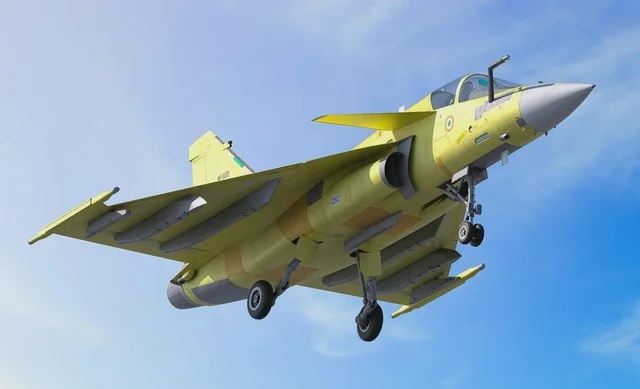
The Tejas Mk2 is being developed as a 4.5-generation multirole combat aircraft intended to bridge the capability gap between the lighter Tejas Mk1A and India’s future Advanced Medium Combat Aircraft (AMCA).
The aircraft is expected to replace several aging IAF fleets, including the Jaguar DARIN III, MiG-29UPG, and Mirage 2000 aircraft currently in service.
Compared to the Tejas Mk1A, the Mk2 incorporates a larger and redesigned airframe with improved aerodynamic characteristics. The aircraft features close-coupled canards positioned near the cockpit section to enhance manoeuvrability, stability, and overall flight performance.
The fighter will have a maximum take-off weight of approximately 17.5 tonnes, compared to 13.5 tonnes for the Mk1A. Payload capacity has also been significantly increased, allowing the aircraft to carry up to 6.5 tonnes of weapons and external stores across 11 hardpoints, compared to 3.5 tonnes across seven hardpoints on earlier Tejas variants.
Advanced Indigenous Systems and Extended Combat Capability
The Tejas Mk2 is planned to incorporate several indigenous systems and avionics upgrades aimed at improving survivability and network-centric combat capability.
The aircraft will be equipped with the indigenous Uttam Active Electronically Scanned Array (AESA) radar and an indigenous electronic warfare suite. Additional avionics improvements include sensor fusion capability, advanced cockpit displays, enhanced mission systems, and compatibility with a wider range of precision-guided munitions and beyond-visual-range air-to-air missiles.
The redesigned airframe also provides greater internal fuel capacity, extending operational endurance and combat reach. The aircraft is expected to achieve a combat range of approximately 1,200 kilometres, extendable to nearly 3,000 kilometres with external fuel tanks and aerial refuelling support.
Prototype and Testing Plan
Development of the Tejas Mk2 is being carried out jointly by DRDO, ADA, and HAL. The programme currently plans for four prototypes during the development phase.
According to programme details, two prototypes will be dedicated to flight testing activities, while the remaining two aircraft will focus on weapons integration and systems evaluation.
Following rollout, the aircraft will undergo ground testing, taxi trials, systems validation, and certification procedures overseen by the Centre for Military Airworthiness and Certification (CEMILAC). Flight testing will proceed only after successful completion of these stages.
Indian Air Force Requirement
The Indian Air Force has indicated an initial requirement for 120 Tejas Mk2 aircraft, although long-term production numbers could eventually exceed 200 fighters depending on future squadron requirements and procurement plans.
The aircraft is intended to support the IAF’s long-term effort to restore squadron strength while increasing the proportion of domestically developed combat platforms within the force structure.
Serial production and induction schedules will ultimately depend on the successful completion of development, engine integration, certification, and flight testing activities over the coming years.
——— End of Article ———