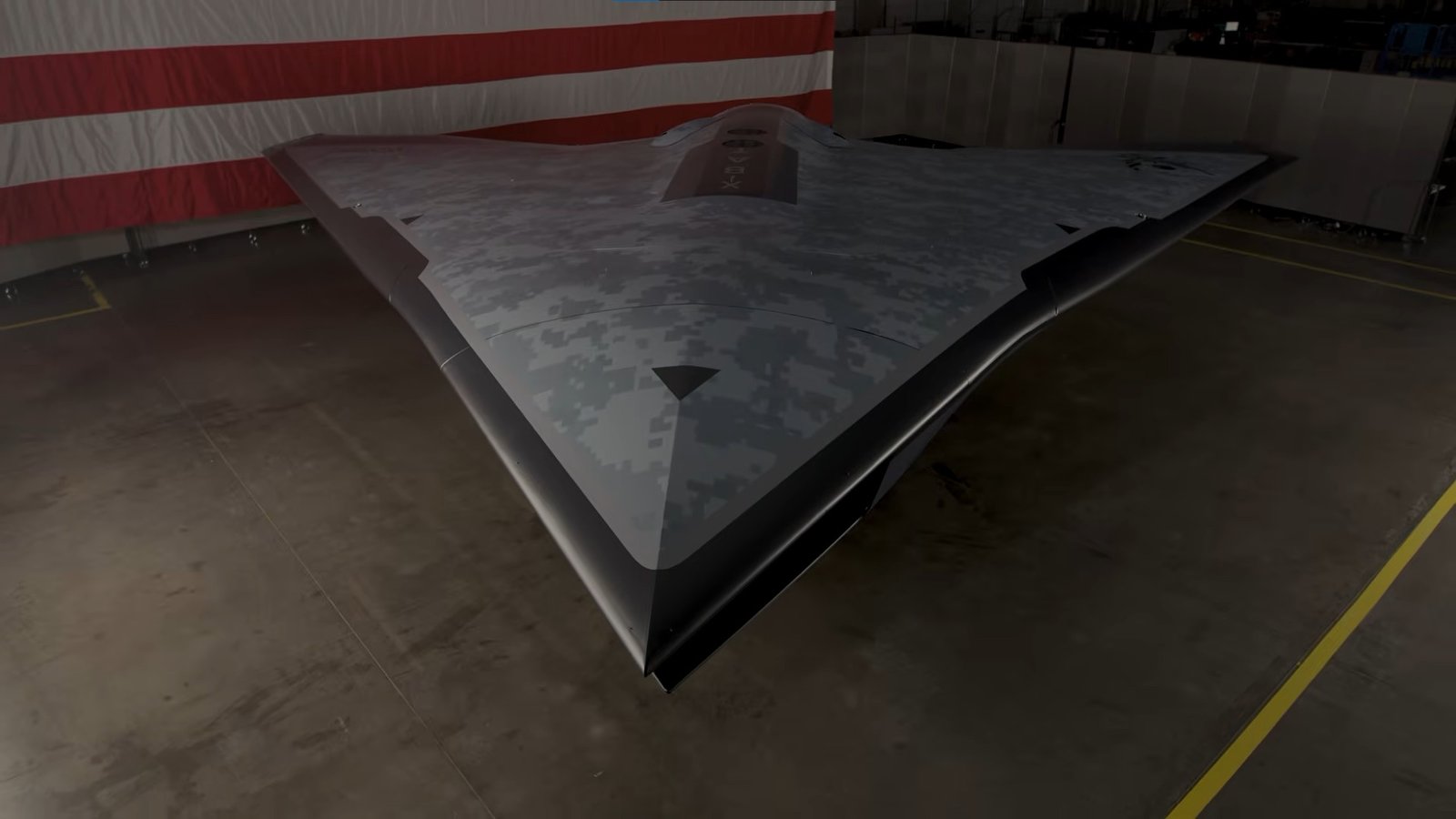
NEWTON, Kansas, — U.S. defense technology company Shield AI has unveiled its first full-scale X-BAT 001 prototype, a jet-powered autonomous combat aircraft designed for vertical take-off and landing (VTOL). The company released its images and video on November 3, marking a major step towards flight testing.
X-BAT 001 is the first of two planned prototypes. Built at Shield AI's facility in Frisco, Texas, the aircraft is now being moved to the company's X-Forge 2 flight test facility at Newton City-County Airport, Kansas. It uses a tailless, tail-sitter design, allowing it to take off and land vertically on its tail without conventional runways.
Design and Engine
The prototype retains the design shown at the Sea-Air-Space exhibition in April 2026, but features some changes. Its thrust-vectoring exhaust nozzle now extends beyond the wing's trailing edge. Two raised structures with air intakes and additional circular, mesh-covered openings are also visible on the upper fuselage. Their exact functions remain unconfirmed.
The aircraft is powered by a GE Aerospace F110-GE-129E turbofan engine, integrated with the Axisymmetric Vectoring Exhaust Nozzle (AVEN). Shield AI and GE Aerospace completed initial integration and ground tests in July 2026. The nozzle controls pitch and yaw, while separate wing-mounted bleed-air thrusters control roll.
Range, Weapons and Autonomy
According to manufacturer targets, X-BAT will have a 39-foot wingspan, a range exceeding 2,000 nautical miles (3,700 km) and a service ceiling above 50,000 feet (15 km). It is designed to withstand manoeuvring loads exceeding 4g.
Its internal weapons bays will accommodate air-to-air and air-to-surface missiles, including weapons in the 2,000-pound class. External hardpoints will support additional strike weapons and electronic warfare equipment.
The aircraft will operate using Shield AI's Hivemind autonomy software, designed to execute missions without GPS, active communications or continuous remote human input.
X-BAT can operate from ships, mobile ground platforms and remote locations without conventional runways. Shield AI says three aircraft can fit within the deck space occupied by one traditional fighter. A skull insignia on the prototype's left wing represents all four branches of the U.S. military.
$400 Million Programme and Production Timeline
Development is supported by the U.S. Navy's Runway Independent Maritime Expeditionary Strike (RIMES) programme, which focuses on long-range strike aircraft that do not depend on conventional airfields. Combined government and private funding has reached $400 million, including earlier Navy and Defense Innovation Unit support and a subsequent Navy funding modification, matched by Shield AI.
In October 2026, Shield AI signed an agreement with Greece's GEK TERNA to establish industrial facilities for parts production, aircraft integration, maintenance and training. The initiative aims to make Greece a regional support hub for X-BAT across Southeastern Europe.
Flight testing is planned before the end of 2026, followed by a mission-capable version targeted for 2028. Serial production is expected to begin in 2029 at Des Moines, Washington. Newton, Kansas, will serve as the primary flight-testing and sustainment centre.
Shield AI has clarified that X-BAT 001 remains an experimental aircraft, and its design will continue to evolve during testing.
——— End of Article ———