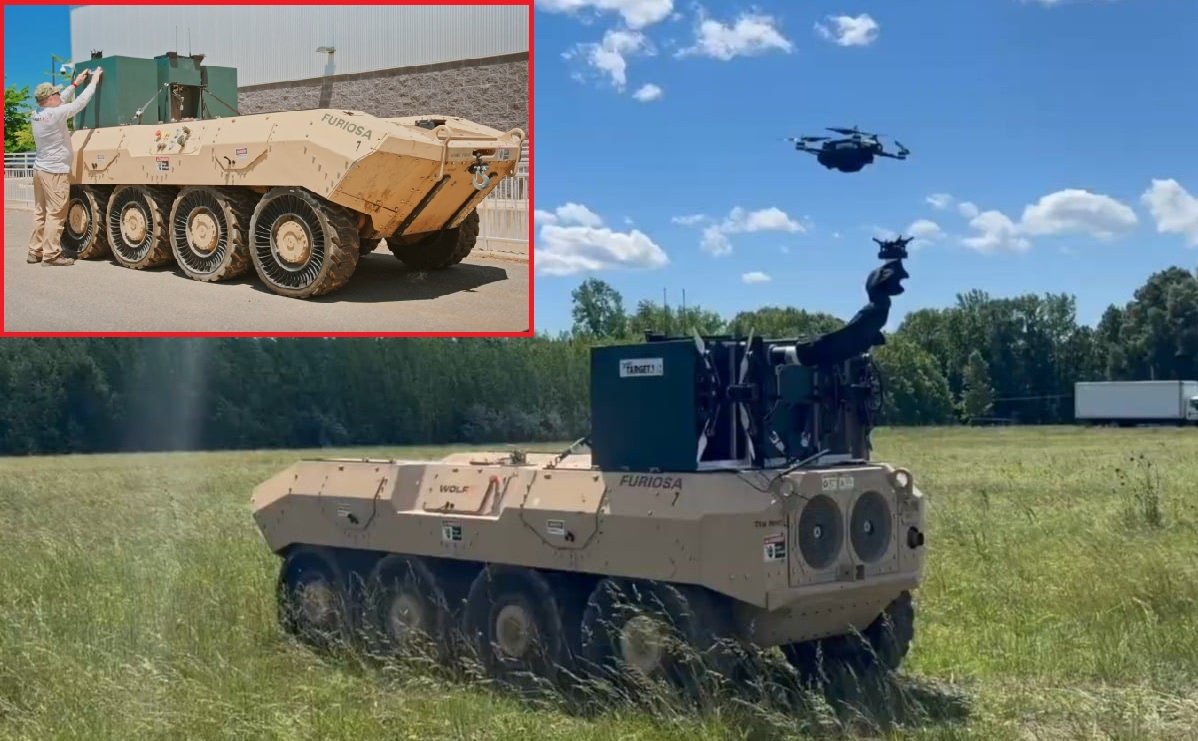
RIDGEFIELD, Connecticut — Robotics and autonomy company Target Arm Inc. has integrated its Ralar 2 autonomous drone launch and recovery system with unmanned ground vehicles (UGVs) developed by HDT Global, creating what the company describes as an autonomous mobile drone base. The integration was announced on July 27, 2026, through the company's social media channels.
The integration combines Target Arm's Ralar 2 technology with HDT Global's Hunter WOLF and WOLF-X unmanned ground vehicle platforms. The system enables certified drones to launch, land, recharge, and relaunch while the host vehicle remains in motion, eliminating the need to stop the vehicle or rely on a human operator to manually manage drone operations in the field.
Drone Operations Without Stopping the Vehicle
Traditional drone operations typically require a vehicle, ship, or other host platform to remain stationary during takeoff and landing. This process often requires human involvement and can slow operations while increasing risk in situations where stopping a vehicle may expose it to potential threats or interrupt time-sensitive missions.
According to Target Arm, its Ralar (Robotic Arm Launch and Recovery) technology is designed to remove this limitation. Using AI-assisted software, a precision sensor engine, and a robotic arm, the Ralar 2 system can recover drones directly from the air while the host platform is moving. After recovery, the drone is placed into an automated magazine that can hold up to 10 aircraft, where batteries are recharged before the drone is prepared for another mission. The entire process is designed to operate autonomously.
Target Arm states that both its Ralar 1 and Ralar 2 systems are designed to support autonomous drone launch, recovery, recharging, and relaunch operations from moving platforms operating on land, at sea, or in the air. The systems can be installed on cars, trucks, all-terrain vehicles, unmanned ground vehicles, boats, ships, and aircraft.
Integrated with Hunter WOLF and WOLF-X
The Ralar 2 system has been integrated with two of HDT Global's unmanned ground vehicle platforms: the Hunter WOLF and the WOLF-X.
The Hunter WOLF (Wheeled Offload Logistics Follower) is a rugged 6×6 unmanned ground vehicle used in military and industrial applications. It is capable of carrying payloads of up to 2,800 pounds across difficult terrain, including steep slopes, narrow trails, and dense vegetation. The platform uses a hybrid diesel-electric drivetrain and can provide up to 15 kilowatts of electrical power while supporting logistics, reconnaissance, and other missions.
The WOLF-X is an 8×8 wheeled robotic combat vehicle equipped with a hybrid powertrain, advanced suspension, and airless tires. The platform is designed for mobility in demanding environments and can also accommodate modular mission payloads.
According to Target Arm, integrating the Ralar 2 system with these platforms allows a single unmanned ground vehicle to support unmanned aerial operations without requiring a separate team to launch or recover drones.
Field Demonstration Showcases the System
Video released with the announcement shows the integrated system during a recent field demonstration. The footage features a technician inspecting equipment mounted on a tan-colored unmanned ground vehicle marked "FURIOSA."
The compact platform is equipped with multiple sensor and camera housings and is designed to travel across rough terrain without an onboard human operator. Roughly the size of a small all-terrain vehicle, the platform is intended for environments where human access may be difficult or impractical.
Applications Beyond Military Operations
While unmanned ground vehicles such as the Hunter WOLF are widely used for transporting equipment, reconnaissance, and carrying sensor payloads, the addition of autonomous drone launch and recovery expands their operational capability.
Target Arm says the technology has applications beyond defense. The company identifies several potential uses, including search and rescue operations, logistics and package delivery, maritime operations involving moving boats or ships, and protection of critical infrastructure such as power plants, pipelines, and water systems.
The company states that the ability to continuously launch, recover, recharge, and redeploy drones from a moving platform could support operations that require persistent aerial coverage without interrupting the movement of the host vehicle.
Previous U.S. Army Collaboration
In June 2026, Target Arm announced a multi-year Cooperative Research and Development Agreement (CRADA) with the U.S. Army Combat Capabilities Development Command Ground Vehicle Systems Center. The agreement is focused on demonstrating the Ralar system as a modular mission payload for U.S. Army ground platforms.
Target Arm is a service-disabled veteran-owned small business headquartered in Ridgefield, Connecticut. The company was founded by CEO Jeffrey A. McChesney and develops autonomous launch and recovery technologies for unmanned systems.
The integration of the Ralar 2 system with HDT Global's Hunter WOLF and WOLF-X platforms represents another step toward combining unmanned ground and aerial systems into a single autonomous platform capable of conducting drone operations while remaining in motion.
——— End of Article ———