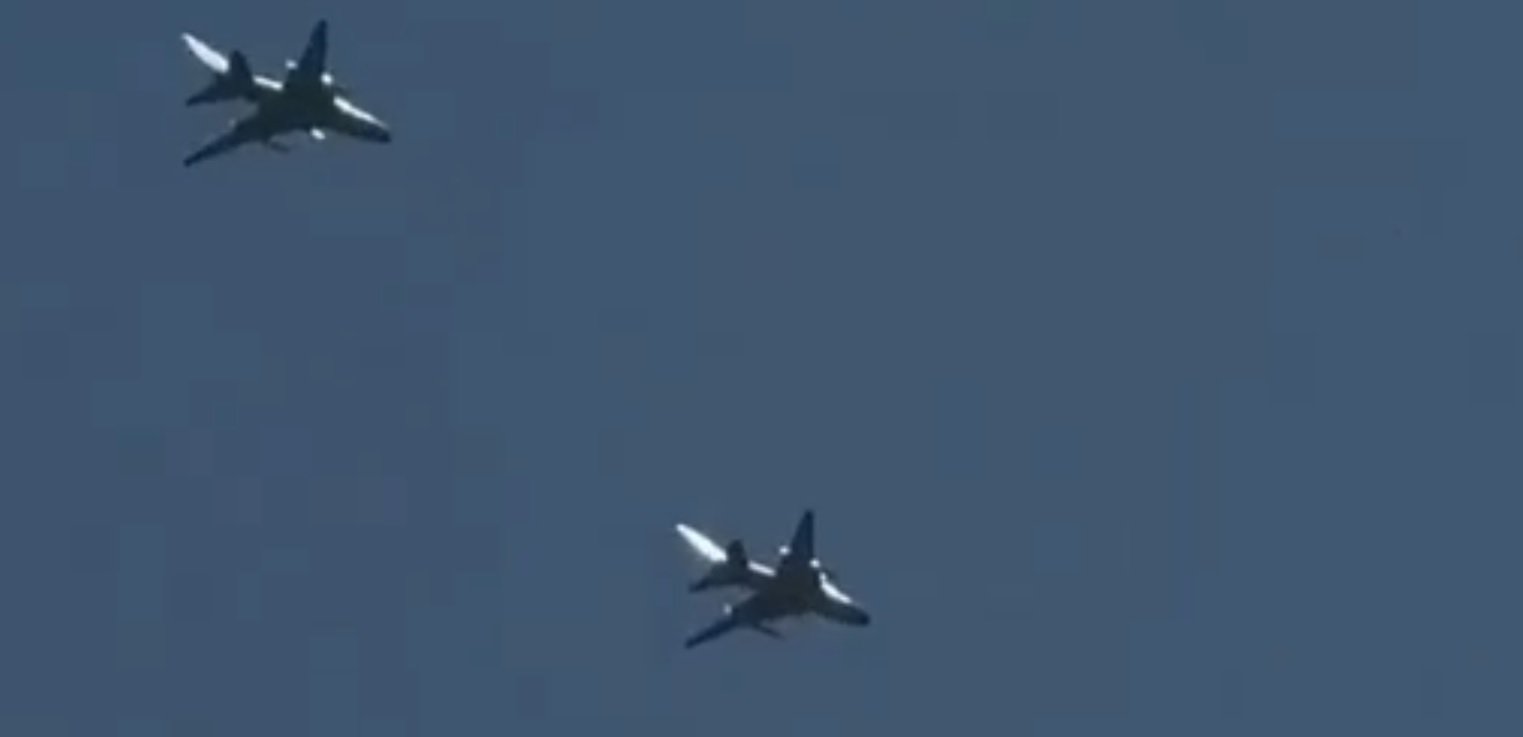
NORTHERN SYRIA — The Syrian Air Force has resumed training flights with at least two Su-22 fighter-bombers as the country’s new government continues efforts to rebuild its aviation capabilities following the fall of Bashar al-Assad’s government in December 2024.
Video footage analyzed by aviation analyst Hassan shows two Su-22M3/M4 aircraft flying over northern Syria. The aircraft are export versions of the Soviet Su-17 fighter-bomber. Reports have identified the flights as part of renewed training activity involving Syrian fixed-wing combat aircraft.
The exact number of Su-22s that are currently airworthy remains unclear. According to The Military Balance, Syria had 20 Su-22M3/M4 aircraft in its inventory in 2024, before the change of government.
طائرات سوخوي سورية تجري طلعات تدريبية فوق سماء عدة محافظات سورية. pic.twitter.com/JqYwI2urOB
— مُضَر | Modar (@ivarmm) August 10, 2026
Syria Begins Rebuilding Its Air Force
Most of the aircraft left behind after the fall of the Assad government were reportedly found in storage and were not considered ready for flight. The new government has not disclosed the exact number or types of aircraft that have been preserved and returned to service.
The rebuilding effort began soon after the political transition. In December 2024, rebel forces seized several SA342 Gazelle helicopters equipped with anti-tank missiles at Mezzeh Air Base in Damascus.
In January 2025, former rebels from Hayat Tahrir al-Sham began organizing aviation units for training and territorial patrols. By March, the new government’s forces had used Mi-24 attack helicopters in combat against remaining pro-Assad forces.
The new authorities also returned the Su-22 to the air. On September 7, 2025, an Su-22 was flown from Shayrat Air Base, marking the first reported flight of the type by the new Syrian government.
The latest flights over northern Syria therefore follow earlier efforts to restore a limited fixed-wing capability.
Training Expansion
The renewed Su-22 activity comes after the graduation of 1,000 cadets from the Syrian Air Force College on July 26. They were the first class trained entirely under the new administration.
The graduation ceremony was held at Khalid bin al-Walid Air Base, formerly known as Kuweires, east of Aleppo. L-39 trainer aircraft and Mi-24 helicopters took part in ceremonial flyovers.
Reports from Israeli sources have also described an accelerated effort by Syria to rebuild its air power, including recruitment of pilots and training involving trainer aircraft, helicopters and fighter aircraft.
The recent Su-22 flights reportedly took place over northern Syrian provinces, including Idlib. Reports identified the pilots as Abdullah al-Obeido from Kafr Nabl and Ibrahim al-Khalid from Maarat al-Numan, although independent confirmation of their identities was not available in the sources reviewed.
Five Decades of Su-22 Operations in Syria
Syria has operated the Su-22 family for decades. The country received its first 15 Su-20 aircraft, an earlier export version of the Su-17, from the Soviet Union in 1973. Eight were lost during that year's war with Israel.
The Soviet Union later supplied additional aircraft. Syria received Su-22M-3s in 1983 and at least 42 Su-22M-4Ks between 1984 and 1985. Syrian industry also upgraded the remaining older Su-22Ms to the Su-22M-2K standard.
In 2010, Syria allocated funding for a gradual modernization program. At that time, the fleet consisted of seven Su-22M-2s, 12 Su-22M-3s, 24 Su-22M-4Ks, five Su-22UM-2Ks and four to five Su-22UM-4Ks, giving an estimated total of 52–53 aircraft.
The fleet suffered substantial losses during the Syrian civil war. The first confirmed Su-22 loss occurred on February 14, 2013, when rebels shot down an aircraft using a man-portable air-defense system.
Several aircraft underwent major overhauls in 2014, but by mid-2015 only about a dozen Su-22s were reported to remain fully combat-ready. The prolonged combat operations had also depleted bomb stocks and spare external fuel tanks.
By mid-2016, around 30 Su-22s of different variants remained, distributed among three squadrons at Tiyas, Shayrat and Dmeir air bases.
Further losses followed. On July 24, 2018, Israel said it had shot down a Syrian Sukhoi fighter after it entered Israeli airspace. Israel said two Patriot missiles were fired; Syrian authorities disputed the claim that the aircraft had entered Israeli airspace. The aircraft was identified by Syrian sources as a Su-22.
In August 2019, Syrian opposition groups reported shooting down another Syrian Su-22 over the Idlib area.
Russia-Syria Agreement Covers Hmeimim and Tartus
The rebuilding of Syria's military aviation is also taking place alongside a new agreement with Russia.
On August 9, Syria and Russia signed a memorandum of understanding concerning the future of Russia's military presence at Hmeimim Air Base near Latakia and the naval facility at Tartus. The agreement followed 18 months of negotiations.
Under the agreement, Syria will take over management of civilian facilities, including Hmeimim Airport and the commercial section of Tartus Port. Military facilities are to be transformed into joint training and qualification centres, with the transition scheduled to be completed within three months. Russian forces are expected to remain at the new training facilities, although the number of personnel has not been specified.
The latest Su-22 flights are therefore part of a broader process in which the new Syrian government is rebuilding its military aviation structure, training personnel and attempting to return some surviving aircraft to operational use.
However, the number of Su-22s currently capable of sustained operations remains unknown, and the available evidence does not establish the size of the restored fleet. The recent flights demonstrate that at least a small number of the aircraft have returned to the air, but they do not by themselves establish the overall readiness of Syria's rebuilt air force.
Source : militarnyi
——— End of Article ———