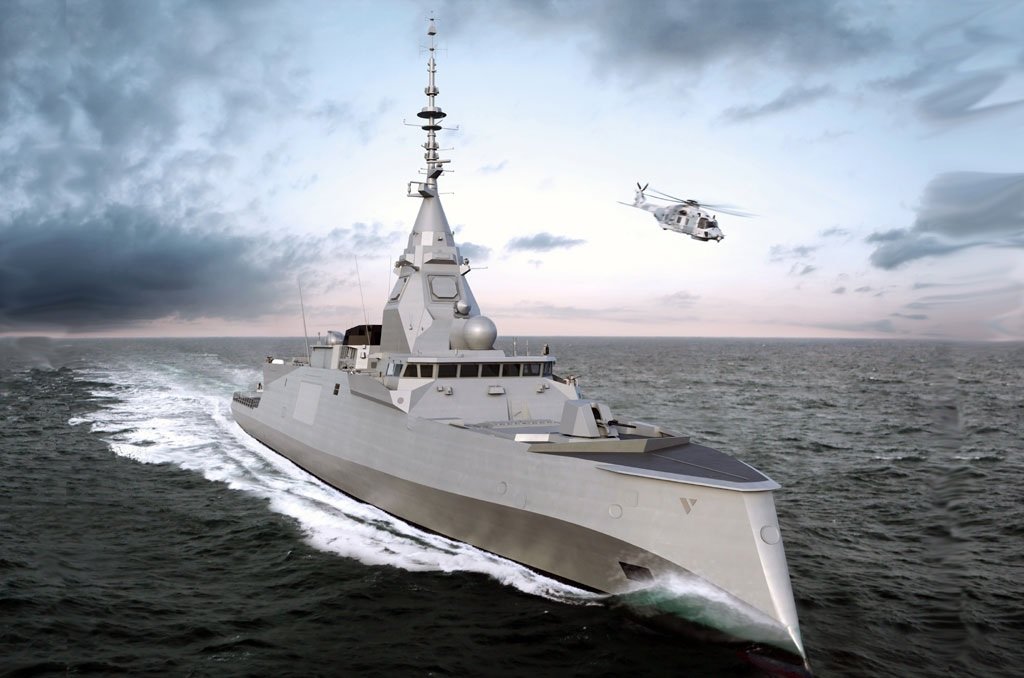
STOCKHOLM — Sweden and France have signed a €4.3 billion contract for four French Defense and Intervention Frigates (FDI) for the Royal Swedish Navy, with the ships to enter Swedish service as the Luleå class. The agreement was signed in Stockholm on August 31, 2026, during French President Emmanuel Macron’s visit to Sweden.
The contract was signed by Mikael Granholm, Director-General of the Swedish Defence Materiel Administration (FMV), and Pierre Éric Pommellet, Chairman and CEO of Naval Group. The ceremony was held aboard the French Navy’s first FDI frigate, Amiral Ronarc’h, and was attended by Macron and Swedish Prime Minister Ulf Kristersson.
The deal follows Sweden’s decision in May 2026 to begin negotiations with Naval Group for four FDI-based frigates. Sweden had selected the French design for its Luleå-class programme, with deliveries planned between 2030 and 2034.
First frigate due in 2030
Naval Group will build the frigates in France, with the first vessel scheduled for delivery in 2030. The four ships will be delivered under the following schedule:
- HMS Luleå — 2030
- HMS Norrköping — 2032
- HMS Trelleborg — 2033
- HMS Halmstad — 2034
FMV said production of the ships and training of Swedish personnel can begin following the signing of the contract. Naval Group will serve as the main system integrator, with the vessels delivered ready for service.
Focus on air defense and anti-submarine warfare
The Swedish frigates will be configured primarily around air defense and anti-submarine warfare. The Swedish government said the ships will also provide Sweden with the ability to establish sea control, protect maritime transport and keep sea routes open.
The ships will use Aster 30 and CAMM-ER surface-to-air missiles. Swedish systems will also be integrated into the vessels, including the RBS15 anti-ship missile, Torpedo 47, Giraffe 1X radar, Trackfire remote weapon stations, and 57 mm and 40 mm naval guns. FMV confirmed the Swedish equipment included in the configuration.
The combination gives the Luleå-class a mix of air-defense, anti-submarine and surface-warfare capabilities while allowing Sweden to incorporate several systems already used by its armed forces.
Larger role for the Swedish Navy
The acquisition is part of Sweden’s broader effort to strengthen its naval capabilities following its accession to NATO.
The Swedish government said the frigates will strengthen Sweden’s ability to defend and exercise control over its territory while improving interoperability with NATO allies during international operations. Air defense is a particular priority, with Defence Minister Pål Jonson stating that the four frigates will triple Sweden’s current air-defense capability at sea.
The ships are intended to operate in the Baltic Sea and other surrounding waters, supporting maritime security and the protection of sea routes.
Wider Sweden-France defense cooperation
The frigate contract was accompanied by a separate framework agreement between the Swedish and French defense ministries.
Swedish Defence Minister Pål Jonson and French Minister of the Armed Forces and Veterans Affairs Catherine Vautrin signed the agreement, which is intended to establish a long-term platform for cooperation in operational matters, defense equipment and industrial development.
The procurement therefore extends beyond the four ships, creating a broader framework for Swedish-French defense cooperation.
A major addition to Sweden’s fleet
The Luleå-class will represent a substantial addition to Sweden’s surface fleet. Based on France’s FDI design, the frigates will be configured specifically for Swedish requirements and will combine French and Swedish defense systems.
The first ship, HMS Luleå, is scheduled to be delivered in 2030, with the remaining three frigates following through 2034. Once delivered, the four vessels will become an important part of Sweden’s naval contribution to national defense and NATO maritime operations.
——— End of Article ———