MADRID — The Spanish Navy has signed a framework agreement with European missile manufacturer MBDA to acquire three SIMBAD-RC short-range air defense systems, introducing a dedicated close-range missile defense capability for its operational fleet.
The agreement is MBDA's first direct contract with the Spanish Navy and supports plans by Spain's Ministry of Defense and the Navy to strengthen protection against anti-ship missiles, sea-skimming missiles, aircraft and unmanned aerial vehicles.
Initial deployment across frontline vessels
The framework agreement covers three SIMBAD-RC systems with a total of four launchers.
Under the initial deployment plan:
- Two Santa María-class (F80) frigates will each receive a single SIMBAD-RC launcher.
- The amphibious assault ship Juan Carlos I (L-61) will receive a twin-launcher configuration.
The deployment gives both escort vessels and the Navy's flagship an organic short-range air defense layer designed to protect high-value ships during operations.
SIMBAD-RC provides dedicated VSHORAD capability
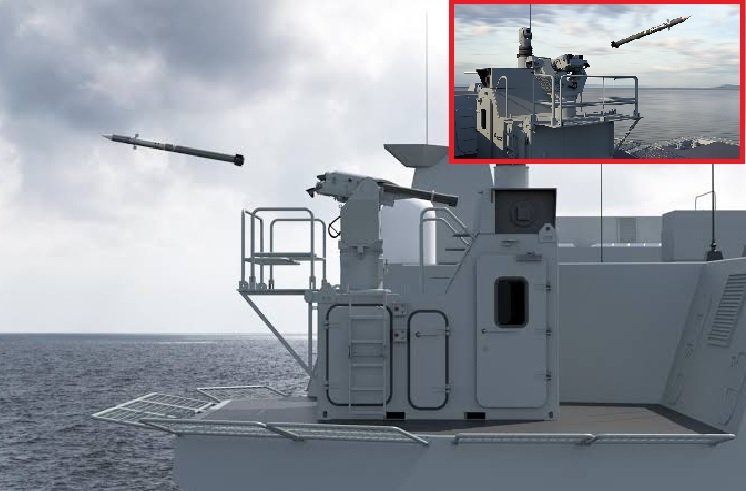
The SIMBAD-RC is a remotely controlled naval self-defense system built around MBDA's Mistral 3 infrared-guided missile. It can serve as a ship's primary very short-range air defense system or operate alongside existing defensive weapons.
The system launches fire-and-forget missiles with a range of more than 8 kilometers. Its automated turret includes a thermal optical sensor suite and a video tracker, allowing targets to be engaged either independently or through connection with a ship's combat management system.
The launcher can also be operated by a single crew member from a protected position below deck using the compact SMU-RC control terminal. MBDA says the system is designed for continuous all-weather operations.
MBDA calls agreement a historic milestone
MBDA Chief Executive Officer Eric Béranger described the agreement as an important step in the company's partnership with Spain.
"This first direct agreement with the Spanish Navy is a historic milestone for MBDA. It demonstrates our growing footprint and long-term commitment to Spain. By delivering critical defense capabilities, we are enhancing fleet security and building a strategic partnership based on innovation and cooperation with the Spanish defense industry," Béranger said.
Wider integration under discussion
The framework agreement is expected to serve as the first phase of a broader fleet modernization effort.
MBDA is currently negotiating with Spanish shipbuilder Navantia to expand SIMBAD-RC integration across additional surface combatants. Platforms under consideration include future Landing Platform Docks (LPDs), European Patrol Corvette (EPC) vessels and potentially the Navy's new F-110 frigates.
Technical discussions continue on how the system would integrate with the combat management architecture of future ships, including the Aegis system planned for the F-110 class.
From Cartago project to operational deployment
Spanish efforts to introduce the Mistral missile family into naval service began nearly a decade ago through the Cartago project, which examined the feasibility of installing Mistral missiles on active naval platforms.
The current contract marks the transition from concept to operational capability by equipping frontline ships with dedicated close-range missile defense.
RC2 today, modular upgrades for the future
The Spanish Navy's order covers the SIMBAD RC2 twin-tube configuration. MBDA has continued developing the system to address evolving threats.
At Euronaval 2024, the company introduced the SIMBAD RC4, a four-round variant designed to counter saturation attacks, fast inshore attack craft and drone swarms. In 2026, MBDA updated the turret architecture so the RC2 and RC4 share a common modular design, allowing existing twin-tube installations to be upgraded more easily to the higher-capacity quad-tube configuration if required.
For the Spanish Navy, the agreement delivers a dedicated very short-range air defense capability for key surface ships while establishing the foundation for broader integration across the fleet in the years ahead.
——— End of Article ———