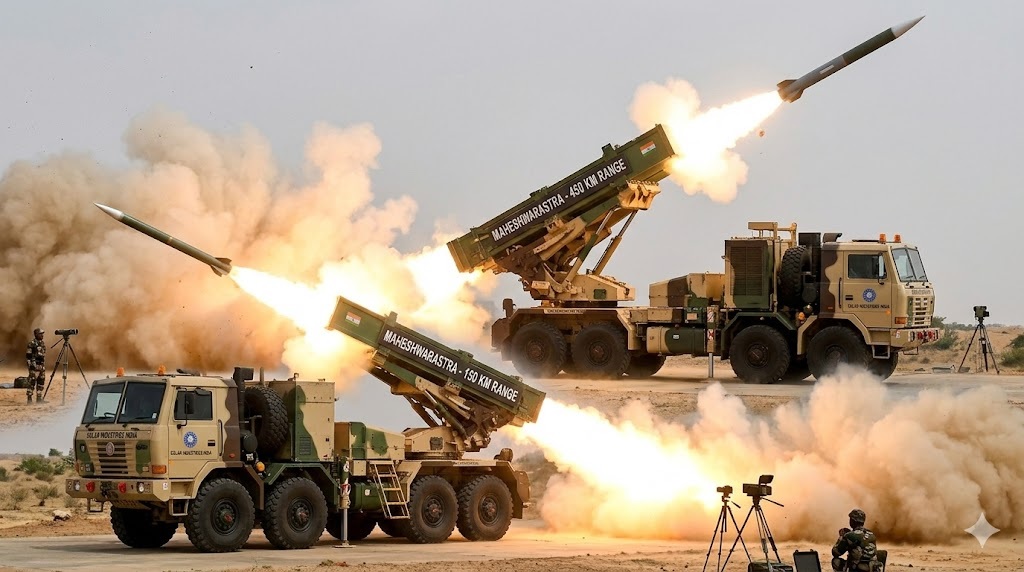
NAGPUR — Solar Industries India Limited is awaiting approval from the Indian Army for its proposed Maheshwarastra long-range precision-guided rocket programme, an indigenous initiative submitted under the Ministry of Defence’s Make-II acquisition framework. The programme is aimed at providing the Army with a cost-effective precision strike capability while supporting India’s ongoing push for self-reliance in advanced defence technologies.
If approved, the Maheshwarastra programme would add a new category of indigenous long-range guided rocket systems to India’s expanding precision strike arsenal and strengthen the role of private sector firms in defence manufacturing.
Maheshwarastra Programme and Proposed Capabilities
Solar Industries has proposed the Maheshwarastra family as a high-mobility, precision-guided rocket system capable of conducting long-range strikes against battlefield and operational targets.
The programme will initially include two variants.
The Maheshwarastra-1 is proposed to deliver precision strikes at a range of approximately 150 kilometres, providing a medium-to-long-range engagement capability for tactical and operational missions.
The Maheshwarastra-2 is being designed as a longer-range precision strike system with a planned baseline range of approximately 300 kilometres. According to Solar Industries, the system has been designed with future growth potential and can be adapted to meet evolving operational requirements.
The company has indicated that if the Indian Army requires extended strike capability, the Maheshwarastra-2 platform could potentially achieve a range between 400 and 450 kilometres. Such an expansion would place it among the longest-range precision-guided rocket systems currently under development in India.
Complementary Role Alongside BrahMos
Solar Industries has positioned Maheshwarastra as a complementary capability rather than a replacement for existing strategic strike platforms.
The system is expected to operate alongside the BrahMos supersonic cruise missile by offering a comparatively lower-cost precision strike option for a wider set of operational scenarios. While BrahMos is primarily intended for high-value strategic targets requiring high-speed engagement, Maheshwarastra is designed to provide precision strike capability against broader battlefield objectives at lower operational cost.
This approach could provide the Indian military with greater flexibility in employing long-range precision strikes in larger numbers across multiple tactical environments.
India’s Expanding Long-Range Strike Capability
The proposal comes as India continues to expand indigenous long-range artillery and stand-off precision strike capabilities.
Alongside the Guided Pinaka programme, the Defence Research and Development Organisation (DRDO) is also working on Extended Range Pinaka variants and other long-range indigenous systems aimed at increasing strike range, accuracy, and operational flexibility for the armed forces.
Solar Industries has already established itself as an important contributor to these efforts through its role in the Pinaka Multi-Barrel Rocket Launching System. The company has developed composite propellants and manufactured rockets used for the Pinaka programme, supporting India’s domestic production of guided artillery systems.
Further highlighting its growing role in defence manufacturing, Solar Industries recently flagged off its first tranche of Guided Pinaka rockets for export to Armenia, reflecting India’s expanding footprint in the global defence export market.
Growing Role of the Private Sector in Defence
The Maheshwarastra programme also reflects the increasing role of private companies in India’s defence research, development, and manufacturing ecosystem.
Under the leadership of Chairman Satyanarayan Nuwal, Solar Industries has expanded from an industrial explosives manufacturer into a major defence company with capabilities across rockets, loitering munitions, and counter-drone technologies.
The company’s Nagastra series of loitering munitions has completed user trials with the Indian Army and was recently used during Operation Sindoor, demonstrating Solar Industries’ growing participation in operational military systems.
In parallel, the company is developing Bhargavastra, a counter-drone platform integrating missile and laser-based technologies intended to neutralise unmanned aerial vehicle (UAV) swarm threats.
Government Push for Defence Self-Reliance
The Indian government has continued to place emphasis on stronger public-private cooperation in defence production as part of the broader Atmanirbhar Bharat initiative.
Defence Minister Rajnath Singh has recently reiterated the government’s objective of increasing private sector participation in defence manufacturing to 50 percent or more, with the long-term goal of reducing dependence on imports and positioning India as a major defence exporter.
The Maheshwarastra programme currently remains under evaluation within the Make-II framework. A final approval from the Indian Army would allow the project to move forward and could further strengthen India’s indigenous long-range rocket and missile manufacturing capability.
——— End of Article ———