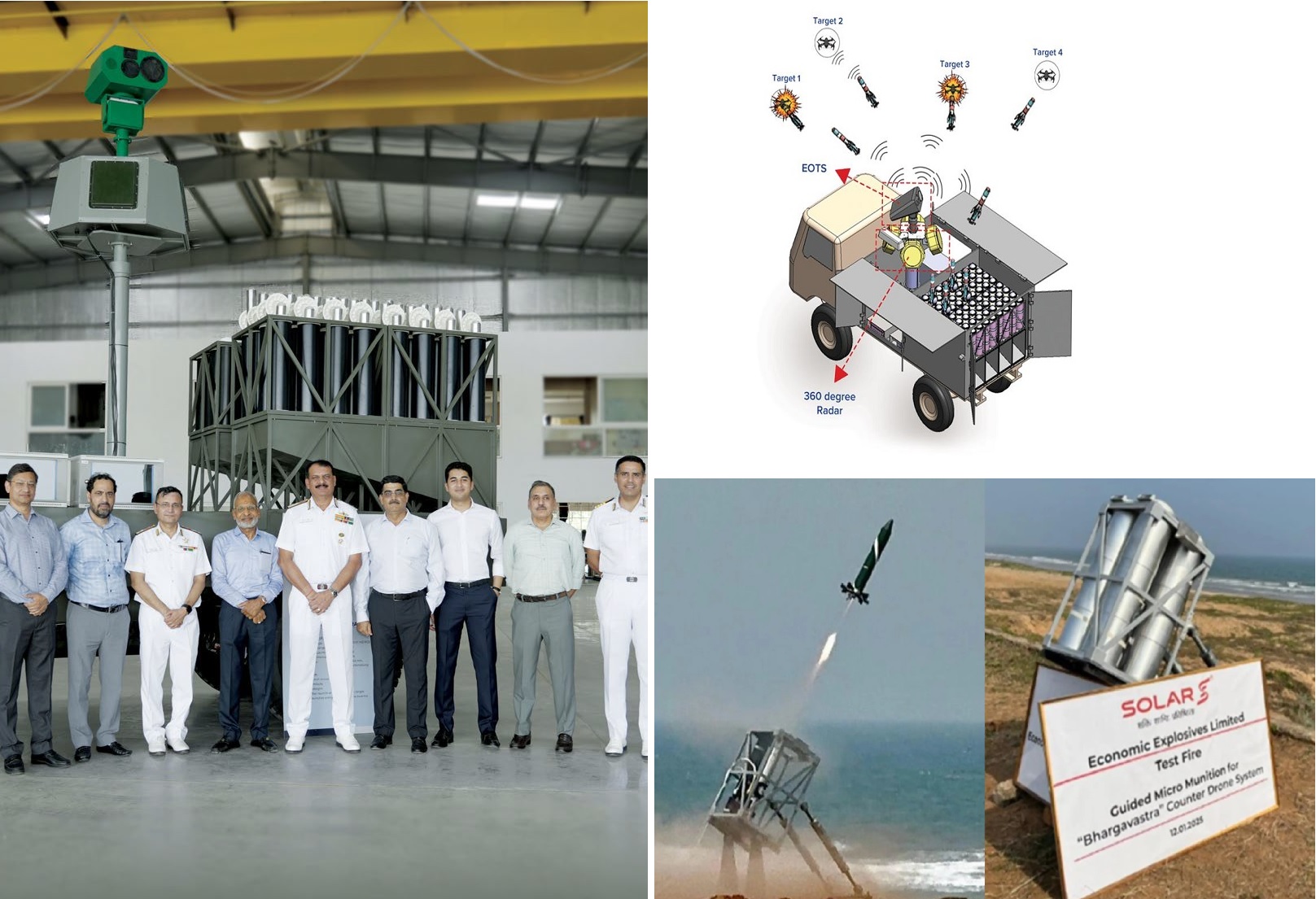
NAGPUR, India — May 16, 2026 : Solar Defence and Aerospace Limited (SDAL), a subsidiary of Solar Industries India Limited, has entered the final phase of testing for its indigenous Bhargavastra counter-drone system, with comprehensive trials scheduled for completion by the end of 2026.
The Bhargavastra system is a hard-kill Counter-Unmanned Aerial System (C-UAS) developed to detect, track and neutralise hostile unmanned aerial vehicles (UAVs), loitering munitions and coordinated drone swarms. The programme was initiated by SDAL in response to the growing use of low-cost drones and autonomous aerial threats in modern warfare environments.
Multi-Layer Counter-Drone Architecture
Bhargavastra uses a layered interception architecture combining unguided micro-rockets and guided micro-missiles. The first defensive layer employs unguided micro-rockets designed to create a fragmentation effect with a lethal radius of approximately 20 metres. This layer is intended to rapidly engage and disrupt large drone swarms through area saturation.
The second layer consists of precision-guided micro-missiles capable of hit-to-kill engagements against individual aerial targets. Each guided interceptor weighs approximately 2.5 kilograms and is powered by a solid-propellant rocket motor. The system is designed to neutralise aerial threats at ranges exceeding 2.5 kilometres.
According to SDAL, Bhargavastra is among the few dedicated anti-drone systems globally capable of carrying and firing a large salvo of interceptors from a single launcher configuration. The platform carries up to 64 micro-missiles or micro-rockets arranged in an 8×8 cassette layout. All 64 interceptors can be launched in salvo mode within approximately 10 seconds, enabling simultaneous engagement of multiple aerial targets and dense drone swarms with 360-degree coverage.
Detection and Command Network
The system integrates an advanced Command-and-Control Centre equipped with C4I (Command, Control, Communications, Computers and Intelligence) technology for target detection, tracking and engagement coordination.
Bhargavastra’s radar system can reportedly detect medium and large UAVs at ranges of up to 10 kilometres, while smaller drones can be identified at distances exceeding 6 kilometres. To improve tracking accuracy against targets with low radar signatures, the platform also incorporates an Electro-Optical/Infrared (EO/IR) sensor suite for visual and thermal target identification.
Once a threat is confirmed, the system can rapidly assign and launch interceptors against incoming aerial targets using either guided or unguided munitions depending on the threat profile.
Mobility and Operational Flexibility
The complete Bhargavastra platform is mounted on a 4×4 high-mobility light truck, allowing rapid deployment and repositioning in operational areas. The system has been engineered for operations across multiple terrain conditions, including deserts, plains and high-altitude mountainous regions up to 5,000 metres above sea level.
Its modular architecture also allows the integration of optional soft-kill systems, including radio-frequency jamming and GPS spoofing modules. This enables operators to combine electronic warfare measures with kinetic interception capabilities to establish a layered anti-drone defence network.
The munitions used by the system were developed by Economic Explosives Limited, another company within the Solar Group.
Trial Progress and Testing Milestones
Testing of the Bhargavastra system began at the Gopalpur Seaward Firing Range in Odisha in January 2025 in the presence of Indian Army officials.
During the initial trial phase, the system successfully engaged a stationary aerial target at a range of 2.5 kilometres and an altitude of approximately 400 metres. A follow-up firing achieved a successful engagement against a moving electronic target, validating the system’s tracking and interception capabilities.
Additional evaluation firings were conducted in May 2025 before senior Indian Army Air Defence officers. The tests included two single-rocket firings and one rapid salvo launch involving two rockets fired within two seconds. SDAL stated that all launch parameters and operational objectives were successfully achieved during the trials.
The current final testing phase is intended to evaluate the system’s operational reliability, target engagement accuracy, salvo-launch performance and battlefield readiness under varied environmental and tactical conditions ahead of the projected completion timeline in late 2026.
Indigenous Counter-Drone Development
Bhargavastra forms part of India’s broader effort to strengthen indigenous counter-drone and short-range air-defence capabilities through domestic defence industry participation.
The system is the first micro-missile-based counter-drone platform of its type developed entirely by an Indian private-sector company. Upon successful completion of final trials and certification, the platform is expected to proceed toward user evaluation and potential induction into Indian Army Air Defence units.
——— End of Article ———