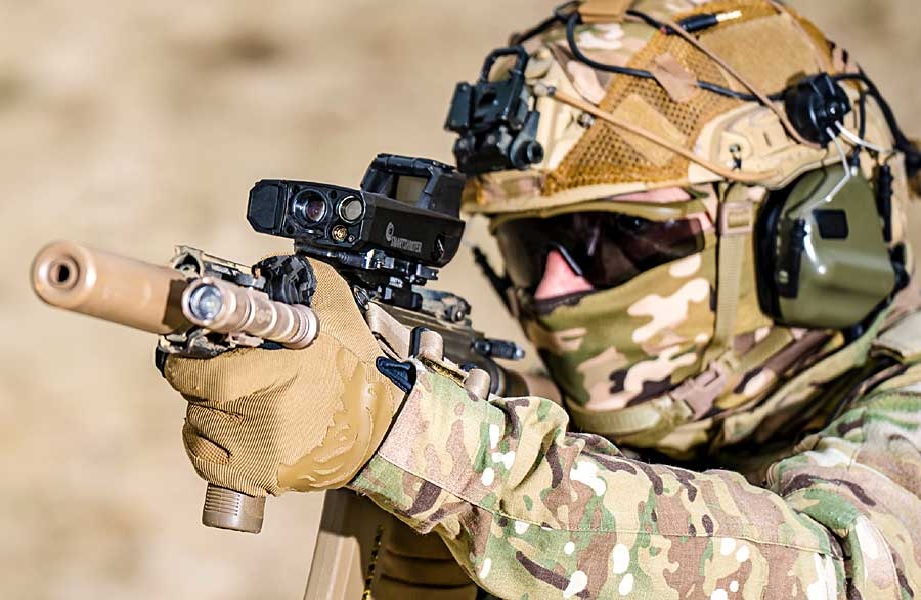
NEW YORK — June 02, 2026 : Israeli defense technology company Smart Shooter has secured a $1.8 million contract to supply the U.S. Navy with its SMASH 2000LE fire control systems, marking the company’s first major procurement agreement with the naval service and completing its operational integration across all four major branches of the U.S. military.
The company announced on June 1 that the Navy agreement follows earlier procurement contracts with the U.S. Army, Marine Corps, and Air Force over the past year. Deliveries of the systems are scheduled for the second half of 2026.
The contract was awarded by the Naval Surface Warfare Center (NSWC), the U.S. Navy’s principal institution for research, engineering, testing, and development of surface warfare systems. Procurement will be managed through Atlantic Diving Supply (ADS), an authorized tactical equipment and logistics provider for the U.S. Department of Defense, enabling faster delivery through an existing acquisition framework.
Navy Procurement Reflects Growing Counter-Drone Focus
The Navy’s adoption of the SMASH 2000LE, also designated in some configurations as the SMASH 3000SA, aligns with a broader U.S. defense effort to strengthen counter-drone capabilities for military personnel and force protection teams.
The increasing use of small unmanned aerial systems (sUAS) in modern conflicts has created new operational challenges for conventional infantry and security forces. Unlike traditional rifle training, which is largely designed for stationary or slow-moving ground targets, engaging small aerial threats requires rapid tracking and precise ballistic calculations.
Military assessments have shown that small drones can move unpredictably and often reach speeds of up to 20 meters per second, making them difficult to engage using standard optics and conventional shooting techniques. The growing use of weaponized and reconnaissance drones has increased demand for kinetic counter-UAS systems capable of improving engagement accuracy.
How the SMASH 2000LE Fire Control System Works
The SMASH 2000LE is an external optical fire control system mounted on standard service rifles, including weapons such as the M4 carbine. Known in Hebrew as “Pigyon,” the system uses artificial intelligence, computer vision, and ballistic processing to improve firing precision.
The system locks onto a target and processes variables including target speed, trajectory, distance, wind conditions, and humidity through an onboard dual-core computer.
During operation, the user tracks a drone or moving target through the optic while pulling the trigger. However, the weapon does not discharge immediately. The fire control mechanism electronically delays firing until the system calculates the highest probability of a successful hit, reducing missed rounds and improving ammunition efficiency.
The system also provides visual aiming support through a digital display, including indicators such as a red dot or targeting cross, allowing operators to maintain continuous tracking of moving aerial targets.
System Specifications and Features
According to Smart Shooter, the SMASH 2000LE is designed primarily for kinetic counter-unmanned aerial system (C-UAS) missions while also improving accuracy against ground threats.
The system offers an effective engagement range of up to 250 meters against small aerial targets and includes features intended for field deployment:
- Lightweight construction of approximately 740 grams
- Day and night operational capability
- See-through optics with integrated digital display
- Lock-and-track targeting for moving threats
- Integration with battle management systems
- Ruggedized construction for operational environments
The system is designed to be attached to standard infantry rifles without requiring major modifications.
Growing U.S. Defense Contracts
The Navy agreement follows Smart Shooter’s expansion within the U.S. defense sector.
In March 2026, the U.S. Joint Interagency Task Force 401 (JIATF-401) awarded the company a $6.1 million contract for 210 SMASH systems intended to protect domestic infrastructure and military facilities against emerging drone threats.
The company also secured a $10.7 million follow-on contract with the U.S. Army in May 2026 for additional SMASH 2000LE systems, with deliveries expected in the third quarter of 2026. Separate procurement agreements have also been reported with the U.S. Marine Corps and U.S. Air Force as part of broader efforts to improve counter-drone protection at military bases and operational facilities.
Company Statement
Smart Shooter Chief Executive Officer Michal Mor described the Navy contract as an important development in the company’s expansion across U.S. defense organizations.
“Securing our first significant contract with the U.S. Navy marks an important milestone in Smart Shooter’s continued expansion across U.S. defense organizations,” Mor said.
“Together with our recent agreements with the U.S. Army, U.S. Marine Corps, and U.S. Air Force, this latest award underscores the growing operational need for precise, reliable, and field-ready solutions to address the drone threat.”
Counter-Drone Systems Becoming a Procurement Priority
The growing adoption of systems such as SMASH reflects lessons drawn from operational environments including Ukraine, the Red Sea, and the Middle East, where small weaponized drones have increasingly been used for reconnaissance, attacks, and force disruption.
These developments have pushed portable counter-UAS systems from a specialized capability into a broader procurement priority for military organizations seeking to strengthen force protection for ships, bases, and frontline units.
With deliveries scheduled for the second half of 2026, the Navy’s acquisition of the SMASH 2000LE is expected to support sailors, force protection personnel, and security teams tasked with defending naval facilities and operational assets from small aerial threats.
——— End of Article ———