Des Moines, Washington, — Defense technology company Shield AI announced on September 30 that it will manufacture its AI-piloted X-BAT fighter in Des Moines, Washington, while flight testing, customer acceptance and long-term fleet sustainment will be based at Newton City-County Airport in Kansas.
Production is scheduled to begin in 2029, with full-rate manufacturing targeted for the early 2030s. Initial flight testing is scheduled to begin later in 2026.
Three X-Forge Facilities
Shield AI has divided the X-BAT program among three facilities.
X-Forge 3 in Des Moines, Washington, will be the main production site. Shield AI has signed a lease for a 420,000-square-foot facility at the Des Moines Creek 2 light industrial park. The site is being built out and is expected to open in spring 2027. It is Shield AI’s first facility in the Puget Sound area, and hiring for the program has shifted to the region.
X-Forge 2 in Newton, Kansas, will handle flight testing, production acceptance, customer acceptance flights and long-term maintenance, repair and overhaul (MRO). Shield AI committed to Newton in 2025 and currently leases office and hangar space and about 10 acres at the airport. It is working with the City of Newton and Harvey County on a larger hangar and expanded footprint. Ground testing is already under way.
No X-BAT will reach a customer without first passing production acceptance testing and customer acceptance flights in Newton. Mayor Rich Stinnett said the city’s role has expanded from flight testing to MRO support for the entire fleet.
X-Forge 1 in Frisco, Texas, will remain the company’s prototyping facility and the home of its smaller V-BAT aircraft. Texas suppliers will provide key X-BAT components, including propulsion and mission systems.
X-BAT Capabilities
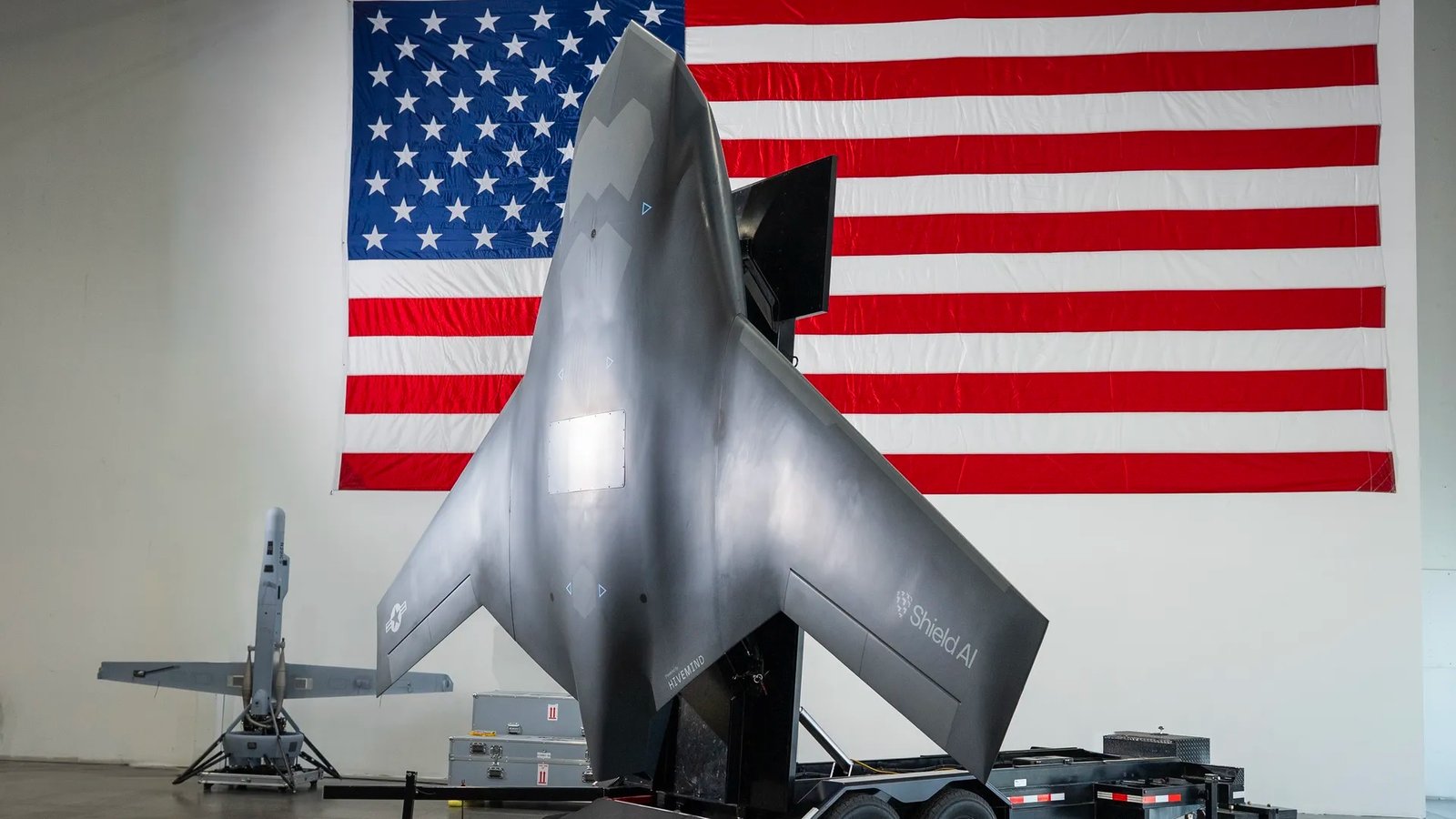
First publicly unveiled in 2025, the X-BAT is a 26-foot, long-range autonomous strike fighter designed for vertical takeoff and landing. Shield AI says it can operate from ships, remote islands and unimproved sites without a traditional runway.
The aircraft will use GE Aerospace’s F110 engine, the same class of engine used in the F-16. Shield AI lists a maximum range of 2,000 nautical miles and an objective combat radius of 1,000 nautical miles.
Its internal weapon bays are designed to carry 2,000-pound-class munitions, with a payload capacity described by the company as comparable to the F-35. The aircraft will also support electronic warfare and intelligence, surveillance and reconnaissance (ISR) payloads.
The X-BAT will use Shield AI’s Hivemind autonomy software, which the company says allows it to conduct complex missions when GPS or external communications are jammed or unavailable.
Economic Impact
Shield AI’s economic analysis projects about 9,800 jobs by the early 2030s and roughly $78 billion in economic impact for the Seattle and Newton areas through 2046, assuming the program reaches planned full production rates.
Washington is projected to account for about 8,000 jobs in the early 2030s, rising to 27,000 by 2046, with roughly $73 billion added to the Seattle-Tacoma-Bellevue economy.
Kansas is projected to support about 1,800 jobs in the early 2030s and 2,900 by 2046, adding about $5 billion to the Newton area.
Texas is projected to support about 1,400 jobs in the early 2030s and 7,900 statewide by 2046, adding roughly $18.6 billion to the state economy. The Frisco facility is projected to support about 600 jobs in the early 2030s and 700 by 2046.
The site selections reflect the aerospace industries in all three states. King County has more than 45,000 aerospace workers at over 400 companies, while Washington has more than 1,500 aerospace suppliers. South-central Kansas has manufactured aircraft since the 1920s and trains workers through institutions including Wichita State University and WSU Tech.
“Both these regions were building airplanes before Shield AI existed, and we went to them for that reason,” said Armor Harris, Shield AI’s senior vice president of aircraft. “X-BAT will be built in Washington and fly in Kansas before it goes to a customer, and Kansas will keep this fleet in the air for decades.”
Washington Governor Bob Ferguson welcomed the investment and the expected jobs, while Kansas Senator Jerry Moran said Kansas’ long aviation history makes it a natural location for keeping advanced military aircraft mission-ready.
Founded in 2015, Shield AI is a venture-backed defense company with facilities across the United States, Europe, the Middle East and Asia-Pacific. Its products include Hivemind, V-BAT, X-BAT and Aechelon simulation and synthetic reality technologies.
——— End of Article ———