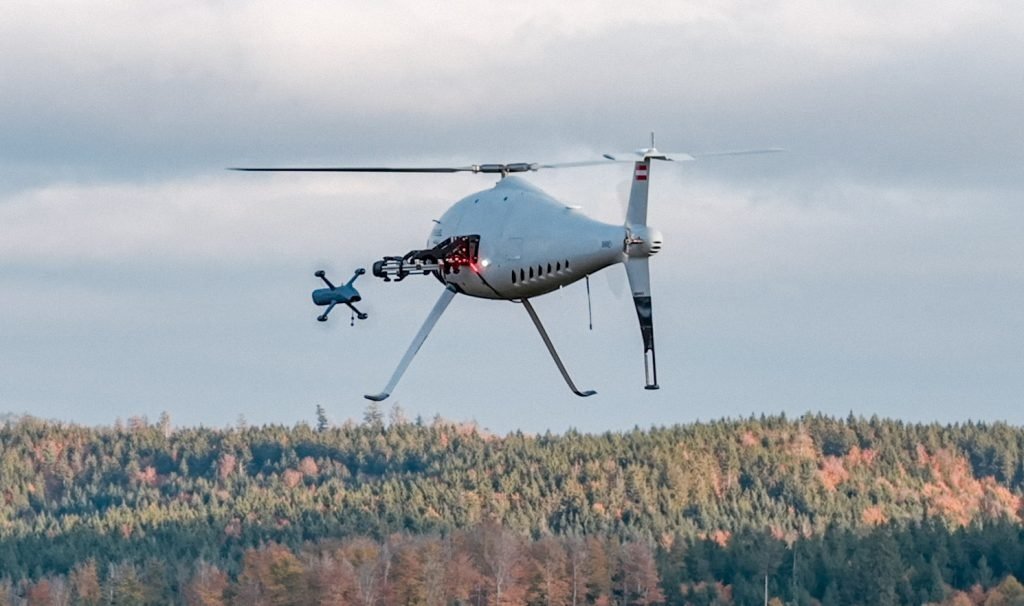
Vienna, Austria — Austrian company Schiebel, in partnership with Poland's OSIRIS, has successfully tested a new capability that allows its CAMCOPTER S-100 unmanned helicopter to carry, launch and control smaller drones during flight.
The demonstration in Austria involved the S-100 carrying and releasing an inert OSIRIS HSCD-1 (High-Speed Camera Drone) while flying forward. After release, the S-100 acted as an airborne communications relay, maintaining the control and video links between the smaller drone and ground operators.
Extended Range and Counter-Drone Applications
The concept combines the endurance of a larger unmanned helicopter with the speed and agility of smaller drones. The S-100 can transport smaller systems closer to their targets and maintain communications after launch, helping overcome their limited battery life and radio range. Its airborne relay can also reduce communication problems caused by terrain, forests and distance.
Schiebel sees potential applications in Counter-Unmanned Aircraft Systems (C-UAS) operations. Future versions could deploy high-speed interceptor drones equipped with effectors, as well as other specialised unmanned systems and loitering munitions.
The company confirmed that the capability can also be integrated across its S-300, S-101 and S-301 platforms, allowing them to act as airborne carriers, launch platforms and communications relays.
Hans Georg Schiebel, Chairman of the Schiebel Group, said the demonstration showed the potential of combining the CAMCOPTER with smaller specialised unmanned systems, including high-speed interceptor drones.
CAMCOPTER S-100 Specifications
The CAMCOPTER S-100 is a vertical take-off and landing (VTOL) unmanned helicopter with a maximum take-off weight of 200 kg and a payload capacity of up to 50 kg. It provides more than six hours of endurance with a typical payload, extending beyond 10 hours with an optional external fuel tank. Its data-link range is up to 200 km, with a dash speed of around 120 knots and cruise speed of approximately 55 knots.
The platform is already used by several navies and other operators for maritime and land-based intelligence, surveillance and reconnaissance (ISR) missions.
The demonstration confirms the technical feasibility of the mothership concept. However, Schiebel has not announced a customer, follow-on contract or expected in-service date.
——— End of Article ———