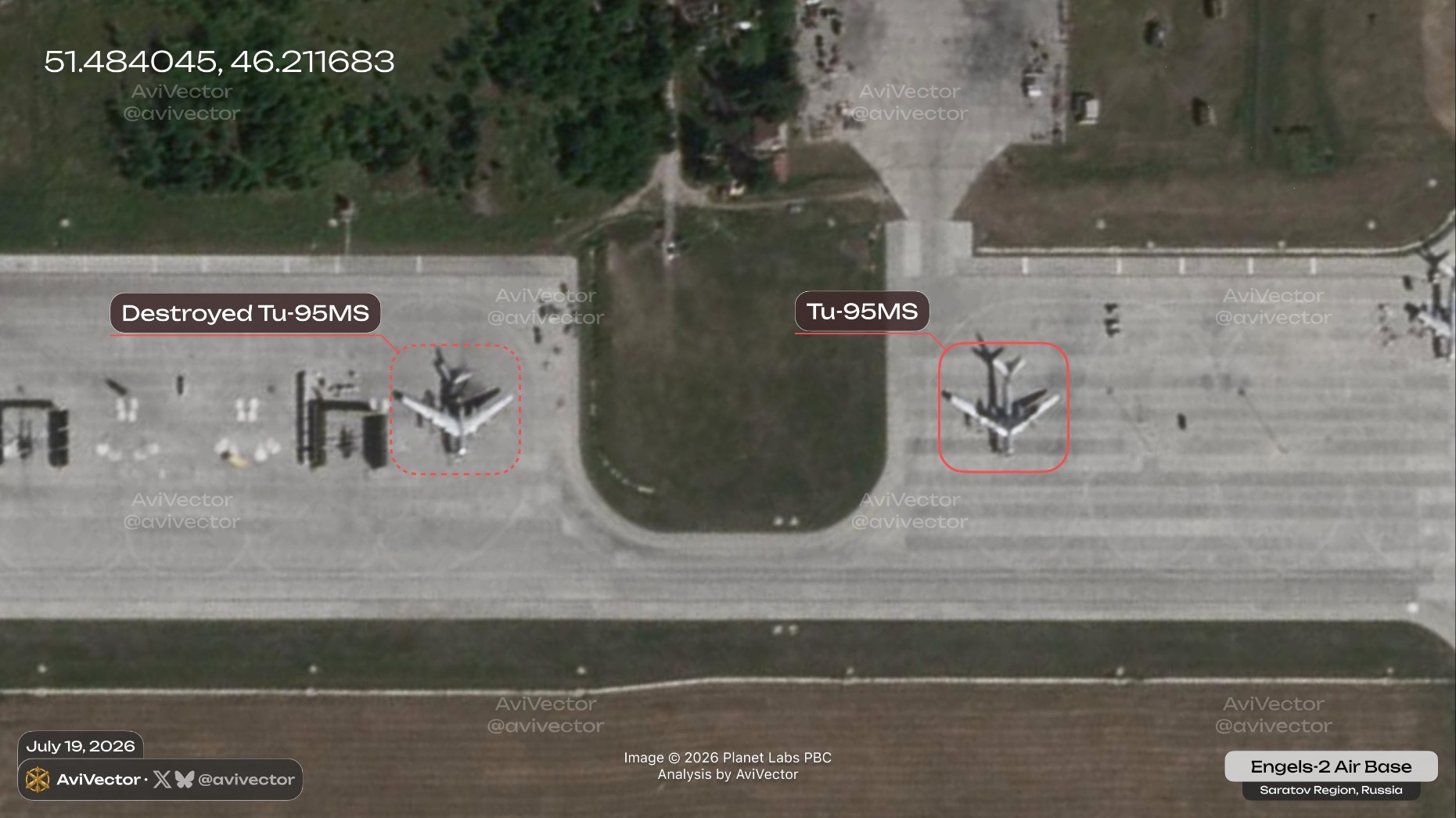
SARATOV REGION, Russia — Commercial satellite imagery released on Saturday appears to confirm the destruction of a Russian Tu-95MS strategic bomber at Engels-2 Air Base following a Ukrainian drone strike carried out earlier this week.
The images, published by open-source intelligence group AviVector using Planet Labs satellite imagery, show a Tu-95MS bomber on the tarmac with severe structural damage. The aircraft's tail section appears to have been completely separated from the fuselage, while damage extends into the internal weapons bay.
🔻 Satellite images of 🇷🇺 Engels-2 Air Base as of July 19, 05:10 UTC
— AviVector (@avivector) July 19, 2026
On the night of July 16, the Security Service of Ukraine destroyed a Tu-95MS strategic bomber at Engels-2 Air Base.
Two Tu-95MS were at Engels Air Base for a long period of time and conducted rotations,… pic.twitter.com/60707jLmGj
According to AviVector and analysis by investigative project Skhemy, part of Radio Free Europe/Radio Liberty, the drone strike triggered a fire that destroyed the rear section of the aircraft. Analysts assessed that the extent of the damage makes the bomber beyond repair. AviVector also noted that two Tu-95MS bombers had been stationed at Engels-2 for an extended period for routine maintenance, crew rotations, and training.
Drone Strike Reported on July 16
The attack took place in the early hours of July 16.
Saratov Region Governor Roman Busargin reported a drone threat at approximately 1:47 a.m. local time. Around 2:30 a.m., residents began reporting explosions and multiple drones over the area on social media, followed by a large fire at the Engels-2 military airfield.
On July 17, Ukrainian President Volodymyr Zelenskyy said the operation was carried out by the Security Service of Ukraine (SBU). He stated that Engels-2 Air Base, located about 800 kilometers from the Ukrainian border, is one of Russia's main bases used to launch long-range cruise missile attacks against Ukrainian cities.
The SBU also said its drones traveled approximately 800 kilometers to reach the target. If confirmed, the satellite imagery would provide the first independent visual evidence indicating the destruction of an aircraft rather than damage limited to airfield infrastructure.
Importance of the Tu-95MS Fleet
The Tu-95MS is a modernized version of the Soviet-era Tu-95 strategic bomber and is used to carry Kh-101, Kh-555, and Kh-55 long-range cruise missiles. Although the original Tu-95 first flew in 1952, the Tu-95MS variant remains one of Russia's primary long-range missile carriers.
Production of new Tu-95 aircraft ended in August 1992, meaning destroyed airframes cannot be directly replaced. Some aircraft have since been upgraded to the Tu-95MSM standard with improved engines, navigation systems, and increased missile-carrying capability.
Before the latest strike, Russia was reported to operate around 31 Tu-95MS bombers and 27 Tu-95MSM aircraft.
Open-source monitoring project Oryx, which documents equipment losses based on photographic evidence, has previously recorded at least 10 Tu-95MS losses since the start of the full-scale war, most of them while parked at Russian air bases. The Engels incident had not yet been added to its verified count at the time of publication.
Engels-2 Remains a Key Strategic Air Base
Engels-2 Air Base hosts Russia's 184th Heavy Bomber Aviation Regiment and the 121st Guards Heavy Bomber Aviation Regiment, making it one of the country's most important bases for long-range aviation.
Following previous Ukrainian drone attacks, Russia strengthened defenses at the base by constructing at least 17 hardened aircraft shelters designed for the large Tu-95 and Tu-160 bombers. Ground crews also painted two-dimensional aircraft decoys on the tarmac in an effort to complicate drone targeting and satellite observation.
Despite these protective measures, the July 16 strike appears to have successfully reached the airfield.
Bombers Relocated to Russia's Far East
The attack follows a series of Ukrainian long-range operations targeting Russia's strategic aviation fleet. After earlier attacks, including Operation Spiderweb in June 2025, Russian military commanders relocated a number of strategic bombers to Ukrainka Air Base in Russia's Far East to reduce their exposure to Ukrainian drone strikes.
Operating bombers from the Far East significantly increases mission distances. A Tu-95MS based at Ukrainka must fly roughly 7,000 kilometers to reach the launch area near Saratov before returning approximately 5,400 kilometers, resulting in a round trip of up to 12,400 kilometers and nearly 23 hours of flight time.
While relocating aircraft reduces the risk of attacks on the ground, the longer missions increase fuel consumption, maintenance requirements, airframe wear, and the workload on flight crews.
The newly released satellite imagery provides additional visual evidence supporting Ukrainian claims that a Tu-95MS bomber was destroyed during the July 16 strike. Further independent analysis and any future official statements may provide additional confirmation regarding the full extent of the damage.
——— End of Article ———