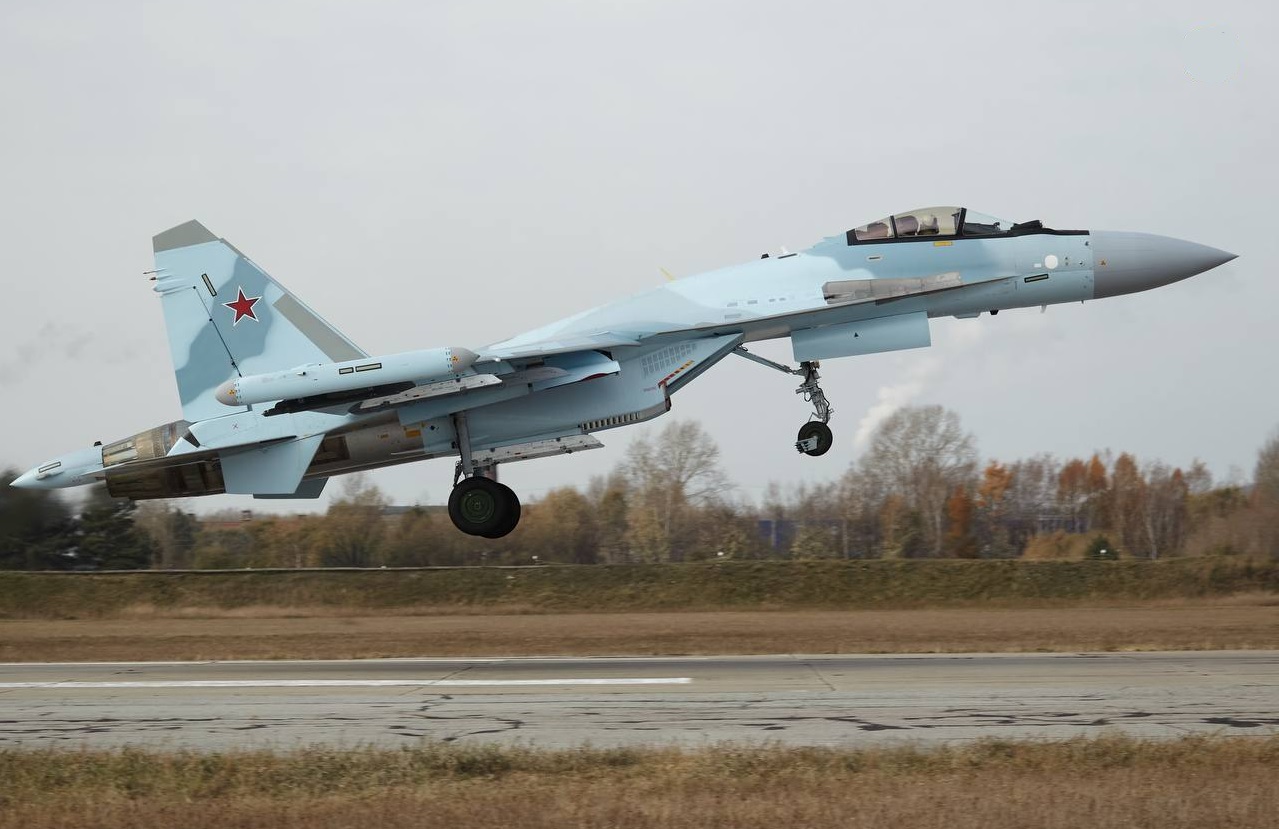
MOSCOW, — May 26, 2026 : The Russian Aerospace Forces (VKS) have officially received a new batch of Su-35S long-range air superiority fighters from the state-owned United Aircraft Corporation (UAC), marking the second publicly confirmed delivery of the aircraft in 2026 following an earlier transfer in mid-April. The handover underscores Russia’s continued effort to sustain tactical aviation production despite international sanctions, wartime pressures and expanding export commitments.
Production Continues Despite Sanctions
The Su-35S is manufactured at the Komsomolsk-on-Amur Aviation Plant (KnAAZ) named after Yuri Gagarin, one of Russia’s principal combat aircraft production facilities. Continued manufacturing at the plant reflects Moscow’s effort to preserve output for its tactical aviation fleet despite restrictions affecting supply chains and access to foreign technology.
The latest transfer follows a sustained rise in production activity. Industry estimates indicate KnAAZ delivered seven batches of Su-35S fighters to the Russian Aerospace Forces during 2025, amounting to approximately 17 to 20 aircraft, compared with roughly 15 aircraft delivered across four batches in 2024. The first publicly confirmed batch of 2026 was transferred in mid-April, with the latest handover arriving in late May.
Continuous deliveries since the aircraft entered operational service in 2014 have expanded the operational Su-35S fleet to an estimated more than 150 aircraft, up from roughly 135 units one year earlier. The fighter has increasingly become a key component of Russia’s tactical combat aviation fleet, supporting air superiority, interception and strike missions.
Combat Operations and Expanding Operational Role
The Su-35S first gained extensive operational experience after deployment to Syria in late 2015, where it provided air cover for Syrian government operations and monitored regional military activity involving Turkey, Israel and NATO member states operating in nearby airspace. Since then, the aircraft has become one of Russia’s most combat-tested post-Cold War fighter platforms in air-to-air operations.
In the ongoing Ukrainian theater, the Su-35S has been used for long-range combat air patrols, escort missions, strike support, reconnaissance and interception tasks. Russian sources attribute the aircraft with the destruction of several Ukrainian Air Force MiG-29 and Su-27 fighters, in addition to an F-16 reportedly shot down in mid-May 2026.
The aircraft has also continued to interact with Western military aviation in international airspace. In early March, Royal Norwegian Air Force F-35A fighters intercepted Su-35S aircraft escorting Tu-95MS strategic bombers over the Barents Sea during a long-range aviation mission.
During the latest delivery, a Russian Aerospace Forces pilot outlined the fighter’s mission profile, describing the Su-35S as a manoeuvrable multirole aircraft used for long-range interception, protection of strike groups and ground facilities, destruction of unmanned aerial vehicles, precision-guided strikes against ground and maritime targets, and reconnaissance missions identifying enemy positions deep behind frontline areas.
Technical Capabilities and Limitations
Russia classifies the Su-35S as a “4++ generation” fighter, combining long operational range, multirole capability and high maneuverability. Powered by twin thrust-vectoring engines, the aircraft is designed for enhanced agility during close-range engagements and has an unrefuelled combat radius exceeding 2,000 kilometres.
However, the fighter lacks low-observable stealth technologies found on fifth-generation aircraft such as the American F-35 and China’s J-20. Its avionics suite relies on the Irbis-E passive electronically scanned array (PESA) radar rather than the active electronically scanned array (AESA) systems increasingly fielded by modern competitors.
For beyond-visual-range combat, the aircraft primarily employs R-77-1 and R-27 air-to-air missiles, both older designs relative to newer Western and Chinese systems. Russia integrated the more advanced R-77M missile onto the Su-35S in 2025, though procurement levels remain limited. In short-range engagements, the aircraft uses the R-74 missile, which analysts assess as having a more restricted high-angle targeting capability compared with systems such as the AIM-9X Block 2 and PL-10.
Although the Su-35S remains a highly capable platform for long-range interception and tactical operations, analysts continue to assess limitations in stealth, sensor technologies and weapons integration when compared with the most advanced U.S. and Chinese fighter aircraft.
Foreign Components and Supply Chain Concerns
Despite being assembled domestically, the Su-35S programme remains dependent on imported electronic components. A recent investigation conducted by the International Partnership for Human Rights (IPHR) and the Independent Anti-Corruption Commission (NAKO), based on the wreckage of downed Russian aircraft, identified 889 foreign-made components produced by 138 international companies inside Su-35S avionics systems.
According to the investigation, the components were sourced primarily from the United States, alongside suppliers in Japan, the European Union, Switzerland, Taiwan and South Korea. Researchers stated that procurement networks involving intermediary firms and shell companies are believed to facilitate access to restricted technologies despite Western export controls.
Export Orders Expand Production Demands
Before 2025, the Su-35S had achieved limited export success, with China remaining the aircraft’s only confirmed foreign operator after purchasing 24 fighters. Export demand expanded significantly after an unannounced delivery of 18 aircraft to Algeria beginning in February 2025.
Leaked Russian government documents later indicated that Iran ordered 48 fighters to modernize its air force, while Ethiopia placed an order for six aircraft. Combined with previous sales to China and Algeria, confirmed export commitments have increased to 96 aircraft across four international customers.
Production for Iran’s order reportedly began in late 2025, leading to questions over how export obligations may influence future delivery rates to the Russian Aerospace Forces as KnAAZ balances domestic procurement and international contracts.
Industry observers have additionally suggested that Moscow may attempt to market the aircraft to North Korea amid expanding defence ties, although Russia’s more advanced Su-57 fifth-generation fighter — which recorded its first export delivery to Algeria in November 2025 — is expected to attract greater long-term attention from potential foreign operators.
Continued Role in Russian Tactical Aviation
The latest delivery reinforces the Su-35S’s position as one of the Russian Aerospace Forces’ principal tactical fighter platforms. The aircraft continues to support long-range interception, strike escort, reconnaissance, unmanned aerial vehicle interception and precision-guided strike missions, while production efforts continue under sanctions, expanding export obligations and sustained operational demand.
——— End of Article ———