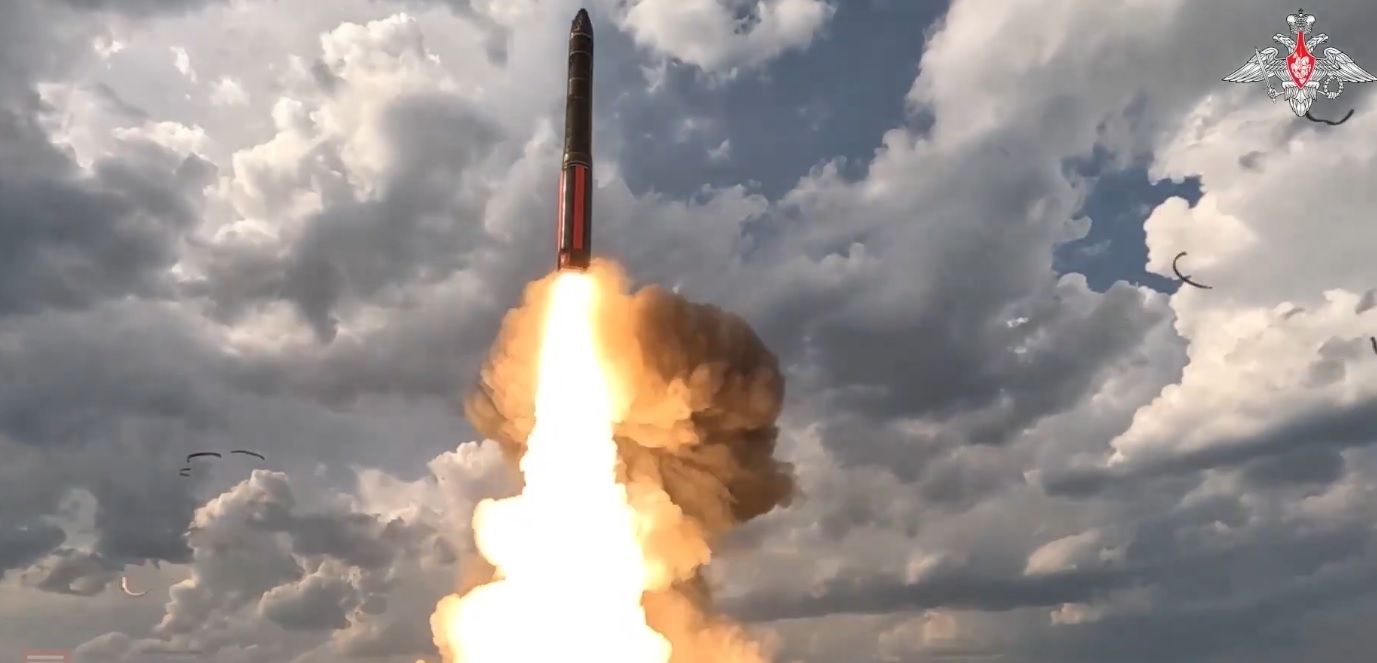
MOSCOW, — May 21, 2026 : Russia launched a Yars intercontinental ballistic missile (ICBM) during large-scale joint nuclear exercises with Belarus, as Moscow and Minsk carried out one of their most extensive strategic readiness drills in recent years involving land, air, and naval nuclear-capable forces.
The three-day exercises, conducted from May 19 to May 21, included the operational deployment of strategic missile systems, long-range aviation assets, naval forces, and mobile missile units across Russia and Belarus. A major feature of the drills was the transfer of actual nuclear munitions to military units for operational training purposes, marking the first time live nuclear payloads were used during such joint tactical exercises.
According to the Russian Defense Ministry, the Yars ICBM was launched from the Plesetsk Cosmodrome in northern Russia toward the Kura testing range in the Kamchatka region in the country’s Far East. Russian officials stated that the missile successfully reached its designated target area.
The Yars missile system is a road-mobile intercontinental ballistic missile capable of carrying multiple independently targetable reentry vehicles (MIRVs). The system has a reported operational range exceeding 10,000 kilometers, enabling it to strike targets across Europe and North America.
Russian military officials stated that the exercises were designed to test combat readiness, command coordination, and the operational handling of strategic and tactical nuclear systems under simulated wartime conditions.
For the first time during joint Russian-Belarusian nuclear drills, live nuclear munitions were formally transferred to missile and aviation units operating in both countries. Previous exercises of this type generally relied on inert or mock warheads used to simulate the weight and electronic characteristics of actual nuclear payloads.
The Russian Defense Ministry stated that military personnel practiced the transportation, storage, security, loading, and deployment of active nuclear munitions at field storage facilities and operational missile positions. Belarusian defense authorities confirmed that Belarusian crews participated in the preparation and handling of nuclear-capable systems stationed on Belarusian territory in coordination with Russian forces.
Russia has maintained tactical nuclear weapons in Belarus following agreements announced in 2023, with deployment activities beginning in 2025.
The exercises involved approximately 64,000 military personnel from both countries, according to Russian defense data. Naval components included 73 surface warships and 13 submarines, including eight submarines equipped with nuclear-capable ballistic missiles.
More than 140 aircraft participated in the drills, including Tu-95MS strategic bombers and MiG-31 aircraft capable of carrying Kinzhal hypersonic missiles. Ground formations included over 200 mobile missile launchers and associated support systems deployed across multiple training areas.
In addition to the Yars launch, Russian forces conducted a submerged launch of a Sineva submarine-launched ballistic missile. The drills also included launches of Kinzhal hypersonic missiles and Zircon hypersonic cruise missiles from naval platforms operating in northern waters, including the Barents Sea.
Belarusian combat crews separately carried out a practical launch of a Russian-made Iskander-M short-range ballistic missile at the Kapustin Yar testing range in Russia as part of the joint operational training program.
Russian President Vladimir Putin and Belarusian President Alexander Lukashenko observed the final stage of the exercises through a video conference link on Thursday.
During the broadcast, Putin stated that the drills were intended to improve coordination between strategic and tactical nuclear forces under conditions involving potential external aggression. Russian officials described the exercises as defensive in nature and aimed at maintaining the operational readiness of the Union State’s nuclear deterrence forces.
Belarusian authorities also stated that the exercises were planned military activities and were not directed against any specific third party.
The drills were conducted amid heightened regional security measures near Belarus’ borders. In recent weeks, Ukraine has strengthened security along its northern frontier with Belarus due to concerns regarding possible cross-border military activity connected to the ongoing conflict in the region.
——— End of Article ———