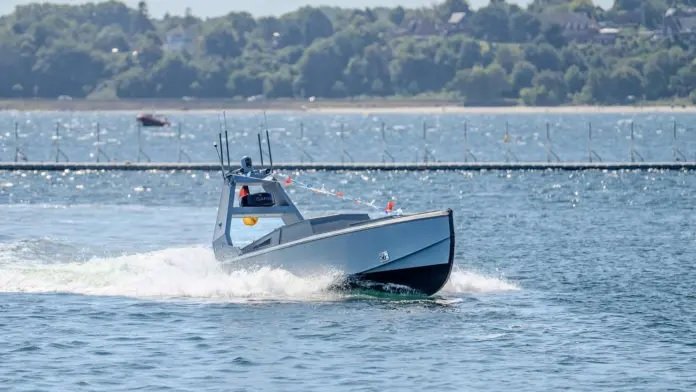
KIEL, Germany — German defence technology company STARK has delivered the first Seetaube autonomous unmanned surface vessel (USV) to the German Armed Forces’ Cyber and Information Domain Service (Kommando CIR).
The six-metre vessel is based on STARK’s Vanta-6 platform and was acquired through an innovation initiative of the Cyber Innovation Hub of the Bundeswehr, in cooperation with the Centre for Digitalisation of the Bundeswehr. The Seetaube was formally christened during a ceremony in Kiel in August 2026.
Maritime Reconnaissance and Signal Detection
Seetaube is equipped with cameras, sensors and radar for maritime reconnaissance. It can follow pre-programmed routes autonomously while operating within defined parameters. An operator monitors the mission remotely and can take manual control at any time. Data collected by the vessel is transmitted securely in real time to the operator terminal.
The USV is designed to provide a second mobile observation point at sea. When operating alongside a manned naval vessel, it can provide an additional bearing point for locating radio signals through cross-bearing measurements. This can help identify suspicious activity and improve the speed and precision of maritime reconnaissance.
Sven Weizenegger, head of the Bundeswehr’s Cyber Innovation Hub, said the system increases force effectiveness without requiring another large manned platform. STARK CTO Johannes Schaback said the system provides sensors, range and endurance in the operational area without requiring additional personnel on manned ships.
Vanta-6 Specifications and Previous Tests
The Vanta-6 can reach more than 45 knots, carry a payload of up to 500 kilograms, and has a range of approximately 1,685 kilometres. It weighs about 2,100 kilograms and can operate in Sea State 4.
The Vanta family was developed for reconnaissance and coastal-water operations, as well as the protection of ports and critical maritime infrastructure.
Vanta systems participated in the NATO exercises REPMUS and Dynamic Messenger in Portugal in September 2025. During the exercises, the vessels conducted missions including high-value-target escort, harbour-control tasks, over-the-horizon reconnaissance and night-time ISR patrols.
The Vanta platform has also been successfully used to launch Cascade loitering munitions from containerised launchers, demonstrating its potential for roles beyond reconnaissance.
The Bundeswehr will now conduct further sea trials and operator training over the coming months before the Seetaube is formally taken into service.
——— End of Article ———