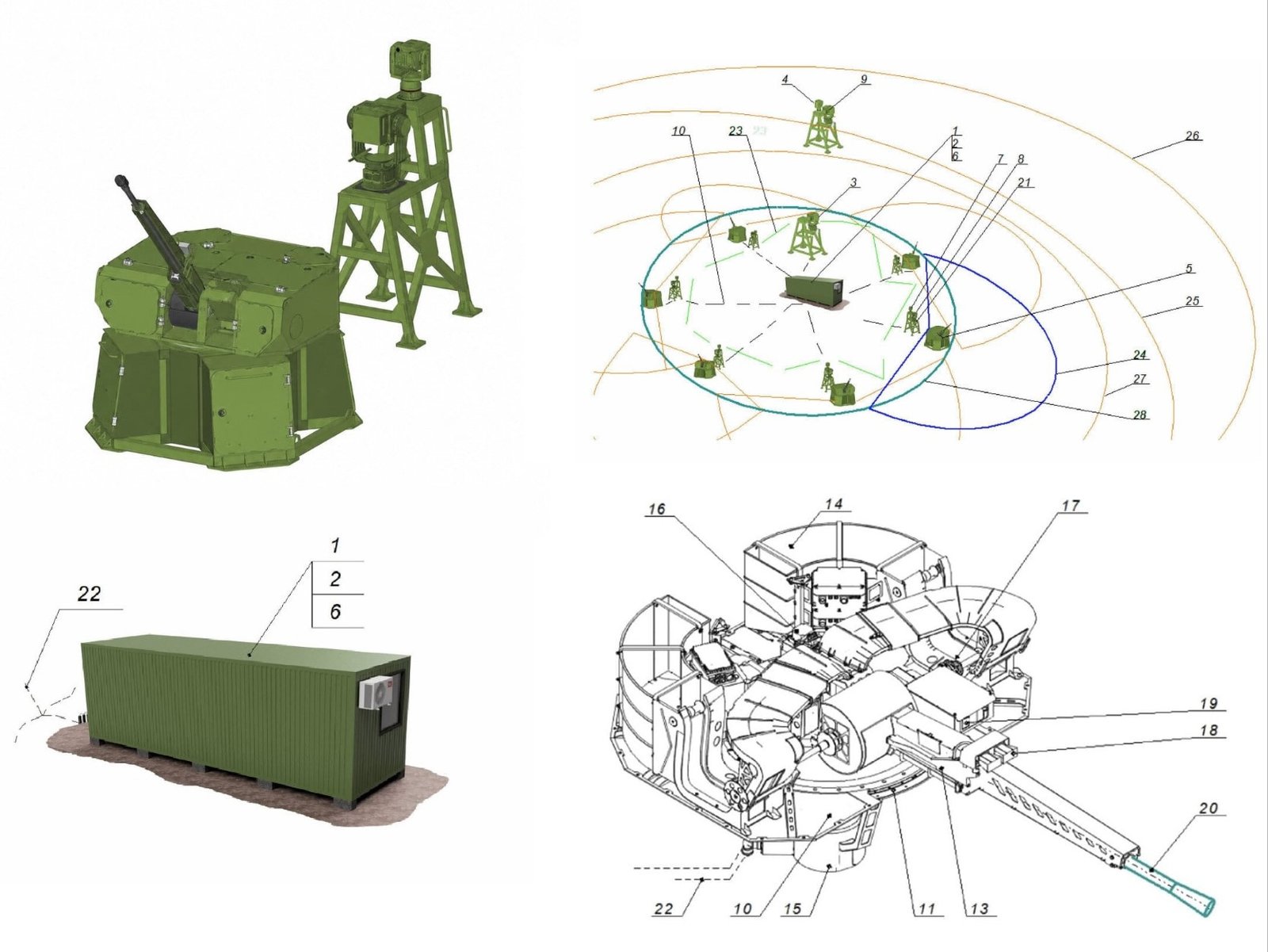
MOSCOW — Newly published patent documents from the Russian Federation's Federal Service for Intellectual Property have revealed detailed technical specifications of the ZAK-30 Citadel anti-drone system, providing new information about its architecture, operating concept, and autonomous engagement capabilities.
The ZAK-30 Citadel was first presented by Russian state-owned defense conglomerate Rostec on May 25, 2026. The company describes it as a short-range anti-aircraft artillery complex designed to protect stationary facilities, including military sites and critical infrastructure, from attacks by individual unmanned aerial vehicles (UAVs) and drone swarms. The system is projected to reach its initial operational capability by July 2026.
Distributed Architecture for Facility Protection
According to the patent documents, the ZAK-30 Citadel is built around a distributed network of sensors, combat modules, and command systems. All components assigned to protect a stationary facility are connected through cable communication lines for data exchange.
The system receives electrical power through cables connected either to a stationary power source at the protected facility or to a mobile power supply unit.
Its main components include:
- Command Post (CP) housed in a container-based unit
- Observation Radar Station (RLS-O)
- Tracking Radar Station (RLS-N)
- Fire Control System (FCS)
- Combat modules equipped with missiles and/or artillery systems
Command Post Coordinates Target Engagement
The container-based command post serves as the control center of the system. It houses the commander's automated workstation and the primary fire control systems.
According to the patent, the command post receives information from remote modules, processes incoming target data, and determines the order in which aerial threats should be engaged.
The centralized fire control system also coordinates simultaneous remote fire control across multiple anti-aircraft weapon systems operating within the network.
Radar Network Provides Detection and Tracking
The ZAK-30 Citadel employs two dedicated radar systems with separate roles.
The Observation Radar Station (RLS-O) establishes the primary detection zone by searching for incoming aerial threats.
Once a target enters the designated engagement area, the Tracking Radar Station (RLS-N) takes over. The electrically driven radar continuously tracks the UAV, calculates its flight path, and provides targeting data for engagement.
According to the patent, the use of multiple radars with range-selective capabilities creates several overlapping detection and engagement zones, allowing the system to provide round-the-clock protection against groups of small unmanned aerial vehicles.
Modular Weapon Configuration
The patent states that the ZAK-30 Citadel supports a modular armament configuration. Depending on operational requirements, the system can be equipped with:
- 7.62-mm machine guns
- 12.7-mm machine guns
- Vertically launched missile launchers
- A 30-mm automatic cannon
The 30-mm automatic cannon is designed to fire programmable ammunition equipped with delayed-action fuses. The programmable airburst rounds contain shrapnel to increase the probability of intercepting small aerial targets.
According to Rostec, the fire control system calculates the optimal detonation point based on the target's trajectory, allowing fewer rounds to be used compared with conventional ammunition.
Autonomous Engagement Process
The patent explains that each aerial target is engaged autonomously according to algorithms integrated into the fire control system.
If the first shot does not destroy the target, the system automatically recalculates the firing solution by analyzing the projectile's initial velocity and the measured miss distance.
Remote combat modules continue tracking the UAV throughout the engagement. If the target remains inside, or re-enters, the acceptable engagement zone, the system automatically fires the next corrected shot without manual intervention.
Integration With Regional Air Defense Network
Beyond operating as a standalone system, the patent states that the command and control unit can receive target designations from external command assets within a regional air defense network.
This capability allows the ZAK-30 Citadel to coordinate engagements with other anti-aircraft systems, supporting integrated air defense operations rather than functioning independently.
Intended Role
According to defense industry analysts, the ZAK-30 Citadel has an effective engagement range of approximately 1.2 kilometers and is intended primarily to protect high-value infrastructure, including military installations and oil refineries, from recurring drone attacks.
Analysts estimate that protecting a single large industrial facility could require a network of six to ten Citadel units. They also estimate the cost of each system at 3.5 million to 7.2 million euros.
They further note that the system's operational effectiveness will depend heavily on the availability and large-scale production of the 30-mm programmable ammunition required to defeat small drone threats.
——— End of Article ———