MOSCOW, Russia — Russia is expanding its Rassvet low-Earth orbit (LEO) satellite communications constellation, developed by Bureau 1440, with 32 production satellites now launched in two batches. The network is intended to provide broadband communications for civilian users, but Russian officials have also linked the project to future military communications and the control of unmanned systems.
Bureau 1440 says Rassvet is being developed to provide broadband connectivity for aircraft, ships, ground vehicles and other users. The company is targeting data rates of up to 1 Gbit/s per user terminal and latency of less than 70 milliseconds.
The military relevance of the network has increased as Russia seeks an independent satellite communications capability for operations involving drones and other systems operating beyond direct line of sight.
Rassvet Moves Into Production
Bureau 1440 began the Rassvet program with three experimental satellites launched in 2023. Three additional Rassvet-2 spacecraft were launched in 2024 to test technologies for the future production constellation. The company also demonstrated satellite communications using its own user terminal and tested laser communications between spacecraft.
The transition to production began on March 23, 2026, when a Soyuz-2.1b rocket launched 16 Rassvet satellites from the Plesetsk Cosmodrome. Bureau 1440 subsequently launched another 16 satellites on July 19, with the company confirming on July 20 that the second group had been placed into orbit.
The first production group has not yet provided continuous coverage. Orbital analysis cited in the supplied data indicates that it provides at least two stable communication windows over Ukraine each day, with individual windows lasting more than an hour.
The planned constellation is considerably larger. Russian plans call for commercial operations from 2027, with the network expanding toward several hundred satellites before eventually reaching more than 900 spacecraft. Earlier targets included about 156 satellites by the end of 2026.
Bureau 1440's project has also received substantial Russian state backing. The supplied project figures include about 102.8 billion rubles from the federal budget under the Data Economy program, while Bureau 1440 has planned additional investment of around 329 billion rubles through 2030.
Military Use Is Part of the Project's Plans
Although Rassvet is officially presented as a civilian broadband network, Russian political and military officials have discussed military applications.
In June 2026, Russian President Vladimir Putin linked the Bureau 1440 project with the future operation of heavy drones. Russian planning also calls for expanding the country's drone fleet and moving the satellite communications system toward commercial operation in 2027.
For military users, the important feature is the ability to maintain communications beyond the range of conventional line-of-sight links. The network could support the transmission of video and telemetry, communication with unmanned aircraft and changes to mission information while a platform is operating away from its control station.
The extent to which these capabilities will be integrated into Russian operational systems will depend on the number of satellites, availability of terminals and the development of supporting ground infrastructure.
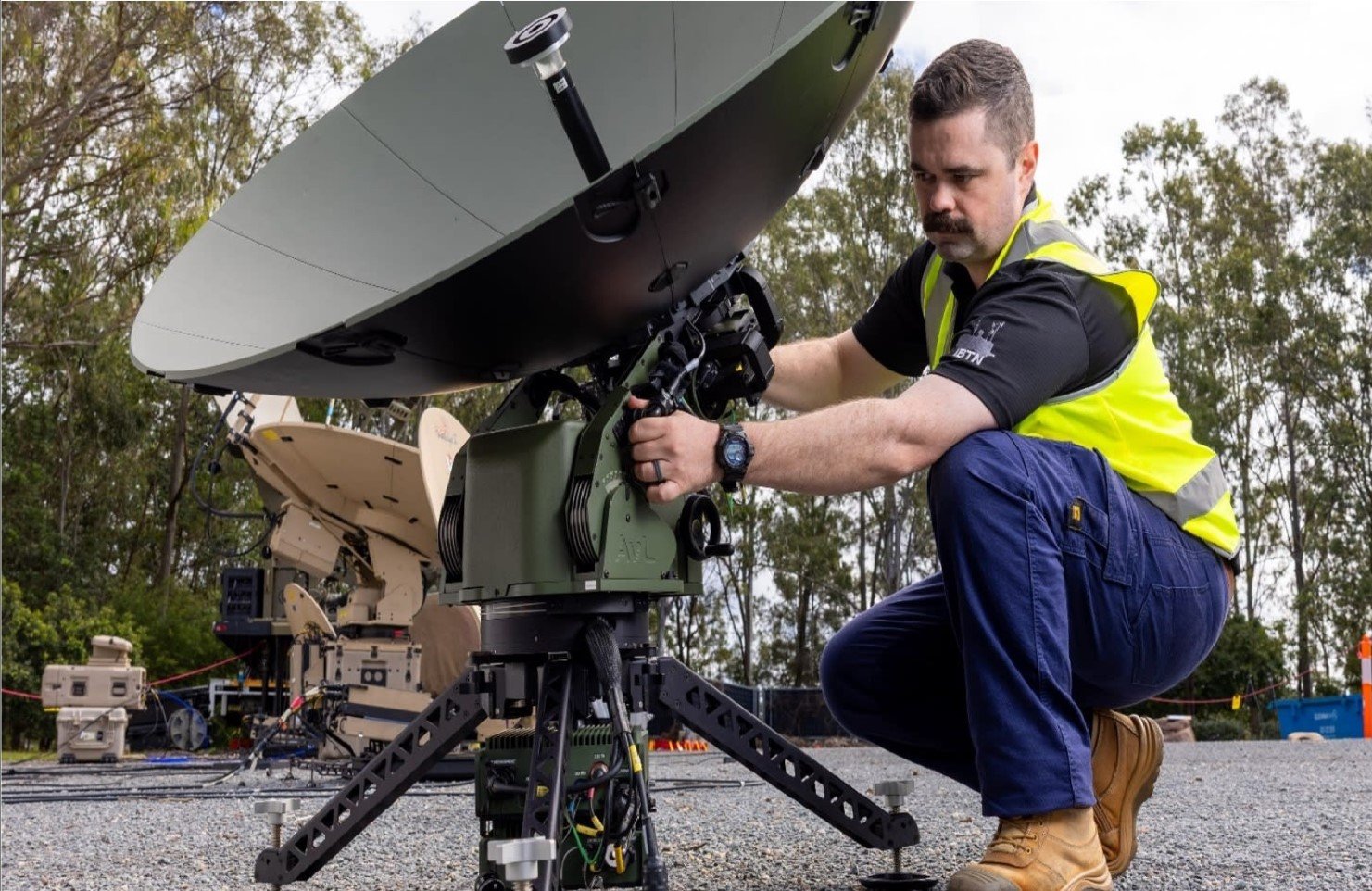
Bureau 1440's user terminals are reported to measure up to 60 cm on each side, weigh less than 15 kg and support bandwidth of up to 1 Gbit/s. They are designed to operate between –40°C and +40°C.
Ukraine's Experience Shows the Importance of Satellite Links
Ukraine's use of Starlink has demonstrated how satellite communications can support drone operations over distances beyond conventional radio links.
Ukrainian unmanned systems have used satellite communications for missions against Russian logistics, air-defense systems, radar installations, electronic warfare equipment and other targets.
Between January and July 2026, Ukraine's Unmanned Systems Forces reported striking 236 Russian anti-aircraft systems, radar stations and related assets, with the value of the equipment claimed at more than $5.4 billion. These figures are Ukrainian military claims and have not been independently verified.
Ukrainian Unmanned Systems Forces commander Robert Brovdi also reported that Russian military cargo traffic along the R-280 route toward Crimea fell by 71 percent over a two-week period following Ukrainian drone strikes. The claim was reported by Ukrinform and other outlets.
These operations illustrate the military value of maintaining a reliable communications link between a drone and its operator. A Russian satellite network capable of providing similar connectivity could therefore become an important component of future Russian unmanned operations.
Electronic Warfare Creates a New Problem
The expansion of Rassvet also creates a new electronic warfare challenge.
Russia is already using systems designed to interfere with satellite communications. One example is the Volna Kupol Garant, which Ukrainian officials say is being used against Starlink.
According to Ukrainian officials cited by Reuters, the system can disrupt Starlink communications over an area of about 20 square kilometers. Reuters reported in July that Ukrainian drone units had identified Russian use of the system against Starlink-supported drone operations.
Ukrainian officials have described Volna Kupol Garant as a system that directs powerful interference toward satellites rather than simply jamming a receiver on the ground. Interfax reported that the system operates around the 14–14.5 GHz range and can affect a satellite passing over an area of up to 20 square kilometers.
This experience is relevant to Rassvet because the Russian constellation also uses Ku- and Ka-band frequencies.
Official frequency allocations cited in the supplied data include 14–14.495 GHz in the Ku band and 29.5–30 GHz in the Ka band for mobile satellite service terminals.
Why Rassvet Would Be Difficult to Jam
Jamming a LEO satellite network is different from suppressing a conventional terrestrial radio system.
Rassvet satellites operate hundreds of kilometers above Earth and move rapidly across the sky. A ground-based jammer therefore cannot simply create a stationary interference zone and expect it to affect the same satellite continuously.
Effective interference against a particular satellite requires accurate tracking and a sufficiently concentrated radio beam. As the satellite moves, the antenna must continue following it.
The problem becomes more complicated as the number of satellites increases. A larger constellation means that several spacecraft can be visible from the same area at different points in their orbits. An electronic warfare system attempting to interfere with the network would therefore require accurate satellite tracking and the ability to move from one spacecraft to another.
The Ka-band frequencies planned for Rassvet also create additional engineering challenges. At around 30 GHz, free-space propagation losses are higher than at 14 GHz, while rain and atmospheric moisture can have a greater effect on the signal. High-power amplifiers and precise antenna pointing are therefore important considerations for systems operating in this range.
Frequency Overlap With Starlink Adds Another Complication
Another issue is that portions of the Rassvet frequency allocation overlap with frequencies used by Starlink.
The Rassvet Ku-band uplink allocation of 14–14.495 GHz overlaps the 14–14.5 GHz range used by Starlink uplinks. The Rassvet Ka-band allocation also overlaps portions of the Ka-band spectrum used by satellite communications systems.
This means that broad-spectrum interference could potentially affect both networks.
For Ukraine, which relies heavily on Starlink for military communications, a counter-Rassvet system would therefore have to distinguish between different satellites and transmissions rather than simply transmitting interference across a large portion of the spectrum.
The exact Rassvet signal structure is not publicly available in sufficient detail to determine all of its channel bandwidths, modulation, coding, polarization and frequency-management techniques. That makes it difficult to design a system specifically optimized to interfere with individual Rassvet communication channels.
A Narrow Development Window
As of August 2026, Rassvet remains much smaller than Starlink and does not provide continuous coverage over Ukraine. However, the network has moved beyond the experimental stage and entered regular production launches.
The first 16 production satellites were launched in March, followed by another 16 in July. Bureau 1440's own timeline confirms both launches as major steps in the deployment of its communications constellation.
The second group is still moving toward its operational orbits, while further launches are expected as Russia works toward its larger constellation targets.
For Ukraine, this creates a period in which the network remains relatively small but its technical architecture can already be studied. Developing countermeasures would require monitoring the satellites, analyzing their signals, developing suitable Ku- and Ka-band equipment and improving systems capable of tracking fast-moving LEO spacecraft.
The challenge will become greater if Rassvet eventually reaches hundreds of operational satellites and Russian forces deploy large numbers of compatible terminals on drones and other platforms.
For now, Rassvet is still in the early stages of deployment. Its first production satellites have established limited communication coverage, while Russia continues building the infrastructure needed for a much larger constellation. The eventual military significance of the system will depend on how quickly the satellite network expands and how extensively Russian forces integrate it with unmanned systems.
Source : militarnyi
——— End of Article ———