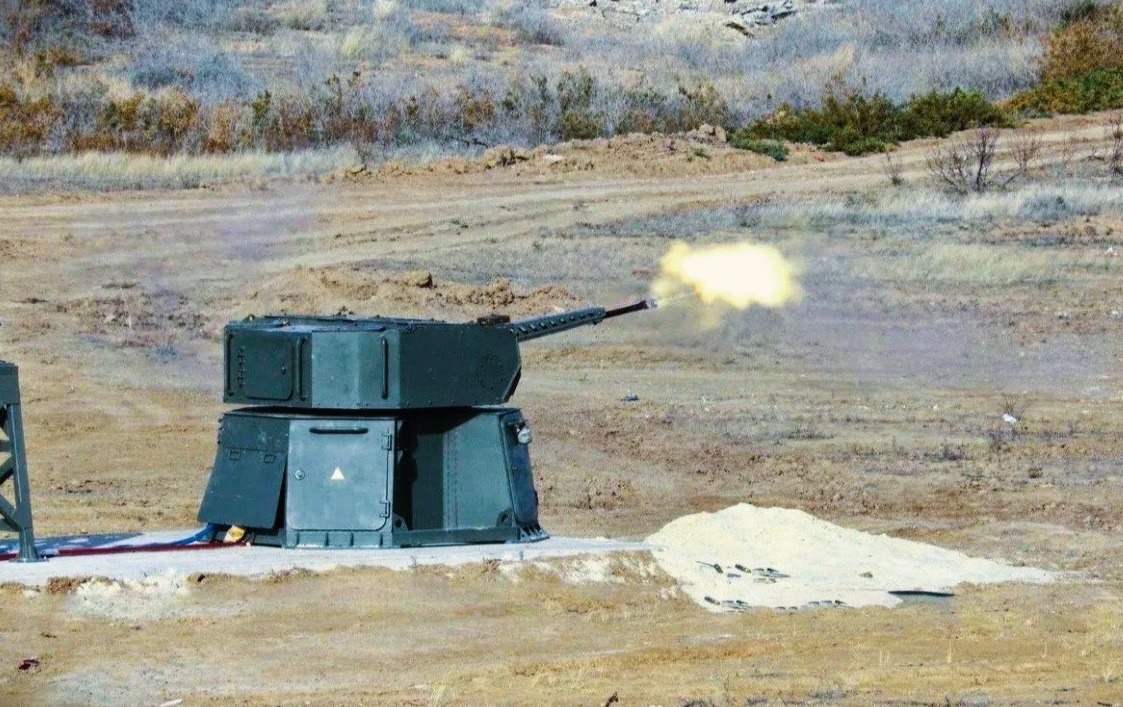
MOSCOW REGION — May 25, 2026 : Russian state defense conglomerate Rostec has publicly unveiled the ZAK-30 “Citadel” (Tsitadel), a new short-range anti-aircraft artillery complex designed to defend stationary facilities against unmanned aerial vehicle (UAV) threats. The 30 mm caliber system is being presented at the First International Security Forum, scheduled to be held at the Live Arena venue in the Moscow Region from May 26 to 29 under the auspices of the Security Council of the Russian Federation.
System Designed for Counter-UAV Protection
The ZAK-30 “Citadel” is intended for the continuous protection of fixed infrastructure against attacks by both fixed-wing unmanned aircraft and smaller multi-copter drones. Developed as a stationary and modernized version of the BM-30-D “Spitsa” combat module, the system has been configured specifically for point defense missions requiring permanent coverage and rapid response.
According to Rostec, the platform’s operational performance has already been validated in combat conditions. The company stated that the system has been used against long-range kamikaze drones, including the Ukrainian AN-196 “Lyuty”, as part of efforts to improve localized air defense against small aerial threats.
Programmable Munitions and Fire-Control System
A central feature of the Citadel is its integration of a 30 mm automatic cannon with programmable fragmentation ammunition equipped with remotely programmable time and proximity fuzes. Rather than depending entirely on direct hits against small and maneuverable aerial targets, the system is designed to intercept UAVs through controlled airburst detonation.
The platform’s automated fire-control system calculates an optimal detonation point based on a target’s real-time flight trajectory. Once fired, the munition detonates at predetermined coordinates along the drone’s projected path, releasing a fragmentation cloud intended to neutralize the target. Rostec stated that this engagement approach reduces ammunition consumption compared with conventional unguided cannon fire, where multiple rounds may be required to achieve a successful interception.
Dual-Channel Detection and Tracking Framework
To support continuous operation across varying weather and visibility conditions, the Citadel incorporates a dual-channel detection and tracking architecture consisting of radar and electro-optical systems operating in both visible and infrared spectrums.
The infrared tracking channel is intended to improve the detection of smaller drones that may have limited radar visibility but generate thermal signatures through propulsion motors and onboard electronics. Radar and optical inputs are processed simultaneously, enabling the system to either combine sensor data or prioritize individual channels depending on environmental interference, visibility limitations, or target behavior.
Rostec described the engagement sequence—from target detection and tracking to fire calculation and target destruction—as highly automated. However, the company did not specify whether the platform is capable of operating under fully autonomous engagement rules or requires operator approval prior to weapons release.
Technical Characteristics and Engagement Parameters
The ZAK-30 “Citadel” is equipped with a 30 mm cannon and carries an ammunition load of 250 ready-to-fire programmable rounds. The system features elevation angles ranging from −10° to +60°, enabling engagement of targets approaching at low altitude as well as those descending at steeper angles.
Its horizontal traverse capability extends ±150° from the centerline, providing a 300-degree firing sector from a fixed mounting position rather than full circular coverage. According to Rostec, the system can detect fixed-wing UAVs at distances of up to 2,000 metres, while multi-copter drones can be identified at ranges of up to 1,000 metres.
The effective engagement range against fixed-wing UAVs is reported to be between 1,000 and 1,300 metres, placing the Citadel within the category of short-range point-defense systems designed for localized infrastructure security.
Cost, Deployment Requirements, and Infrastructure Protection
The estimated procurement cost of a single ZAK-30 Citadel unit is approximately 600 million rubles, or roughly $8 million depending on exchange rates. The system additionally relies on programmable ammunition, which carries a higher unit cost than standard 30 mm rounds due to its fuze programming and airburst capabilities.
Because the Citadel is a stationary platform with a 300-degree firing sector rather than full 360-degree rotation, larger facilities require overlapping defensive positioning to maintain perimeter coverage. A typical large Russian oil refinery spans approximately 6 to 13 square kilometres, exceeding the effective defensive area of a single unit.
Based on the platform’s engagement radius of approximately 1.2 kilometres against fixed-wing UAVs, defense estimates suggest that between six and ten Citadel systems would be required to provide overlapping protection around an industrial facility of that scale. At current estimated procurement costs, such a deployment would require hardware spending between approximately 3.48 billion and 5.8 billion rubles, excluding maintenance, logistics, ammunition replenishment, and associated support infrastructure.
Ongoing Counter-UAV Development
The unveiling of the ZAK-30 “Citadel” reflects continuing Russian efforts to strengthen counter-UAV capabilities around strategic and industrial infrastructure amid increasing use of long-range drones in modern conflict environments. Rostec did not provide further details regarding production schedules, procurement plans, export availability, or future integration timelines during the system’s presentation announcement.
——— End of Article ———