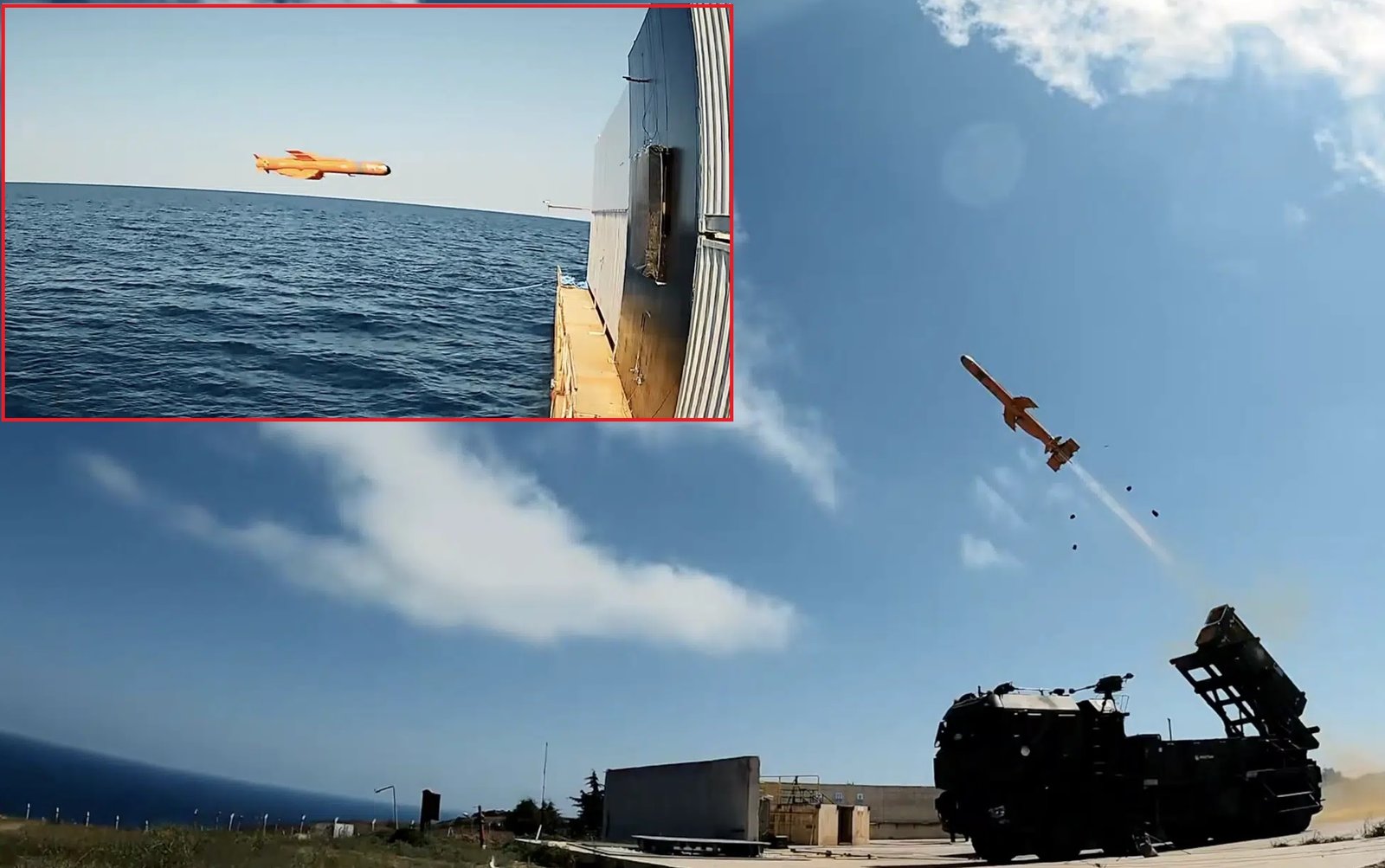
ANKARA, Turkiye — Turkish defense manufacturer Roketsan has conducted the first publicly announced ground-launch tests of its CAKIR cruise missile, firing two missiles from a mobile land-based launcher against separate land and maritime targets.
In a statement released on August 28, 2026, Roketsan said the two missiles were launched in separate tests conducted on different days and both achieved direct hits. The tests used a next-generation Imaging Infrared (IIR) terminal seeker and also demonstrated an extended range enabled by a new fuel system.
Roketsan did not disclose the exact test location, engagement ranges, target types, flight profiles or telemetry data. Reporting identified the launch vehicle as a Koluman DERMAN 8x8 tactical truck. The surface-launched version uses a solid-fuel booster and folding fins for canister carriage before the missile's turbojet takes over.
The tests expand ÇAKIR's publicly demonstrated launch options beyond its earlier air-launch trials. The missile was first unveiled in March 2022 as a modular system designed for air, naval and land platforms, including aircraft, unmanned combat aerial vehicles, unmanned surface vessels, tactical wheeled vehicles and surface combatants.
In May 2023, a Bayraktar Akıncı UCAV conducted ÇAKIR's first flight test from an altitude of about 7,000 metres. That test also marked the first demonstrated use of Kale Arge's indigenous KTJ-1750 turbojet engine.
CAKIR Specifications
CAKIR is a high-subsonic cruise missile with a stated speed of Mach 0.75 to 0.85 and a manufacturer-stated family range exceeding 150 km. Roketsan's published specifications give the missile a weight of about 275 kg without the booster, while different surface-launch configurations have been published at around 330–350 kg with the booster.
The missile has a diameter of about 275 mm. Its approximately 70-kg warhead is offered in high-explosive, blast-fragmentation and thermobaric configurations and is intended for use against surface ships, coastal targets and land targets.
Its guidance system combines inertial navigation, anti-jam satellite navigation, altimeter and terrain-referenced navigation. ÇAKIR can use IIR, radio-frequency (RF) or hybrid IIR/RF terminal seekers; the latest ground tests used the new-generation IIR seeker.
A two-way datalink allows in-flight target updates, re-attack decisions and mission aborts. Roketsan has also designed the missile for terrain-masking flight over land and sea-skimming flight over water, as well as coordinated employment by multiple missiles.
Export and Indonesian Cooperation
CAKIR also has an international market. Roketsan's chief executive said in July 2023 that an export agreement had been signed before the missile entered Turkish service. Qatar and Indonesia are publicly identified as customers.
Indonesia has confirmed procurement of CAKIR along with other Turkish systems. Roketsan and Indonesian partners have also established cooperation for local missile and rocket production. During Indo Defence 2025, Indonesian shipbuilder Republik Palindo, part of Republikorp, displayed a fast attack craft concept equipped with CAKIR.
The latest tests demonstrate a land-based launch capability for CAKIR against both land and maritime targets. However, Roketsan has not stated that the tests completed formal qualification or confirmed an immediate operational deployment by the Turkish Armed Forces. Further testing will be required to establish the performance of the boosted ground-launched configuration across its full range and target envelope.
——— End of Article ———