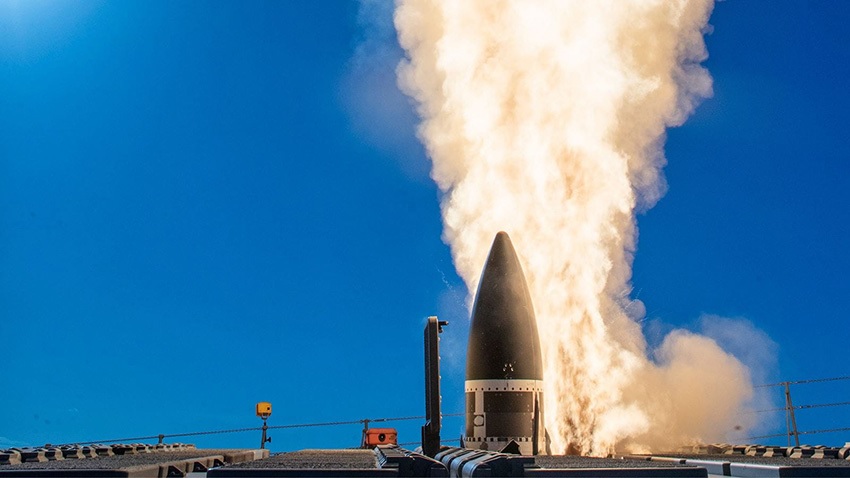
Raytheon, a leading subsidiary of RTX, has marked a significant achievement by transitioning to full-rate production for its Standard Missile-3 (SM-3) Block IIA interceptors. This production milestone comes at a critical time, as global demand for advanced missile defense systems continues to rise, particularly from the United States and allied nations like Japan. The SM-3 Block IIA has now reached a level of design maturity that confirms its performance and reliability, with no further concerns regarding design or manufacturing risks.
This step into full-rate production follows a substantial $1.9 billion contract awarded in July 2024 by the U.S. Missile Defense Agency (MDA). The contract covers the procurement of additional SM-3 Block IIA interceptors, with orders intended for both the U.S. and Japan's Ministry of Defense. The shift to full-rate manufacturing is not just a technical milestone but also a sign of confidence in the missile’s operational effectiveness, reinforcing its position as a key component of missile defense systems for years to come.
The SM-3 Block IIA is the result of a collaborative effort between the U.S. Missile Defense Agency, Japan's Ministry of Defense, and their industrial partners. This missile represents a technological leap in missile defense, featuring larger rocket motors and an upgraded kinetic warhead. These improvements give the SM-3 Block IIA the ability to intercept and neutralize ballistic missile threats with greater speed and over a larger geographical area than previous iterations of the SM-3 family.
Designed to defend against short- to intermediate-range ballistic missiles, the SM-3 Block IIA enhances protection not only for the United States but also for its allies, particularly Japan. Its advanced capabilities make it an indispensable asset in the layered missile defense strategy, providing a critical shield against evolving global threats. Barbara Borgonovi, president of Naval Power at Raytheon, highlighted the importance of this milestone, stating that it reflects the continuing partnership with Japan and the overall maturation of missile defense technologies.
What sets the SM-3 Block IIA apart is its adaptability and the scale of its development. It is the first missile defense program of its kind to reach full-rate production status, underlining the maturity of its design. The larger rocket motors allow for faster responses to missile threats, while the enhanced kinetic warhead ensures more precise destruction of ballistic targets. These advancements are pivotal as nations seek to bolster their defense capabilities against increasingly sophisticated missile threats.
Raytheon’s production facilities in Tucson, Arizona, and Huntsville, Alabama, will be the hubs for manufacturing these cutting-edge interceptors. The company expects to continue production through February 2031, underscoring the long-term commitment to building and deploying these defense systems.
The SM-3 Block IIA program also symbolizes a new era of cooperation between the United States and Japan. By sharing technology, expertise, and production responsibilities, the two nations have developed a missile defense system that is not only capable of defending their own territories but also contributes to the security of allied nations worldwide. This partnership has been instrumental in bringing the SM-3 Block IIA to full operational status, making it a cornerstone of modern missile defense.
As the global landscape of missile threats continues to evolve, the SM-3 Block IIA stands as a powerful testament to international cooperation in defense technology. Its transition to full-rate production ensures that it will remain a crucial part of missile defense strategies for decades to come, offering an expanded range of protection and increased efficiency in neutralizing threats. With the full backing of the U.S. and Japanese defense agencies, the SM-3 Block IIA is poised to be a game-changer in global security.
——— End of Article ———