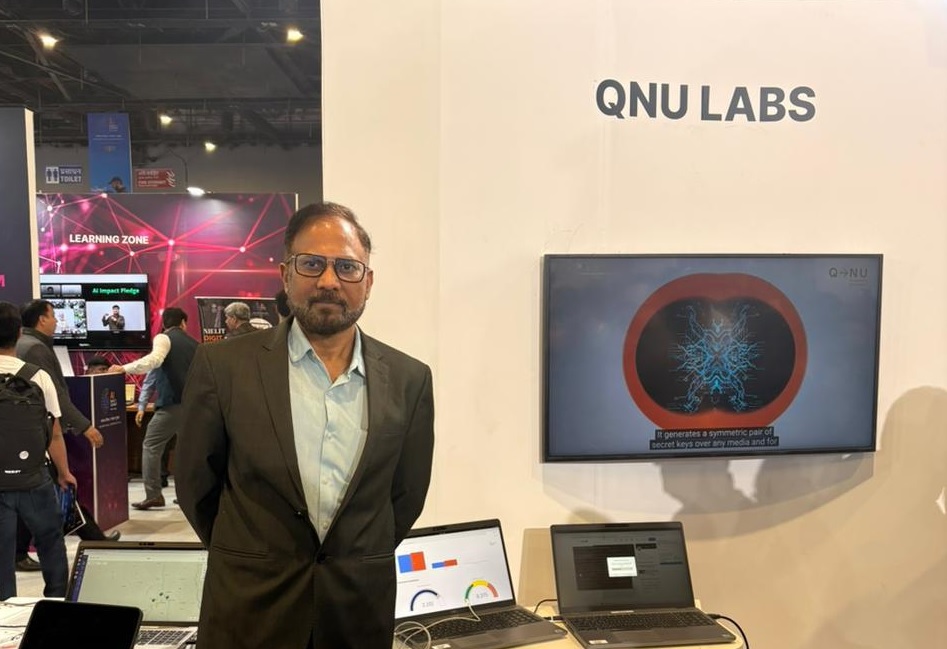
NEW DELHI : QNu Labs, a hybrid quantum cybersecurity solutions provider, is presenting a live demonstration of quantum-secured artificial intelligence (AI) infrastructure at the India AI Impact Summit 2026, being held from February 17 to 20. The company is participating alongside the Ministry of Electronics and Information Technology (MeitY), aligning its showcase with the Summit’s focus on responsible and scalable AI adoption under the IndiaAI Mission.
The demonstration highlights how sovereign hybrid quantum security can function as a foundational layer to protect AI systems, data centres, and mission-critical digital infrastructure as India expands its AI capabilities across governance, finance, healthcare, defence, and critical infrastructure sectors.
Quantum-Secured AI Architecture
As AI systems become embedded in public and private sector operations, concerns over data interception and future quantum-enabled cyberattacks are increasing. QNu Labs is demonstrating infrastructure designed to address these risks through quantum-derived cryptographic mechanisms rather than relying solely on conventional mathematical encryption.
The company’s solution enables real-time key generation, key distribution, advanced key provisioning, and centralized key management. By leveraging quantum-derived keys, the system strengthens encryption across AI workloads, model exchanges, and sensitive data transfers, supporting long-term resilience against emerging computational threats.
A central feature of the showcase is a sovereign, indigenous hybrid quantum communication architecture integrating advanced Quantum Key Distribution (QKD) solutions across three nodes. One of these nodes demonstrates a free-space QKD system. The hybrid configuration is designed to overcome distance and deployment limitations typically associated with single-medium quantum networks, enabling scalable deployment across geographically distributed environments.
The architecture also supports satellite-ready quantum-secured communication, facilitating secure AI data exchange across long distances. In addition, QNu Labs is showcasing its Quantum Safe Key Distribution Network (QKDN), designed to integrate quantum security into existing enterprise and government networks.
According to the company, these solutions are already deployed across defence organisations, critical infrastructure networks, and enterprise environments, reflecting operational implementation beyond pilot stages.
Secure Computation and Enterprise Integration
The demonstration includes homomorphic encryption capabilities, allowing computation to be performed directly on encrypted data without decrypting underlying datasets. This capability supports privacy-preserving AI use cases, particularly where sensitive or regulated data must remain protected during processing.
QNu Labs is also presenting real-time quantum-secured communication across enterprise applications, including voice, video, messaging, and secure data transmission. These applications are shown operating within live production networks to illustrate compatibility with existing enterprise infrastructure.
An interactive segment at the Summit demonstrates how quantum-generated keys secure information in real time, providing practical examples of enterprise deployment scenarios.
Executive Commentary
Sunil Gupta, Co-founder and Chief Executive Officer of QNu Labs, stated that AI is increasingly forming the base of national digital infrastructure, making data and model integrity essential. He noted that quantum-secured networks are operational and scalable, and positioned as indigenous solutions designed to protect AI ecosystems against future quantum-capable cyber threats.
Dilip Singh, Chief Technology Officer of QNu Labs, said that building sovereign quantum-secured AI infrastructure involves architectural integration beyond stronger encryption alone. He emphasized interoperability with enterprise networks, AI workloads, and distributed infrastructure, adding that the company’s systems are engineered for scalable deployment in operational environments rather than confined to laboratory settings.
Industry Position and Technology Stack
Founded in 2016 at IIT Madras Research Park, QNu Labs describes itself as a full-stack hybrid quantum cybersecurity company. It operates under the National Quantum Mission and provides patented hardware based on quantum physics and software based on advanced cryptographic mathematics. Its solutions comply with NIST, FIPS, and ETSI standards.
The company operates across India, the United States, Australia, APAC, Europe, and the Middle East, serving defence, telecom, finance, government, and enterprise sectors.
Its flagship platform, QShield™, is a SaaS-based quantum security framework combining Quantum Key Distribution (QKD), Quantum Random Number Generation (QRNG), and Post-Quantum Cryptography (PQC). The platform is designed to secure seven layers of digital infrastructure, ranging from hardware and network layers to cloud, platform, and endpoint environments. It is structured for integration into existing infrastructure with deployment and scalability considerations.
Strategic and Operational Benefits
The solutions demonstrated at the Summit offer multiple operational and strategic benefits:
- Strengthened encryption using quantum-derived keys to reduce vulnerability to quantum-enabled attacks.
- Real-time key lifecycle management for AI systems and distributed data centres.
- Secure AI model exchange and protected data flows across geographically dispersed networks.
- Homomorphic encryption to enable secure processing of encrypted data.
- Compatibility with enterprise-grade applications including voice, video, and messaging systems.
- Satellite-ready architecture supporting future long-distance quantum communication expansion.
- Indigenous development supporting sovereign digital infrastructure objectives under the IndiaAI Mission and National Quantum Mission.
Through its participation at the India AI Impact Summit 2026, QNu Labs is presenting an integrated quantum-safe framework intended to support the secure scaling of AI infrastructure across sectors. The demonstration underscores the company’s focus on operational deployment models designed for government and enterprise adoption as India advances its AI-driven digital transformation.
——— End of Article ———