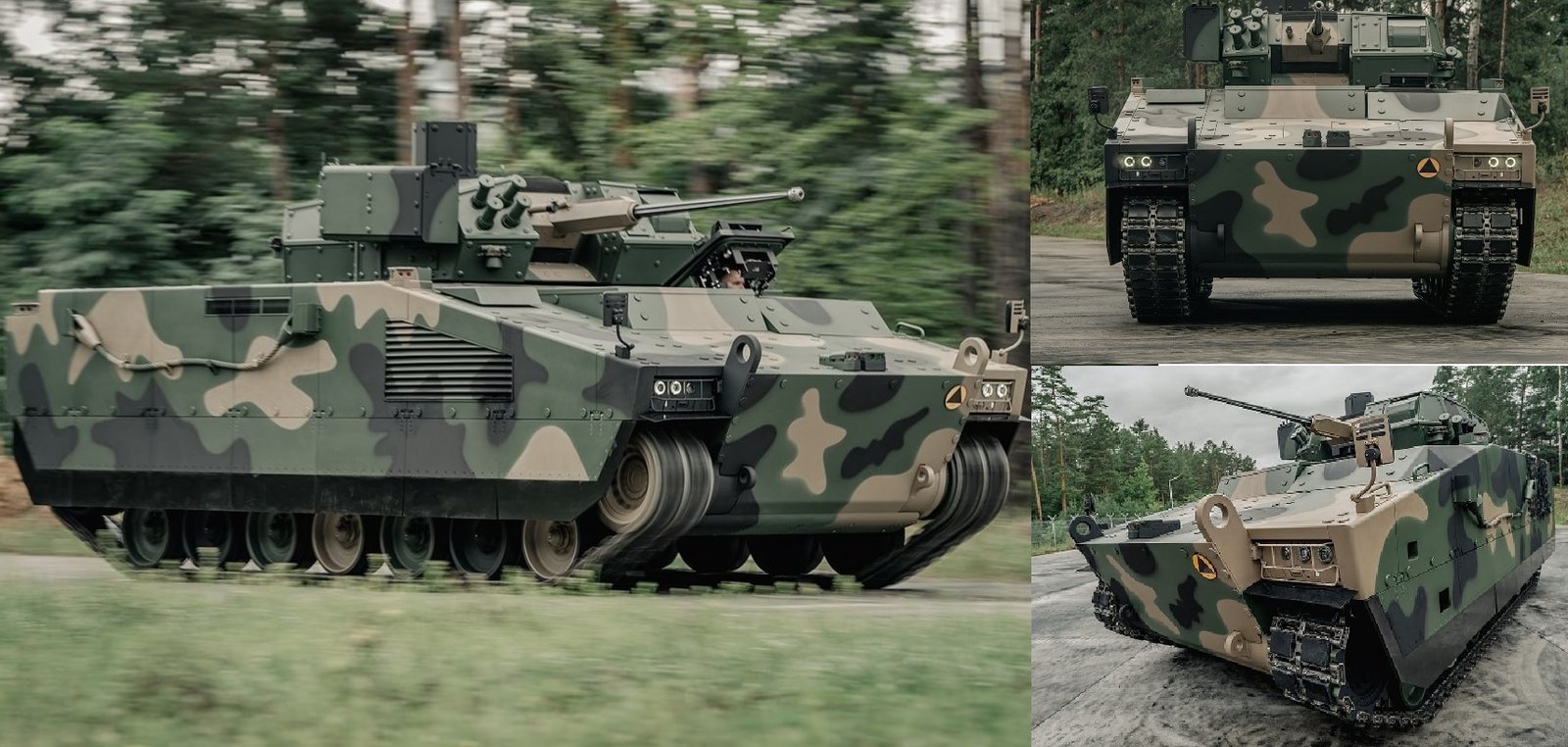
KIELCE, Poland — Poland’s state-owned defense conglomerate Polska Grupa Zbrojeniowa (PGZ) has unveiled a full-scale, mobile technology demonstrator of its new Heavy Infantry Fighting Vehicle (CBWP) at the MSPO 2026 defense exhibition in Kielce.
The vehicle, designated CBWP (Ciężki Bojowy Wóz Piechoty) and previously shown under the name Ratel, was developed by Huta Stalowa Wola (HSW), a PGZ subsidiary. A 1:4-scale model was displayed at MSPO 2025, while partial images of the vehicle had been released on social media before this year's exhibition.
The CBWP is designed to transport and protect mechanized infantry while providing direct fire support. It has a three-person crew and can carry up to eight soldiers. Its intended targets include armored and unarmored vehicles, exposed weapons positions and field fortifications.
Heavy Protection
The vehicle weighs approximately 40 tons, around 12 tons more than the amphibious Borsuk IFV. Unlike the Borsuk, the CBWP is not designed to swim, allowing greater emphasis on ballistic and mine protection.
Its tracked chassis incorporates design elements from the Krab self-propelled howitzer. The vehicle uses an MTU diesel engine producing 800 kW, paired with an American transmission. It has a reported top speed of up to 65 km/h and a range of about 500 km.
The frontal armor is designed to withstand 30×173 mm armor-piercing rounds fired from 500 meters, corresponding to STANAG 4569 Level 6 protection. The hull can accommodate explosive reactive armor, including Poland's modular Pangolin system.
Other protection systems include the Obra-3 laser warning system, smoke grenade launchers, an NBC protection and filtration system, and provisions for a future active protection system (APS).
ZSSW-30 Turret
The demonstrator is equipped with the ZSSW-30 remote-controlled turret, already used on Poland's Rosomak and Borsuk. Developed by HSW and WB Group, it carries a 30 mm Mk 44/S Bushmaster II cannon, a coaxial 7.62 mm machine gun and twin launchers for Spike-LR anti-tank guided missiles.
The cannon can fire programmable ABM ammunition for engaging ground and aerial targets. The turret's hunter-killer system allows the commander to search for new threats with day and night sensors while the gunner engages another target.
Several components, including the auxiliary power unit, filtration system, heating, periscopes and lighting, are shared with the Borsuk to simplify logistics and reduce costs.
Procurement and Development
PGZ, HSW and Poland's Armament Agency signed a framework agreement in August 2023 covering several hundred CBWPs in different configurations, together with logistics and training packages. Earlier project information outlined a requirement for approximately 700 vehicles. The vehicles are primarily intended for heavy mechanized formations, including units in eastern Poland and formations equipped with Abrams tanks.
The current demonstrator has completed a substantial portion of testing, including ballistic resistance trials, and is expected to begin factory trials. Two fully functional prototypes are planned for 2027, followed by qualification, ballistic and mine-resistance testing and formal military assessment.
Subject to successful testing and final configuration agreements with the Polish Armed Forces, series production is targeted for 2029.
The modular design also allows potential alternative configurations, including a 40 mm cannon or a fire-support variant armed with a 105 mm gun.
——— End of Article ———