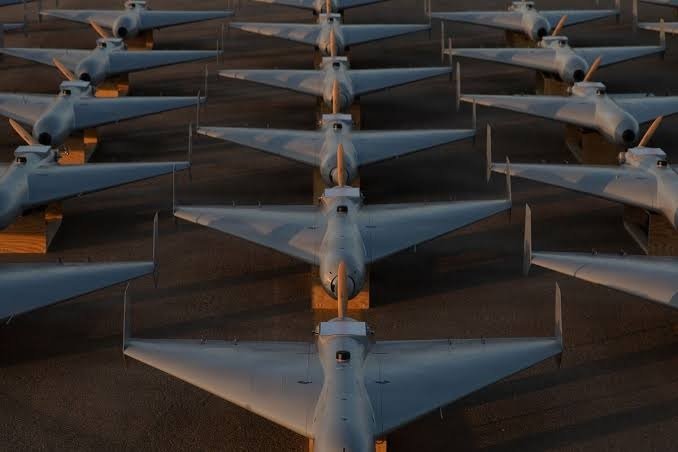
WASHINGTON, — The U.S. Department of Defense (Pentagon) has selected nine defense companies to supply approximately 60,000 one-way attack drones under the second phase of its Drone Dominance Program, known as Gauntlet II. The program aims to expand domestic drone manufacturing and equip U.S. forces with affordable unmanned systems.
Gauntlet II was conducted over a month in August 2026 at Fort Carson, Colorado. The Defense Innovation Unit (DIU) and the Test Resource Management Center managed the evaluation. Nineteen companies advanced to the event following an earlier qualification process involving 49 companies, while an initial pool of 25 vendors was reported for the selection process.
Nine Companies Selected
The order is divided between two categories: Deep Strike, for longer-range missions, and Close Quarters Battle, for shorter-range operations in confined environments. The boundary between the categories is approximately 15 kilometers.
Perennial Autonomy, manufacturer of Hornet drones, ranked first in Deep Strike with 80.1 points and is set to receive 8,000 drones. Neros, which produces first-person-view (FPV) drones, including the Archer series, ranked first in Close Quarters Battle with 88.1 points and third in Deep Strike. As the only company among the leading performers to qualify in both categories, Neros is allocated 14,000 drones.
The reported allocations are:
| Category | Company | Drones |
|---|---|---|
| Deep Strike | Perennial Autonomy | 8,000 |
| Deep Strike | Hyperscale | 7,000 |
| Deep Strike | Neros | 6,000 |
| Deep Strike | Skycutter | 5,000 |
| Deep Strike | Swarm Defense Technologies | 4,000 |
| Close Quarters Battle | Neros | 8,000 |
| Close Quarters Battle | ORQA US | 7,000 |
| Close Quarters Battle | XTEND Reality | 6,000 |
| Close Quarters Battle | Vector | 5,000 |
| Close Quarters Battle | ModalAI | 4,000 |
The maximum allocation is 8,000 drones per company in a single category, or 14,000 for a company selected in both. Final contract quantities will be confirmed when the awards are issued.
The evaluation tested find-fix-finish missions, requiring operators to locate, confirm and strike targets during day and night operations. The program also assesses performance, manufacturing readiness and supply-chain compliance. Its requirements include U.S.-aligned supply chains and restrictions on components from certain countries, including a reported requirement to exclude Chinese-manufactured parts.
Pentagon Plans Further Drone Procurement
The Pentagon is adopting an incremental procurement strategy rather than building large stockpiles of systems that could quickly become outdated. Lessons from conflicts such as the war in Ukraine, where drone technology and electronic warfare tactics continue to evolve, are influencing the development and testing of new systems.
The first phase of the program resulted in orders for approximately 30,000 one-way attack drones. The overall initiative has a planned investment of around $1.1 billion and aims to acquire more than 200,000 small drones by 2027, while building domestic manufacturing capacity for rapid production.
A further selection stage is planned for reusable bomber drones. Phase III, opened in late September 2026, has an allocation of $450 million and targets approximately 60,000 additional drones, with an option for more units. It focuses on manufacturing scalability, higher production rates and performance in contested environments.
The phase also sets target prices of $3,000 for Close Quarters Battle drones and $5,000 for Deep Strike drones. Through successive procurement rounds, the Pentagon aims to increase drone availability while allowing manufacturers to improve their systems as operational requirements and technology change.
——— End of Article ———