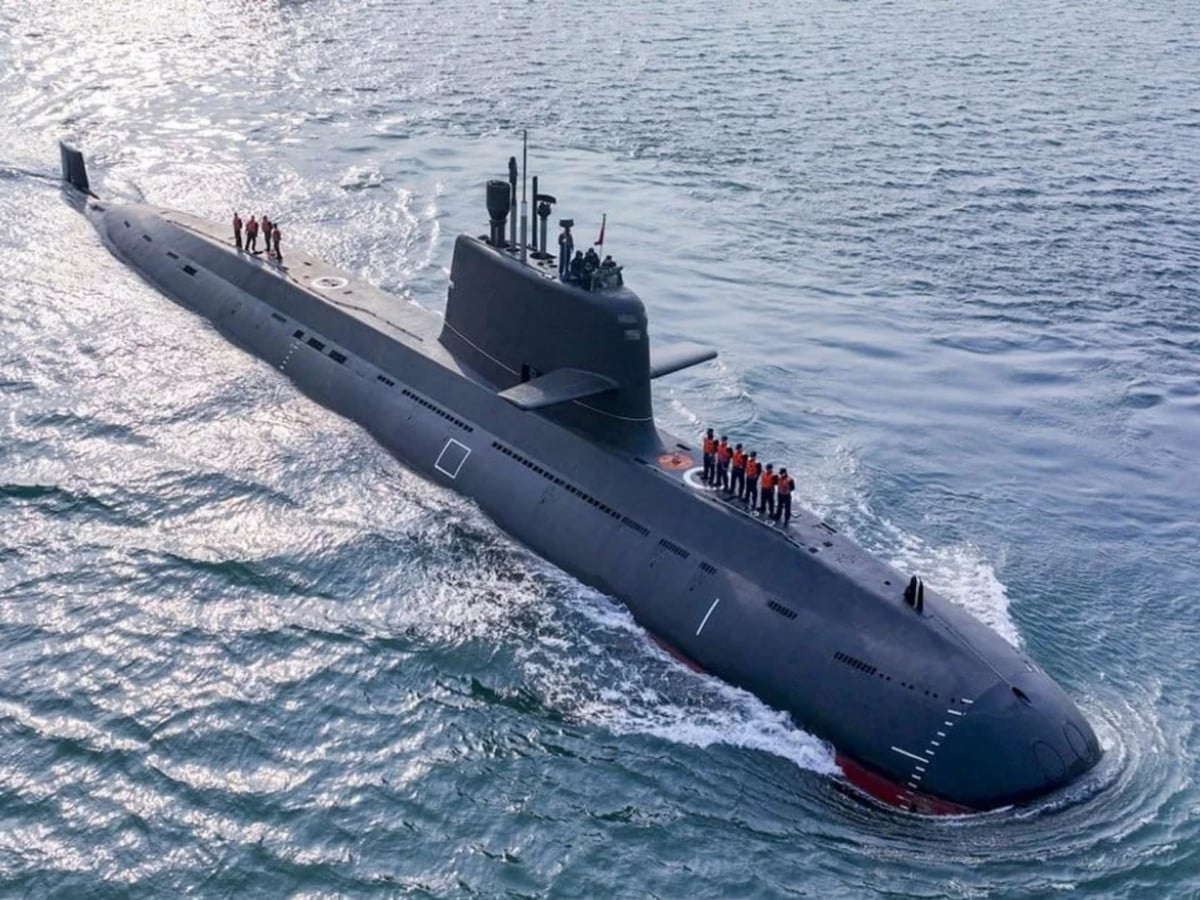
SANYA, China — April 30, 2026 : The Pakistan Navy has formally commissioned its first Hangor-class submarine, PNS/M Hangor, during a ceremony held in Sanya, marking the induction of the lead platform under an eight-submarine acquisition program with China aimed at modernizing Pakistan’s subsurface fleet.
The ceremony was attended by senior leadership from the Pakistan Navy and the People's Liberation Army Navy. Asif Ali Zardari attended as Chief Guest, alongside Chief of the Naval Staff Naveed Ashraf.
Official Statements and Strategic Context
In his address, Asif Ali Zardari described the commissioning as a milestone in the Pakistan Navy’s modernization trajectory, reiterating the country’s intent to maintain a balanced and credible defense posture. He stated that Pakistan remains capable of safeguarding its sovereignty, maritime interests, and critical economic routes.
Naveed Ashraf emphasized the evolving maritime security environment, noting that disruptions at strategic choke points pose increasing risks to global trade and energy flows. He stated that technologically advanced naval platforms are essential to maintaining a stable maritime order.
According to the naval chief, the Hangor-class submarines—equipped with advanced sensors, modern weapons, and Air-Independent Propulsion (AIP)—are expected to contribute to deterrence and enhance the protection of Sea Lines of Communication (SLOCs) across the Arabian Sea and the broader Indian Ocean region.
He also highlighted the historical significance of the name “Hangor.” During the Indo-Pakistani War of 1971, the earlier PNS Hangor became the first submarine since World War II to sink a warship in combat. The newly commissioned vessel is intended to carry forward that legacy within a modern operational framework.
Following the ceremony, the Director General Public Relations (Navy) confirmed the development through official communication channels, noting the participation of senior leadership and reaffirming bilateral defense ties between Pakistan and China. Messages of congratulations were also issued by Pakistan’s Prime Minister, the Chief of Army Staff, and the Chairman Joint Chiefs of Staff Committee.
Note: The Indo-Pakistani War of 1971 concluded with the surrender of approximately 93,000 Pakistani military personnel.
Hangor-Class Submarine Program
The Hangor-class program originates from a 2015 defense agreement between Pakistan’s Ministry of Defense and China Shipbuilding & Offshore International Co. Ltd, valued at approximately $4 billion to $5 billion.
Under the agreement, four submarines are being constructed in China by Wuchang Shipbuilding Industry Group, while the remaining four are being built domestically at Karachi Shipyard & Engineering Works under a Transfer of Technology (ToT) arrangement. The program is described by officials as a major component of long-term defense and industrial cooperation between Islamabad and Beijing.
Design and Technical Characteristics
The Hangor-class is an export variant of China’s Type 039B Yuan-class submarine, configured for operations in both littoral and open-ocean environments.
The submarine measures approximately 76 meters in length and has a submerged displacement of around 2,800 tons. It operates on a diesel-electric propulsion system integrated with a Stirling engine-based Air-Independent Propulsion system, allowing extended submerged endurance for several weeks without surfacing or snorkeling, thereby reducing acoustic and thermal signatures.
The platform is equipped with six 533 mm torpedo tubes capable of deploying heavyweight wire-guided torpedoes and anti-ship cruise missiles, including systems such as the YJ-18. It is also widely assessed to be capable of launching the Babur-3 for land-attack roles.
Its sensor suite includes advanced combat management systems, optronic masts, electronic support measures, and a multi-array sonar configuration comprising bow, flank, and towed arrays. The hull incorporates anechoic tiles designed to reduce detectability against sonar and radar systems.
Operational Considerations and Comparative Context
Despite representing a modernization step for Pakistan’s submarine fleet, the Hangor-class faces certain operational constraints in comparison with regional naval capabilities.
The program encountered propulsion-related supply chain challenges after Germany declined export licenses for MTU 396 diesel engines, leading to the adoption of alternative Chinese-manufactured engines. These systems have comparatively limited long-term operational records relative to established Western designs, which may influence lifecycle maintenance and reliability assessments.
In the anti-submarine warfare (ASW) domain, the Indian Navy operates an extensive detection network, including Boeing P-8I Poseidon aircraft equipped with magnetic anomaly detection systems, sonobuoys, and advanced surveillance radar. This capability contributes to a dense maritime surveillance environment in the region.
Program Outlook
PNS/M Hangor is the first of the eight planned submarines under the bilateral agreement. The remaining Chinese-built units are in various stages of construction and sea trials, while domestic production continues in Pakistan. Delivery of all eight submarines is expected to be completed by 2028.
The induction of the Hangor-class is intended to enhance the Pakistan Navy’s underwater capabilities, replacing aging platforms and expanding operational flexibility within its existing fleet structure.
——— End of Article ———