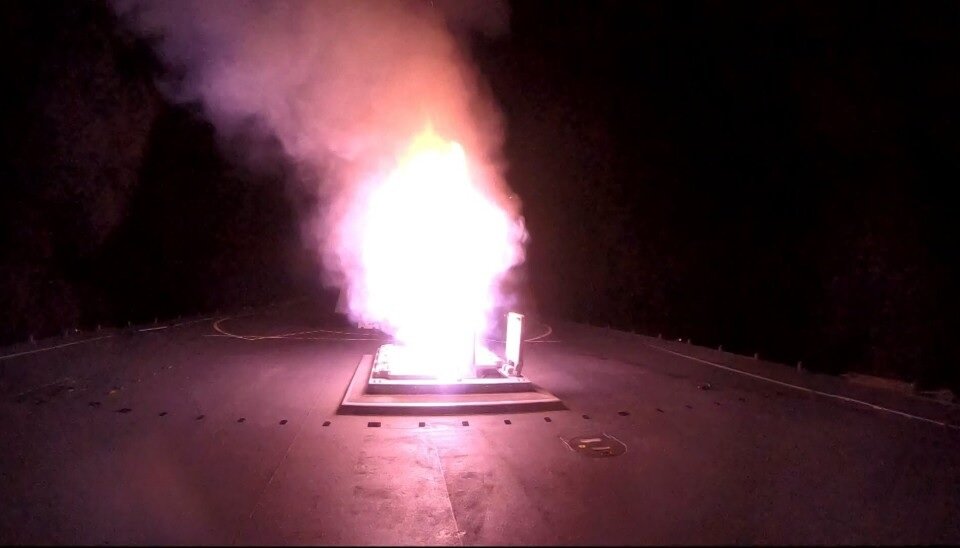
OSLO, Norway — The Norwegian Defence Materiel Agency (FMA) has completed the first live firing of the Evolved SeaSparrow Missile (ESSM) Block 2 from a Royal Norwegian Navy vessel. The test was conducted off the coast of Andøya aboard the Fridtjof Nansen-class frigate KNM Otto Sverdrup as part of Project P6192, managed by the FMA’s Maritime Capabilities division.
The testing campaign included simulated launches and live firings against drone targets to evaluate the missile’s performance, updated communication features, active guidance and integration with newly updated software in the ship’s Aegis combat system. Data collected from the missile and onboard combat system has been sent to the United States for detailed analysis. Preliminary results indicate that the project remains on track to deliver the upgraded capability to Norway’s fleet.
The trial involved the U.S. Navy, Andøya Space Defence (ASD), Lockheed Martin, the National Maritime Operations Centre (NSS N6) and the Royal Norwegian Navy Logistics Command (SFK). FMA Project Manager Commander Tor Harald Monsen directed the exercise from Range Control at ASD.
“This has been an excellent international collaboration, with professional execution by both the crew of KNM Otto Sverdrup and the test leadership at Range Control,” Monsen said.
ESSM Block 2 Features and Specifications
Developed through the international NATO SeaSparrow Consortium and manufactured by RTX (Raytheon), the ESSM Block 2 is designed to defend naval vessels against advanced anti-ship cruise missiles, tactical aircraft and other surface threats.
Its main improvement over Block 1 is a dual-mode active and semi-active radar seeker. While Block 1 relies on continuous-wave illumination from shipboard fire-control radars throughout an engagement, Block 2 can use its active radar seeker to guide itself during the final interception phase. This reduces dependence on shipboard illuminator radars and allows the Aegis combat system to manage multiple engagements with fewer illumination-channel limitations.
Key specifications include:
-
Top speed: More than Mach 4.
-
Operational range: More than 50 kilometres (approximately 27 nautical miles).
-
Length: Approximately 3.66 metres.
-
Weight: Approximately 280 kilograms.
-
Warhead: 39-kilogram blast-fragmentation warhead.
-
Launch system: Compatible with existing Mark 41 Vertical Launching Systems (VLS).
-
Quad-pack capability: Four missiles can fit into one compatible launch cell.
KNM Otto Sverdrup and Next Steps
KNM Otto Sverdrup is a Fridtjof Nansen-class frigate equipped with the Aegis combat system, AN/SPY-1F radar and an eight-cell Mk 41 VLS. The launch system can accommodate up to 32 ESSM missiles in a quad-pack configuration. The frigate class also carries Naval Strike Missiles, a 76 mm gun and other onboard systems.
The ESSM Block 2 retains the physical dimensions and launch compatibility of Block 1, allowing integration with existing launch systems.
Following the successful test, the FMA’s Maritime Capabilities division and the Royal Norwegian Navy will proceed with final installation, fleet integration and formal operational certification of the upgraded missile system. The trial represents a step in updating Norway’s ship-based air-defence capabilities.
——— End of Article ———