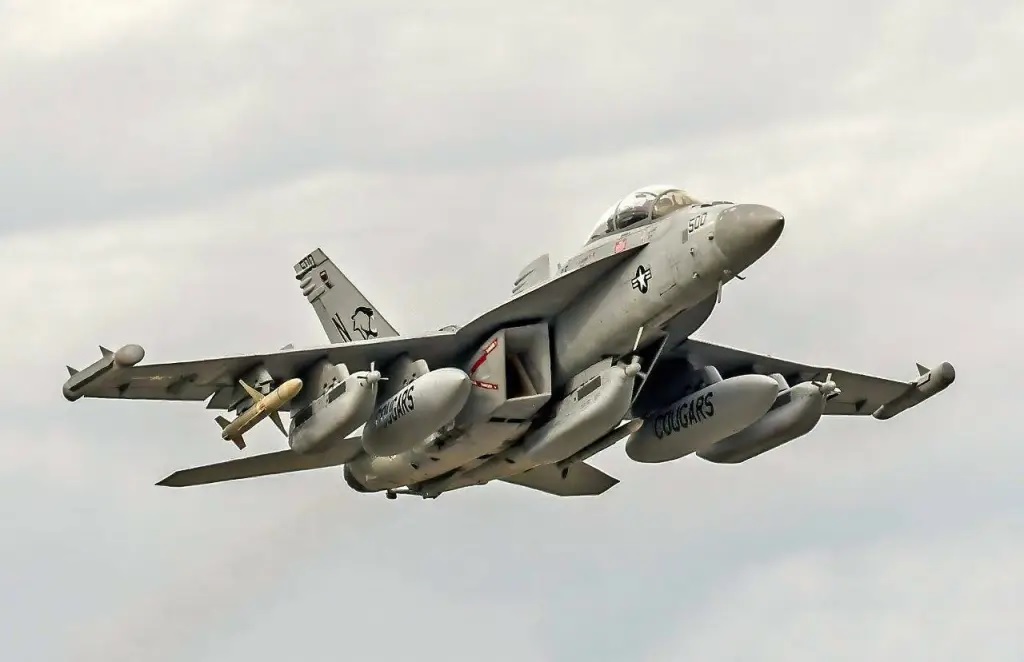
PATUXENT RIVER NAS, Md. — June 02, 2026 : The U.S. Navy has awarded a $61 million contract to Northrop Grumman Mission Systems for upgrades to the AN/ALQ-218 tactical jamming receiver aboard the EA-18G Growler, the Navy’s dedicated airborne electronic warfare aircraft. The contract is intended to strengthen the aircraft’s ability to detect, classify, and locate enemy radar and communications systems in increasingly contested electromagnetic environments.
The award was issued by the Naval Air Systems Command (NAVAIR) at Patuxent River Naval Air Station in Maryland. According to contract details, Northrop Grumman will manufacture and deliver 28 processor unit upgrade assemblies, 30 Digital Measurement Receiver (DMR) assemblies, and 77 Low Band Dedicated Receiver (LBDR) assemblies. All funding was obligated at the time of the award through fiscal year 2026 Navy aircraft procurement accounts.
Work will be carried out at Northrop Grumman’s Linthicum, Maryland facility and is scheduled to continue through February 2030.
AN/ALQ-218 to Receive Core Sensor Enhancements
The AN/ALQ-218 serves as the core passive sensing system of the EA-18G Growler and plays a central role in the aircraft’s electronic warfare missions. Unlike active radar systems that emit signals, the system passively listens across multiple radio frequency bands to detect and identify radar emissions, communications signals, and electronic activity without revealing the aircraft’s position.
Operating across RF bands 0, 1, 2, and 3, the system functions as a radar warning receiver, electronic support measures (ESM) suite, and electronic intelligence collector, helping crews build a detailed picture of the electromagnetic environment before conducting jamming or suppression missions.
The contract funds three major hardware improvements designed to improve processing power, signal measurement accuracy, and low-frequency detection capability.
Processor Unit Upgrades
The contract includes 28 processor unit upgrade assemblies aimed at improving computational performance inside the AN/ALQ-218 system. These processors sort, classify, and prioritize large volumes of signals detected in dense operational environments.
The upgraded processors are expected to improve the Growler’s ability to rapidly organize and analyze overlapping radar and communications signals to support faster operational decisions.
Digital Measurement Receiver Enhancements
Northrop Grumman will also provide 30 Digital Measurement Receiver (DMR) assemblies to improve signal identification accuracy.
These receivers precisely measure intercepted signals, allowing the system to distinguish specific radar emitters and operating modes rather than grouping them into broader categories. Improved signal precision supports more accurate threat identification, targeting, and electronic disruption.
Low Band Dedicated Receiver Improvements
The contract additionally covers 77 Low Band Dedicated Receiver (LBDR) assemblies intended to improve performance in lower-frequency portions of the electromagnetic spectrum.
These frequencies are commonly used by long-range surveillance radars, early warning systems, and military communications networks, improving the aircraft’s ability to monitor systems that higher-frequency receivers may not efficiently capture.
Responding to a More Complex Electromagnetic Environment
The Navy’s decision to modernize the AN/ALQ-218 reflects changes in electronic warfare environments since the EA-18G Growler entered service in 2008.
Potential adversaries have increasingly invested in frequency-agile radar systems capable of rapidly changing wavelengths to reduce vulnerability to detection and jamming. Modern military operations also involve denser electromagnetic environments with overlapping sensors, communications traffic, and electronic counter-countermeasure systems.
As a result, improvements in receiver sensitivity, signal processing speed, and threat classification are intended to help Growler crews build a more accurate threat picture before selecting jamming strategies or supporting strike operations.
Role of the EA-18G Growler
Built by Boeing as a specialized variant of the F/A-18F Super Hornet, the EA-18G Growler is operated by a pilot and a naval flight officer responsible for managing electronic warfare systems.
The aircraft specializes in suppression and destruction of enemy air defenses (SEAD/DEAD), escort jamming, communications disruption, and real-time electronic intelligence collection. The U.S. Navy currently operates approximately 160 Growlers assigned to carrier air wings and land-based electronic attack squadrons.
Operational Use in Venezuela
The Growler’s operational role was demonstrated during Operation Absolute Resolve in Venezuela in January 2026, where EA-18G aircraft were used to suppress Venezuelan air defense systems, enabling special operations helicopters to enter and exit operational areas without engagement from surface-to-air missile systems.
The operation highlighted the aircraft’s role in mapping hostile electromagnetic activity and disrupting enemy systems in defended airspace.
Foundation for Growler Block II Modernization
The newly funded receiver upgrades support the Navy’s broader EA-18G Growler Block II modernization program, which expanded through contracts issued during 2025 and 2026.
A key element of the program is the integration of the AN/ALQ-249 Next Generation Jammer Mid-Band (NGJ-MB) developed by Raytheon, replacing the aging AN/ALQ-99 tactical jamming pod with active electronically scanned array (AESA) technology for improved jamming precision and flexibility.
Additional Block II upgrades include open mission systems architecture, upgraded Joint Tactical Terminals, satellite communications enhancements, and machine learning-enabled software designed to adapt jamming techniques based on observed threat behavior.
However, advanced jamming capabilities depend on accurate threat detection before engagement. The upgraded AN/ALQ-218 system provides the sensing foundation required to identify, classify, and geolocate enemy emitters before electronic attack measures are employed.
The Navy views these upgrades as an important step toward maintaining the EA-18G Growler’s operational effectiveness and sustaining U.S. electronic warfare capabilities into the 2030s.
——— End of Article ———