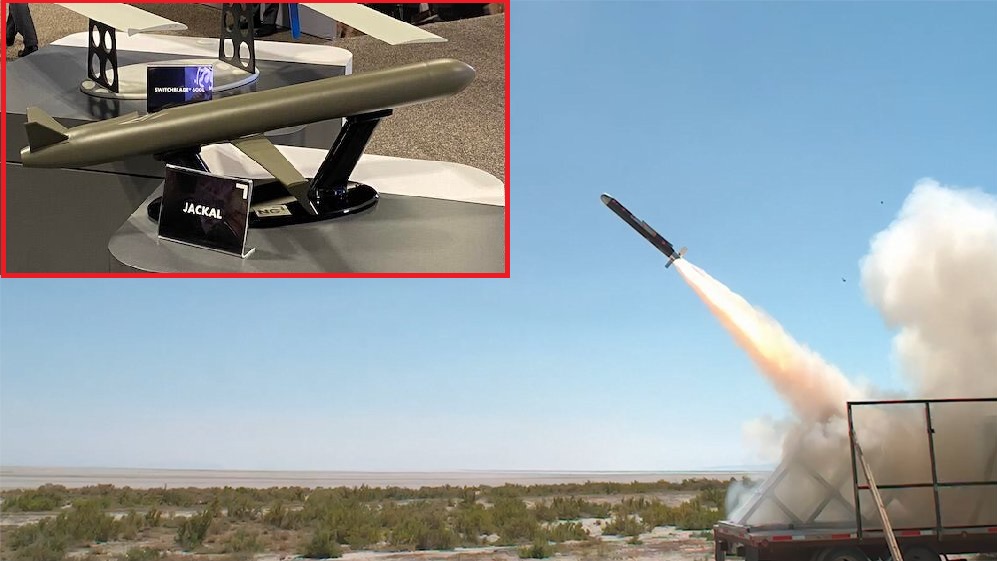
WASHINGTON — June 01, 2026 : Northrop Grumman has completed a successful flight test of its Jackal precision strike missile, validating key technologies intended to support the next stage of development for the long-range autonomous strike system.
The June 1 test confirmed several critical capabilities, including automated turbojet engine startup, autonomous flight controls, navigation systems, autopilot-controlled flight, and high-speed maneuvering. According to the company, the test demonstrated that the missile’s propulsion, guidance, airframe, and control systems have reached an important level of maturity for continued testing and development toward operational use.
The Jackal missile is being developed in partnership with AeroVironment and incorporates avionics and mission control systems refined through the Switchblade 600 program. Designed for operations in contested environments, the missile is intended to provide ground forces with a precision strike capability while reducing dependence on crewed aircraft operating inside heavily defended airspace.
Northrop Grumman developed Jackal to bridge the gap between smaller loitering munitions and larger cruise missiles. The system is designed to conduct long-range precision strikes while allowing military units to engage targets from stand-off distances beyond many air defense threat zones.
Powered by a fuel-efficient turbojet engine, Jackal can sustain speeds exceeding 300 mph (approximately 600 km/h), enabling rapid engagement of time-sensitive targets. The ground-launched version has a range of up to 100 kilometers, while an air-launched variant extends the range to approximately 125 kilometers. At maximum ground range, the missile can reach targets in roughly 12 to 15 minutes depending on mission conditions.
The missile also includes a loiter capability of up to 15 minutes, allowing it to gather intelligence or observe targets before engagement. Its open-architecture design supports modular payloads of up to 10 pounds (4.5 kilograms), enabling configurations for lethal strike missions, electronic warfare, intelligence, surveillance and reconnaissance operations, and non-lethal effects.
A key feature of the Jackal system is its autonomous targeting capability. Unlike traditional precision-guided weapons that rely mainly on fixed GPS coordinates, Jackal incorporates artificial intelligence-based algorithms capable of recognizing target characteristics during the final stage of flight. This enables the missile to adapt to changing battlefield conditions, track mobile targets, and select optimal impact points.
The system is also designed to operate in GPS-denied and electronically contested environments, reducing vulnerability to jamming and spoofing techniques increasingly used in modern warfare.
Another major feature of the missile is its rapid launch capability. The automated turbojet startup system removes the need for complex manual preparation, allowing operators to launch the weapon quickly after a strike order is issued and improving responsiveness against emerging targets.
Northrop Grumman states that Jackal can be integrated onto standard light tactical vehicles, with a single platform capable of carrying up to eight launch canisters. This setup allows ground forces to conduct precision strikes across an area of more than 31,000 square kilometers while maintaining mobility and a relatively small logistical footprint.
The company confirmed that the Jackal program remains in active development. Future testing will focus on guidance accuracy, target recognition performance, mission effectiveness, and operational integration as the missile moves closer to operational readiness.
——— End of Article ———