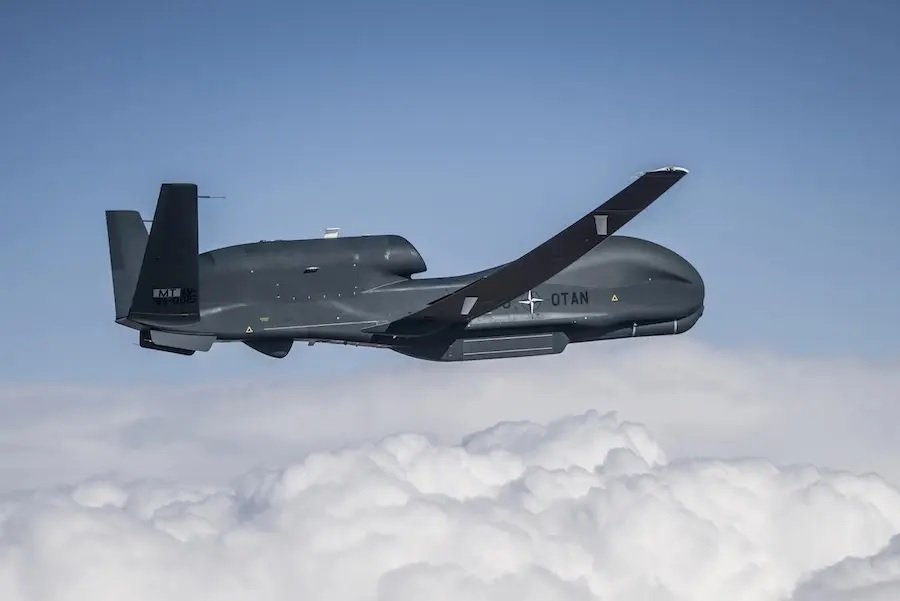
Sigonella, Italy — NATO’s RQ-4D Phoenix remotely piloted aircraft provided persistent intelligence, surveillance and reconnaissance (ISR) coverage across the High North and North Atlantic during Neptune Strike 26-3, supporting Allied maritime, air and joint forces during the multinational activity.
The NATO Intelligence, Surveillance and Reconnaissance Force (NISRF) operated the Phoenix from its main operating base at Sigonella, Italy, throughout the exercise, which ran from July 17 to July 23, 2026. NISRF said the aircraft supported NATO’s Find-Fix-Track process and supplied intelligence products for operational planning, situational awareness and decision-making.
RQ-4D Phoenix supports NATO operations
The persistent ISR coverage helped contribute to NATO’s shared operational picture as Allied forces conducted operations across the High North and North Atlantic. According to NISRF, the information collected by the aircraft supported commanders coordinating maritime, air and joint forces during the enhanced vigilance activity.
The RQ-4D Phoenix is NATO’s high-altitude, long-endurance remotely piloted ISR aircraft. NISRF operates a fleet of five NATO-owned RQ-4D Phoenix aircraft, all based at Sigonella. The aircraft are derived from the RQ-4 Global Hawk design and were developed specifically to meet NATO requirements.
The aircraft are equipped with Multi-Platform Radar Technology Insertion Program (MP-RTIP) and synthetic aperture radar (SAR) sensors, together with long-range wideband data links. NATO says the SAR capability allows the aircraft to conduct surveillance independently of weather conditions, during both day and night.
The Phoenix has a maximum operating altitude of 60,000 feet, according to NATO specifications. Its radar and communications systems allow collected information to be processed and shared as part of NATO’s wider ISR architecture.
Neptune Strike expands into the High North
Neptune Strike 26-3 was led by Naval Striking and Support Forces NATO (STRIKFORNATO) and focused on the High North and North Atlantic. The activity brought together Allied maritime, air and joint capabilities to strengthen interoperability, readiness and multi-domain coordination.
The 2026 iteration was significant because the Neptune Strike series expanded into the High North and North Atlantic under NATO’s Arctic Sentry framework.
NATO launched Arctic Sentry in February 2026 as a multi-domain military activity intended to strengthen the Alliance’s posture in the Arctic and High North. It brings together Allied exercises, forces and capabilities under a broader operational approach.
Participating nations in Neptune Strike 26-3 included Croatia, Denmark, France, Greece, Iceland, Italy, Norway, Poland, Portugal, the Republic of North Macedonia, Romania, Spain, the United Kingdom and the United States, alongside NISRF. Major naval elements included the UK Carrier Strike Group centred on HMS Prince of Wales and the Spanish Navy Expeditionary Strike Group.
The exercise also included long-range air operations, expeditionary planning and the integration of autonomous systems.
NISRF continues to build operational readiness
Brigadier General John B. Creel, Commander of NISRF, said Neptune Strike demonstrated the value of persistent multinational ISR and that each mission strengthens interoperability with Allied forces while supporting commanders with timely intelligence.
NISRF said its continued participation in NATO exercises and enhanced vigilance activities such as Arctic Sentry is building operational experience, readiness and interoperability. These activities also support the force’s progress toward Full Operational Capability.
The RQ-4D Phoenix is a core part of NISRF’s ISR mission. NATO describes NISRF as a collectively owned and operated capability that provides persistent, long-range surveillance on land and at sea and supplies intelligence products to NATO decision-makers and Allied forces.
The deployment during Neptune Strike 26-3 therefore provided NATO with continued airborne ISR coverage while Allied maritime, air and joint forces operated across the High North and North Atlantic.
——— End of Article ———