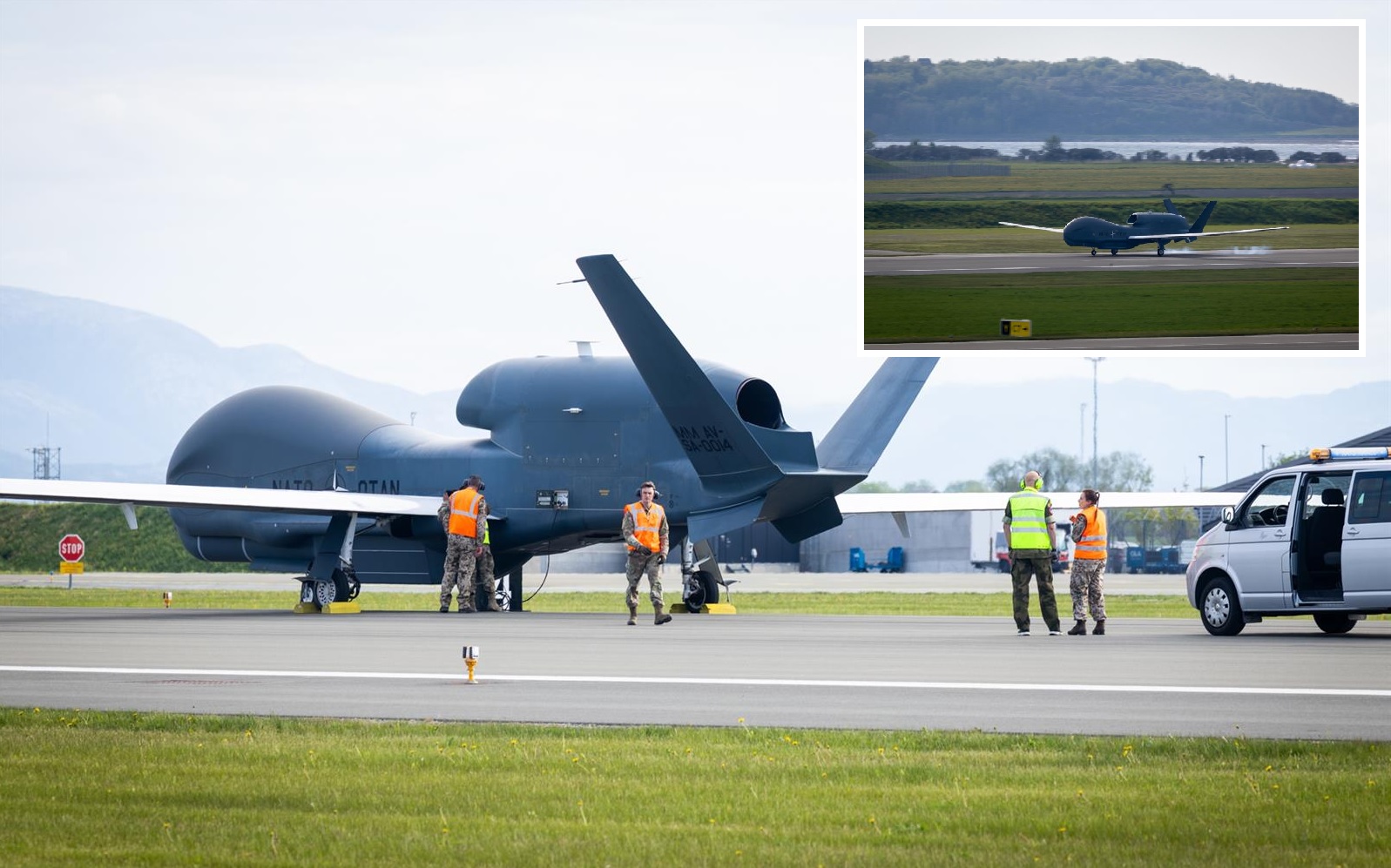
ORLAND, Norway, — May 22, 2026 : The NATO Intelligence, Surveillance and Reconnaissance Force (NISRF) has conducted the first-ever deployment of an RQ-4D Phoenix remotely piloted aircraft to Norway, marking a new operational milestone for NATO’s Alliance Ground Surveillance (AGS) programme and its expanding Agile Combat Employment (ACE) strategy.
The high-altitude, long-endurance (HALE) unmanned aircraft arrived at Ørland Air Base on May 21, 2026. The deployment represents only the third time the RQ-4D Phoenix has operated outside its main operating base at Sigonella Air Base in Sicily, Italy.
According to NATO, the mission demonstrated the NISRF’s capability to conduct persistent intelligence, surveillance and reconnaissance (ISR) operations from dispersed and flexible locations beyond southern Europe. The deployment follows a similar operation conducted from Finland in 2025 and reflects NATO’s broader effort to improve operational resilience and survivability through distributed air operations.
Expanding NATO’s Agile Combat Employment Operations
The operation was carried out under NATO’s Agile Combat Employment concept, which focuses on dispersing aircraft and support infrastructure across multiple operating locations rather than relying solely on fixed main bases. NATO considers the concept important for maintaining operational continuity and improving survivability in contested or high-intensity operational environments.
Brigadier General John B. Creel, Commander of the NISRF, stated that the deployment highlighted the flexibility and readiness of the multinational ISR force.
“This underscores the flexibility and readiness of the NATO Intelligence, Surveillance and Reconnaissance Force,” Creel said. “Operating the RQ-4D Phoenix from Norway highlights our ability to deliver ISR effects wherever required in support of our Alliance.”
NATO officials stated that the successful deployment confirmed the Alliance’s ability to sustain ISR operations from decentralized northern locations while continuing to provide real-time intelligence support to NATO commanders.
Coordination With Norwegian Forces
Preparations for the deployment included advance training conducted by personnel from the NISRF Training Centre. Local Norwegian support teams received specialized instruction to ensure aircraft procedures, mission support operations and maintenance activities could be integrated efficiently at Ørland Air Base.
The operation was conducted in close coordination with the Royal Norwegian Air Force and the 132 Air Wing stationed at Ørland.
Colonel Ole Marius Tørrisplass, Base Commander and Chief of the 132 Air Wing, said the deployment strengthened interoperability and operational cooperation between Norwegian forces and NATO.
“Hosting the RQ-4D Phoenix in Norway is a significant step in strengthening our cooperation with NISRF and NATO,” Tørrisplass stated. “This reflects our shared commitment to collective defence and operational readiness.”
NATO Alliance Ground Surveillance Capability
The NISRF is a multinational NATO force responsible for operating the Alliance’s fleet of five NATO-owned RQ-4D Phoenix aircraft. The system forms the core of NATO’s AGS capability and provides continuous ISR support for NATO operations and the Supreme Allied Commander Europe.
The AGS programme was jointly acquired by 15 NATO member states: Bulgaria, Czechia, Denmark, Estonia, Germany, Italy, Latvia, Lithuania, Luxembourg, Norway, Poland, Romania, Slovakia, Slovenia and the United States. The capability achieved initial operational capability in February 2021.
RQ-4D Phoenix Capabilities
The RQ-4D Phoenix is derived from the United States Air Force RQ-4 Global Hawk Block 40 but has been modified extensively to meet NATO operational requirements.
The aircraft is capable of remaining airborne for more than 32 hours and has an operational range of approximately 16,000 kilometres. It can operate at altitudes of up to 18,000 metres, or around 60,000 feet, enabling wide-area surveillance from significant stand-off distances.
The system is equipped with the Multi-Platform Radar Technology Insertion Programme (MP-RTIP) radar and Synthetic Aperture Radar (SAR) sensors, allowing continuous detection and tracking of moving targets while generating high-resolution radar imagery in all weather conditions, both day and night.
The aircraft has a wingspan of 39.8 metres, a length of 14.5 metres and a maximum take-off weight of 14,628 kilograms. It is powered by a Rolls-Royce AE 3007H turbofan engine and uses both line-of-sight and beyond-line-of-sight wideband communication links for long-range data transmission to NATO command centres.
NATO stated that the successful operation from Norway demonstrated the ability of the RQ-4D Phoenix fleet to support Alliance ISR missions from dispersed operating locations while maintaining persistent situational awareness across multiple operational theatres.
——— End of Article ———