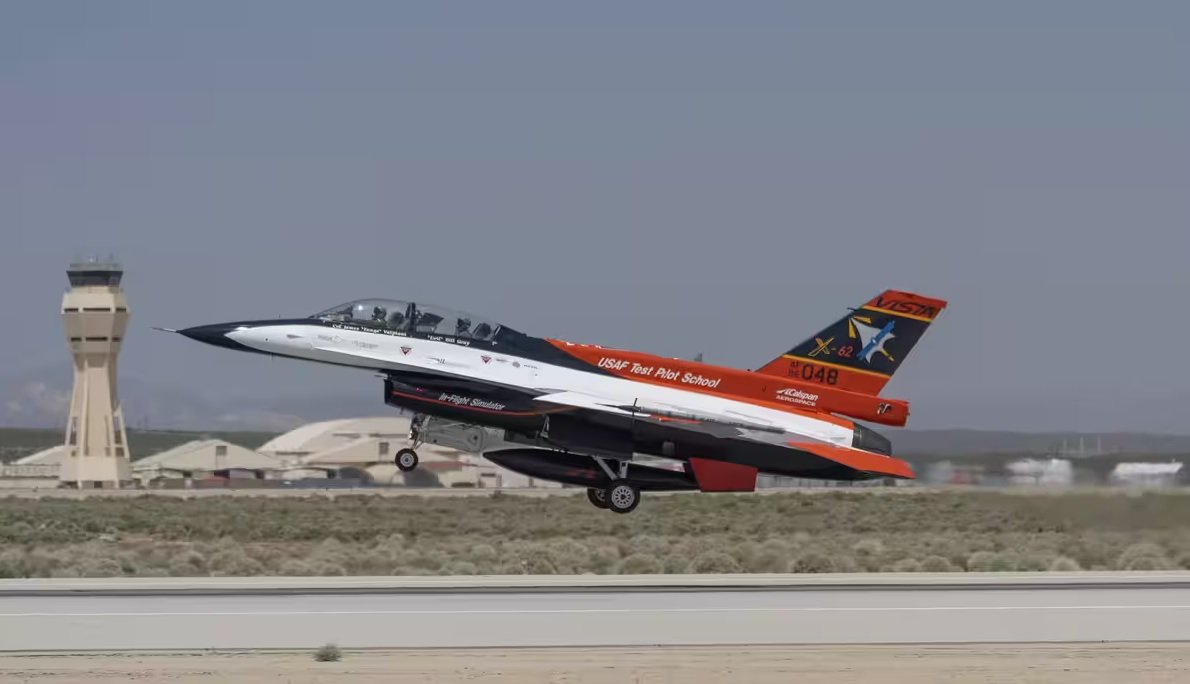
EDWARDS AIR FORCE BASE, Calif. — Lockheed Martin Skunk Works and the U.S. Air Force Test Pilot School (TPS) have completed a flight test campaign demonstrating an artificial intelligence (AI) agent directly controlling a fighter aircraft during live intercept missions using operational onboard sensor data.
During the campaign, the U.S. Air Force's X-62 Variable In-flight Simulation Test Aircraft (VISTA) completed 27 AI-controlled intercepts against a live T-38 target aircraft across eight flights. The tests demonstrated the AI system's ability to receive live sensor information, make tactical decisions, and control the aircraft during real-world intercept maneuvers without relying on simulated target data.
AI Demonstrates Real-Time Sensor-to-Action Capability
The X-62, a heavily modified F-16 used for advanced flight research and autonomy testing at Edwards Air Force Base, was equipped with Lockheed Martin's Legion Pod, an operational infrared search-and-track (IRST) sensor.
During each intercept, the Legion Pod continuously tracked the T-38 target aircraft and securely transmitted live targeting data to the onboard AI agent. Using only this real-time sensor information, the AI autonomously controlled the X-62 and maneuvered the aircraft into tactical intercept positions.
The flight tests successfully connected target detection, autonomous decision-making, and aircraft control in real time, completing what engineers describe as the "sensor-to-action loop." According to Lockheed Martin, the campaign marked the transition from AI operating with simulated target information to using live data from an operational onboard sensor during flight.
Three-Month Development and Integration
Lockheed Martin said the project validated the complete software development process, including AI development, simulation, training, integration, ground testing, and live flight operations.
The company completed AI-agent integration and all required ground testing within three months using its proprietary "Supermassive" AI agent generation capability, which is designed to accelerate software development and system integration.
The successful campaign also expands the U.S. Air Force Test Pilot School's work in integrating mission-critical onboard AI and operational autonomy into advanced flight testing.
Company Officials Highlight Operational Benefits
Ron Fehlen, vice president and general manager of Lockheed Martin Skunk Works, said the latest flight series demonstrated the AI's ability to operate on an operational combat aircraft using live sensor data.
"Our ongoing partnership with TPS is driving important progress with this latest flight test series demonstrating that our AI can effectively and reliably close the sensor to action loop aboard an operational combat aircraft. Our autonomous agents consumed classified infrared search and track feeds and executed combat-critical maneuvers in real time. This achievement marks a decisive advance toward delivering AI augmented air dominance for the United States."
Stacy Kubicek, vice president and general manager of Lockheed Martin Sensors and Global Sustainment, said reliable sensor data becomes more valuable when it is directly connected to AI systems capable of taking action.
"Our ability to provide reliable sensor data is critical, but the real advantage comes when that data can connect seamlessly with AI to take action. This project demonstrates how sensing and autonomous AI can come together as a force multiplier to make faster, more informed action in complex environments."
Lockheed Martin added that allowing AI to perform complex tracking and maneuvering tasks gives pilots more time to focus on broader tactical awareness, improving effectiveness and survivability during complex operations.
Future Mission Systems Upgrade Planned
Building on the successful completion of the 27 AI-controlled intercepts, Lockheed Martin plans to carry out a Mission Systems Upgrade for the X-62.
According to the company, the future architecture will integrate advanced combat systems, sensors, and airborne AI agents within a next-generation mesh communications network. The upgrade is intended to support future uncrewed and AI-assisted fighter operations.
X-62 Continues to Support Advanced Flight Research
Skunk Works has supported the X-62 program for decades through its open hardware and software architecture, allowing the aircraft to serve as a flexible platform for testing new technologies.
Originally designated NF-16D before being redesignated X-62A, the aircraft has been used for variable-stability flight research and, more recently, for autonomy and artificial intelligence flight testing, including earlier work under the DARPA Air Combat Evolution (ACE) program.
The latest flight campaign further expands the U.S. Air Force Test Pilot School's experience in testing onboard AI and autonomous flight technologies using operational aircraft and live sensor data.
The results of the flight test campaign were announced on August 4, 2026.
——— End of Article ———