ORLANDO, Fla. — Lockheed Martin Missiles and Fire Control has received a $244.96 million contract modification from the U.S. Navy to produce 48 Infrared Search and Track (IRST) Block II systems for Boeing F/A-18E/F Super Hornet fighter aircraft. The U.S. Department of Defense announced the award on September 29, 2026, with production scheduled for completion by the end of February 2031.
The contract covers the second full-rate production lot, including 45 infrared sensor systems for the U.S. Navy and three for the Royal Australian Air Force. The package also includes 74 processors, 27 inertial measurement units for the Navy, test equipment, spare parts, maintenance equipment and production materials.
Funding was fully obligated at the time of the award. The breakdown includes $232.5 million in fiscal year 2026 Navy aircraft procurement funds, $1.6 million in Navy working capital funds and $10.8 million from Australia through the Foreign Military Sales (FMS) programme.
Work will be performed primarily in Orlando, Florida, accounting for 79.42% of production. Additional work will take place in Santa Barbara, California (11.70%); Ocala, Florida (5.70%); and Archbald, Pennsylvania (3.18%). The modification, designated P00004 under contract N0001925C0009, was not competitively procured. Naval Air Systems Command in Patuxent River, Maryland, is the contracting activity.
IRST Block II Provides Passive Target Tracking
The system is built around Lockheed Martin's IRST21 long-wave infrared sensor, which detects and tracks airborne targets by sensing their infrared signatures without transmitting radar signals. It complements the Super Hornet's AN/APG-79 active electronically scanned array (AESA) radar and provides an additional method of detecting and tracking aircraft at extended ranges.
Unlike conventional radar, IRST operates passively, allowing the aircraft to search for targets without revealing its position through sensor emissions. This capability is useful in contested airspace where electronic warfare and electromagnetic jamming can limit radar operations. The system can operate independently or alongside other sensors, providing tracking and targeting data that support beyond-visual-range missile engagements.
The sensor can also help detect and track low-observable aircraft, including fifth-generation fighters. However, detection performance depends on factors such as atmospheric conditions, target characteristics and the operational environment.
Upgrades and Aircraft Integration
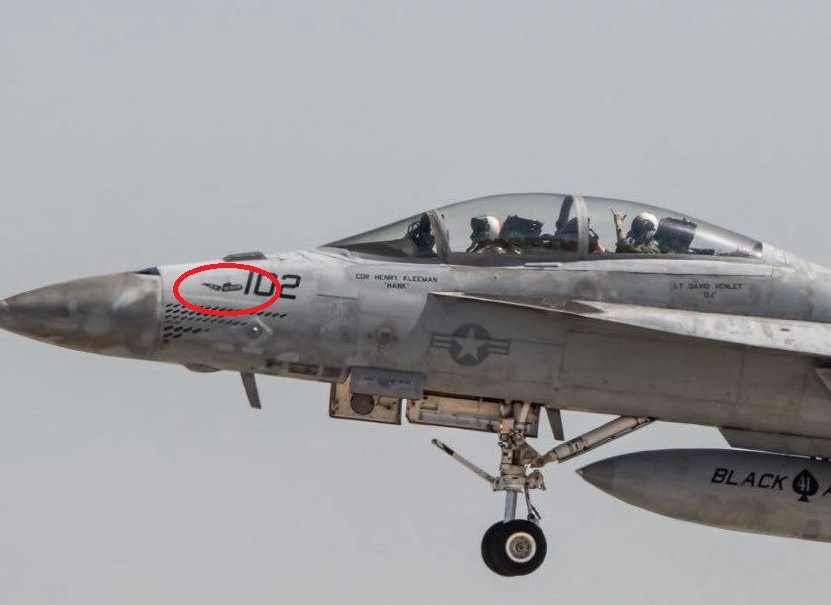
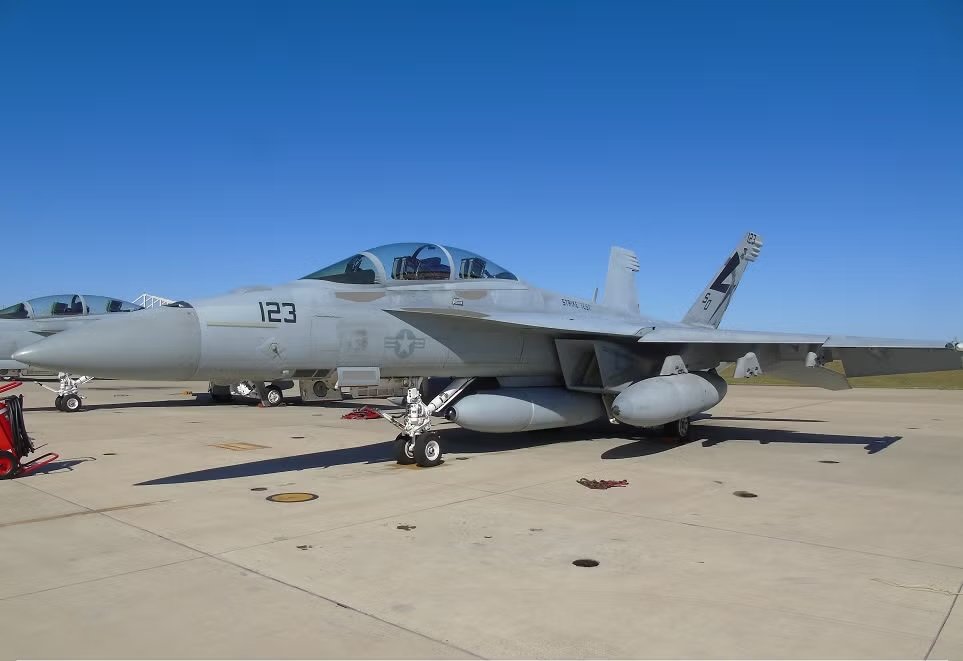
The IRST sensor is installed in the forward section of a modified external centerline fuel tank carried beneath the Super Hornet's fuselage. This arrangement provides a wide field of view without occupying a dedicated weapon station, although the modified tank has less fuel capacity than a standard centerline tank.
The Block II configuration introduces a modified electro-optical sensor head, a new central processor and updated software algorithms designed to improve target detection and tracking performance over earlier versions.
The U.S. Navy declared initial operational capability for IRST Block II on the F/A-18E/F Super Hornet in February 2025, and the programme has advanced to full-rate production.
The latest contract continues production for U.S. Navy and Australian Super Hornet fleets, providing their crews with an additional passive sensor capability to support airborne target detection, tracking and situational awareness in contested electromagnetic environments.
——— End of Article ———