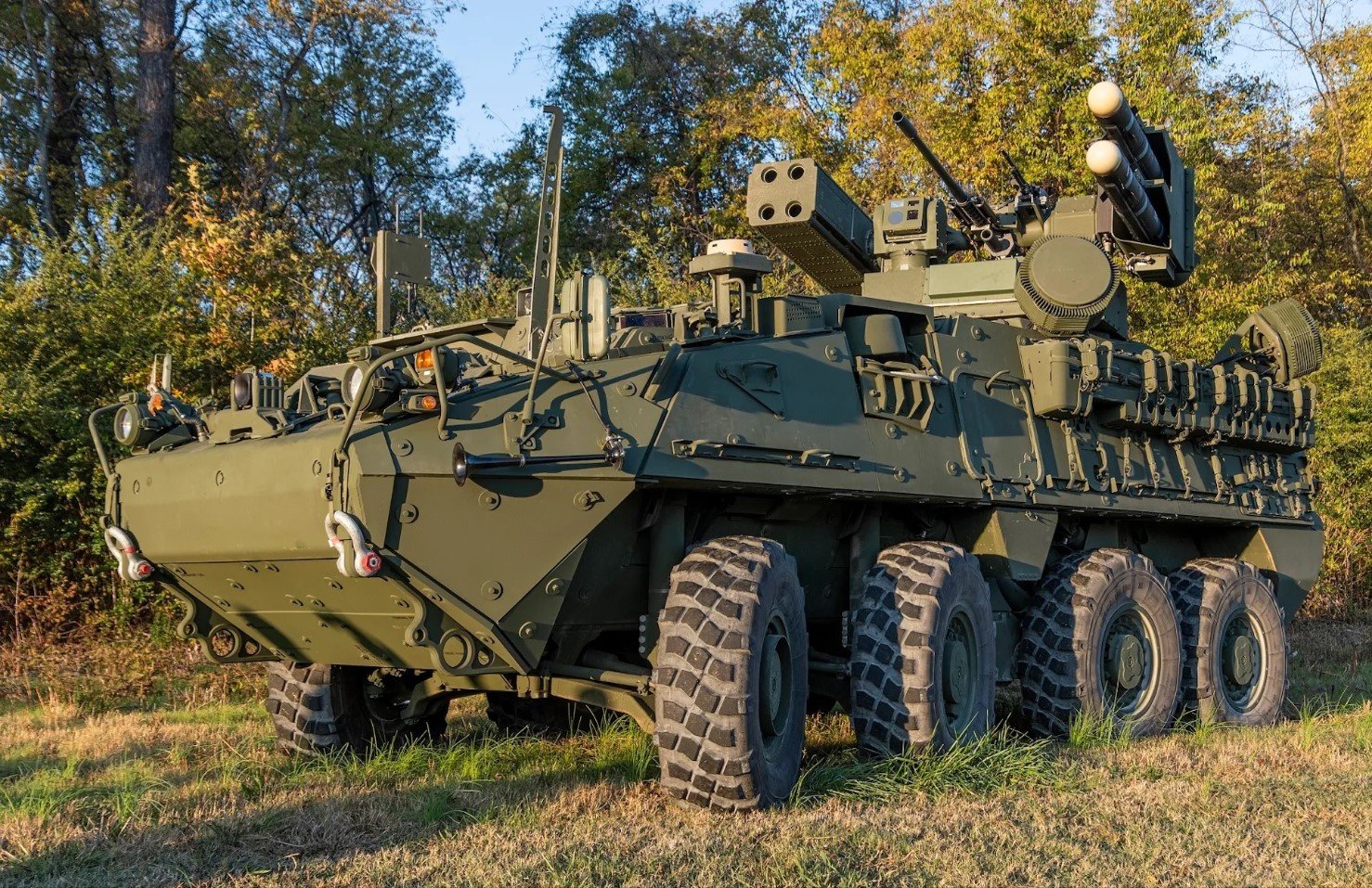
ARLINGTON, Va. — Leonardo DRS announced that its SGT STOUT Maneuver Short-Range Air Defense (M-SHORAD) Mission Equipment Package successfully defeated Group 1 and Group 2 small unmanned aircraft systems (sUAS) during a recent U.S. government test event.
According to Leonardo DRS, the expanded capability was achieved through software updates to the system’s detection and fire-control functions. The company said the test did not require the addition of new physical hardware to the Mission Equipment Package.
The SGT STOUT is the U.S. Army’s M-SHORAD system based on a Stryker vehicle. The Army renamed the system in June 2024 after Sgt. Mitchell W. Stout, a Medal of Honor recipient who served with the 1st Battalion, 44th Air Defense Artillery Regiment during the Vietnam War.
Expanded Counter-Drone Capability
SGT STOUT was developed to provide mobile air defense for maneuver formations. Leonardo DRS says the system can detect, identify and track air threats using onboard sensors and engage them with multiple kinetic effectors. The company’s current description also identifies Group 1 and Group 2 UAS as smaller air threats that the system can defeat at closer ranges using direct fire when required.
The recent government test demonstrates an expansion from the system’s original focus on larger Group 3 unmanned aircraft systems, as well as rotary-wing and fixed-wing aircraft. Leonardo DRS said the new capability allows the existing Mission Equipment Package to address smaller drone threats without replacing its hardware.
The company attributed the software-based upgrade path to SGT STOUT’s modular and open-architecture design.
“SGT STOUT was engineered from the start for modernization, so capability can evolve as the threat evolves,” said Aaron Hankins, senior vice president and general manager of the Leonardo DRS Land Systems business unit. “This event highlights an upgrade path that emphasizes speed, safety, cybersecurity-by-design, and operational interoperability.”
Designed for Maneuver Forces
SGT STOUT is designed for formation-based air defense, rather than primarily serving as a stationary point-defense system. Its mission equipment combines sensing, cueing and engagement functions to support maneuvering forces.
Leonardo DRS previously described the system as providing the mobility, survivability and lethality needed to move with Brigade Combat Teams while detecting, tracking and defeating low-altitude aerial threats. The system also integrates with existing Army networks and is interoperable with Sentinel radar.
The U.S. Army has also been developing tactics for using SGT STOUT against Group 1 and Group 2 UAS. An Army Air Defense Artillery Journal article published in June 2026 identified counter-small-UAS training and updated tactics as important areas for SGT STOUT units.
Existing System and Future Upgrades
The Mission Equipment Package uses modular and platform-portable interfaces, allowing additional technologies to be integrated without redesigning the complete platform. Leonardo DRS has identified potential future additions including passive detection options, artificial intelligence-enabled decision aids, edge computing and new effectors.
The company said several proven technologies could be incorporated into SGT STOUT systems already operating in the field. These upgrades are intended to further improve the system’s ability to detect, track and defeat Group 1 and Group 2 drone threats.
The Army’s 2027 budget documents also show ongoing investment in SGT STOUT modernization, including software upgrades for its Multi-Mission Hemispheric Radars and other product-improvement work.
The system is mounted on a Stryker platform and uses a combination of sensors, guns and missiles. Leonardo DRS lists the XM914 30 mm cannon and M240 7.62 mm machine gun among its onboard weapons, while the Army has also demonstrated Stinger missile launches from SGT STOUT during training in 2026.
Lessons From Counter-UAS Programs
Leonardo DRS said it is also using experience from its role as prime contractor on the Mobile Low, Slow UAS Integrated Defeat System (M-LIDS) program. The company said lessons from SGT STOUT and other counter-UAS work are supporting the continued development of modular, software-driven air-defense capabilities.
The latest test therefore demonstrates that changes to the SGT STOUT capability do not necessarily require a new vehicle or a new hardware configuration. In this case, Leonardo DRS said the ability to defeat Group 1 and Group 2 small drones was demonstrated through updates to the existing detection and fire-control software.
——— End of Article ———