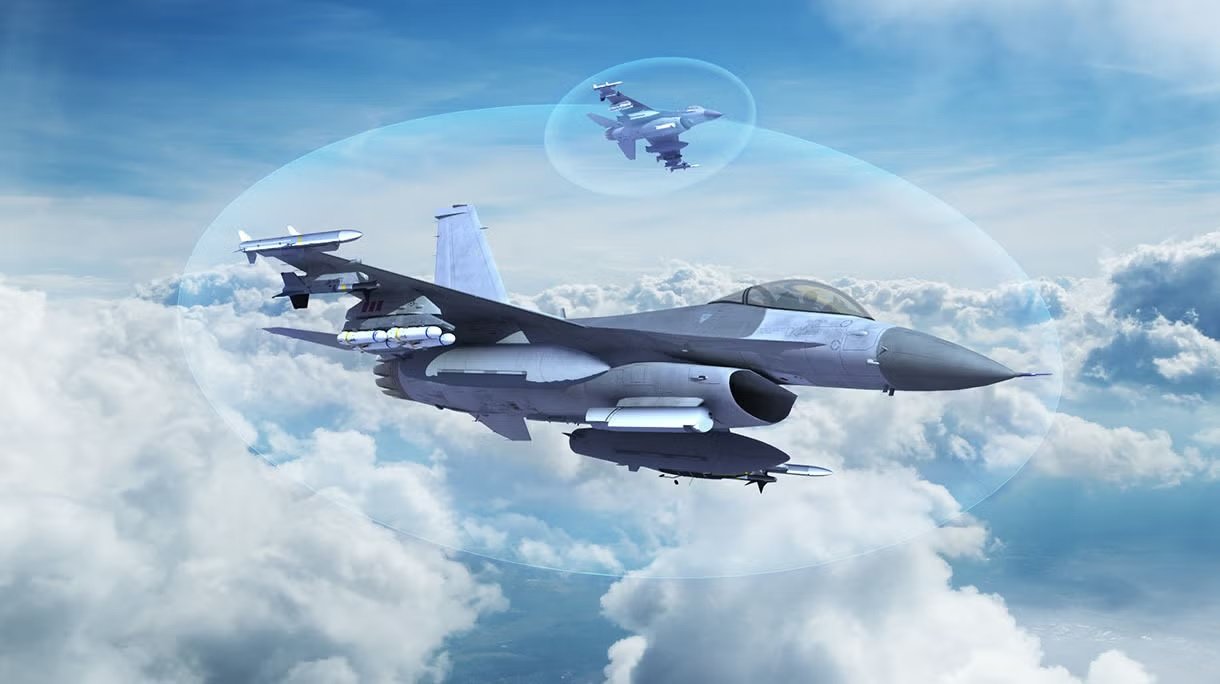
EDWARDS AIR FORCE BASE, Calif. — L3Harris Technologies has completed the first two-aircraft flight tests of its Viper Shield electronic warfare system at Edwards Air Force Base, marking the first time the system has flown simultaneously aboard an F-16C and an F-16D.
L3Harris announced the milestone on Aug. 5 following a series of two-ship flights conducted as part of the ongoing Viper Shield flight-test campaign. The latest testing moves the program beyond individual aircraft evaluations and expands testing into coordinated multi-aircraft operations.
The campaign is intended to reduce integration risks, expand the system's test envelope and support preparations for planned deliveries to international F-16 operators.
Viper Shield Tested in Two-Aircraft Operations
During the flights, test teams evaluated Viper Shield's ability to detect, identify and counter advanced electromagnetic threats while operating alongside the F-16's existing avionics and mission systems.
Engineers also assessed the system's digital architecture and real-time response capabilities across different mission profiles.
Adding a second aircraft allowed L3Harris and the U.S. Air Force test community to evaluate the electronic warfare suite in a more representative operational environment. Fighters commonly operate alongside other aircraft, requiring electronic warfare equipment to function without disrupting friendly sensors, communications or coordinated tactics.
A key part of the evaluation was therefore determining how Viper Shield performs when multiple equipped aircraft operate together.
The system is designed to prevent electronic warfare interference between wingmen when fighters simultaneously operate their radars, sensors and countermeasures.
F-16C and F-16D Used for Testing
The campaign involved both the single-seat F-16C and two-seat F-16D, allowing engineers to evaluate Viper Shield across different aircraft and mission configurations.
The F-16C was used to assess combat loadouts, sensor configurations and specific electronic warfare profiles.
The F-16D, which is also used for training and multi-crew missions, provided additional opportunities to evaluate the system under different flight conditions, cockpit workflows and mission configurations.
Testing the two variants together provided a broader assessment of Viper Shield's performance than previous single-aircraft sorties.
Lauren Barnes, President of Spectrum Superiority, Communications & Spectrum Dominance at L3Harris, said the two-aircraft flights demonstrated continued progress in the flight-test program.
“The two-ship flights with Viper Shield are another strong example that the system is performing as intended,” Barnes said. “Viper Shield is showing exceptional threat awareness and rapid reaction capability throughout the flight test campaign at Edwards.”
AN/ALQ-254(V)1 Viper Shield
Viper Shield, designated AN/ALQ-254(V)1, is an all-digital, software-defined electronic warfare suite developed to improve the survivability and combat effectiveness of advanced F-16 fleets.
The system combines digital radar threat warning, threat identification and electronic countermeasure capabilities.
Its digital radar warning receiver is designed to integrate with the F-16's APG-83 Active Electronically Scanned Array radar, allowing the electronic warfare suite and aircraft radar to operate as part of an integrated configuration.
Viper Shield also incorporates a Digital Radio Frequency Memory-based jammer (DRFM jammer), designed to provide rapid and precise electronic countermeasures against advanced radar-guided threats.
L3Harris is developing Viper Shield in partnership with Lockheed Martin and the U.S. Air Force.
Providing Threat Information to F-16 Pilots
Viper Shield is designed to process electromagnetic activity around the aircraft and provide pilots with usable threat information.
The system combines threat detection, identification and countermeasure functions to help aircrews respond to hostile emitters. This can provide pilots additional time to maneuver, employ defensive measures or change their mission plan when required.
The two-ship flights also allowed test teams to examine how the system supports pilot situational awareness during coordinated operations rather than evaluating aircraft protection only in isolated sorties.
L3Harris has incorporated commercial off-the-shelf technology (COTS) into Viper Shield's digital architecture to reduce overall weight and simplify future software upgrades.
Internal and Podded Configurations
Viper Shield's compact design allows the electronic warfare system to be installed internally on an aircraft or carried in a self-contained external pod.
The two configurations use common hardware, helping simplify maintenance, training, software upgrades and logistics support across different F-16 blocks and national configurations.
According to L3Harris, Viper Shield is currently the only electronic warfare system in production with a form factor small enough to fit the range of F-16 blocks.
The flexible installation approach is particularly relevant for international F-16 fleets because aircraft configurations can differ between operators.
233 Viper Shield Systems Planned
L3Harris is preparing to move toward full-rate production of 233 planned Viper Shield systems.
The company said eight nations have selected Viper Shield for their F-16 fleets.
L3Harris is supporting the program with an active production line, quality assurance processes and a supply chain being prepared for large-scale manufacturing.
The planned production effort will support international operators adopting the system as an electronic warfare and survivability upgrade for their F-16 aircraft.
Program Moves Toward Operationally Relevant Testing
The first coordinated flights involving Viper Shield-equipped F-16C and F-16D aircraft represent another stage in the system's flight-test campaign at Edwards Air Force Base.
Moving from individual aircraft evaluations to two-ship operations allows engineers to assess how the electronic warfare suite performs when multiple fighters operate together while using their sensors, radars and defensive systems.
The latest testing is intended to further reduce integration risks and support Viper Shield's progression toward planned deliveries to international F-16 operators.
——— End of Article ———